

Key Takeaways
Option A
National Park
The protected, curated showcase of America's natural and cultural heritage.
Best for: Visitors who want iconic scenery, developed infrastructure, and a structured outdoor experience with clear rules and facilities.
Option B
National Forest
The flexible, multi-use expanse where recreation and resource management coexist.
Best for: Visitors seeking greater freedom — dispersed camping, off-road access, hunting, and fewer permit requirements.
If you want iconic scenery, wildlife viewing, and visitor centers with interpretive programming
National Park
National Parks are designed for immersive, curated experiences at the country's most celebrated landscapes, with ranger-led programs and well-maintained facilities.
If you want to camp without reservations and avoid entrance fees
National Forest
Most National Forests allow dispersed camping for free with minimal permitting, making them far more accessible for spontaneous trips.
If you plan to hunt, ride ATVs, or bring horses on multi-day trips
National Forest
National Forests explicitly support multiple-use recreation including hunting and motorized off-highway vehicle trails, which are banned in most National Parks.
If you're traveling with children and want developed campgrounds with restrooms and safety infrastructure
National Park
National Parks generally offer more developed campgrounds, clearly marked trails, and on-site rangers — better suited to families unfamiliar with backcountry travel.
If crowds and permit lotteries are a dealbreaker for your trip
National Forest
Many National Forests border popular National Parks and offer comparable terrain with far less congestion and no timed-entry requirements.
Two Agencies, Two Very Different Mandates
The confusion is understandable — both designations involve federally protected land, scenic landscapes, and outdoor recreation. But National Parks and National Forests operate under separate agencies with fundamentally different governing philosophies.
National Parks are administered by the National Park Service (NPS), which sits within the Department of the Interior. The NPS mandate, established by the Organic Act of 1916, prioritizes preservation — protecting resources "unimpaired for the enjoyment of future generations." Recreation is welcome, but it must not compromise the land's integrity.
National Forests fall under the U.S. Forest Service (USFS), an agency of the Department of Agriculture. The guiding principle here is multiple use and sustained yield — meaning the same land can simultaneously support timber harvesting, grazing, watershed protection, and public recreation. The philosophical gap between these two approaches shapes nearly every practical difference visitors encounter. For a broader look at how these designations fit into the wider public lands picture, see our full breakdown of National Parks, National Forests, and BLM land.
Fees, Permits, and Access
One of the most immediate differences visitors notice is cost and entry logistics.
National Parks charge entrance fees — typically ranging from around $15 to $35 per vehicle depending on the park. Beyond entry fees, many high-demand parks like Zion, Rocky Mountain, and Glacier now require advance timed-entry permits during peak season. Campsite reservations often need to be secured months ahead. Planning a trip to several parks back-to-back? The America the Beautiful annual pass covers entrance fees at all NPS sites and is worth considering for frequent visitors.
National Forests generally have no entrance fee, though some developed recreation areas, trailheads, or campgrounds within them may charge a day-use or site fee. Permits are less common and, when required, are usually simpler to obtain. This lower barrier to entry makes National Forests far more accessible for last-minute or budget-conscious trips.
| Criterion | National Park | National Forest |
|---|---|---|
| Managing Agency | National Park Service (NPS) | U.S. Forest Service (USFS) |
| Primary Mandate | Preservation and enjoyment | Multiple use and sustained yield |
| Entrance Fee | Yes, typically $15–$35/vehicle | Generally no entrance fee |
| Timed-Entry Permits | Required at many popular parks | Rarely required |
| Dispersed Camping | Not permitted | Widely permitted |
| Hunting | Prohibited | Permitted (state laws apply) |
| Off-Highway Vehicles | Prohibited or very limited | Allowed on designated routes |
| Dogs on Trails | Restricted; often paved areas only | Generally allowed on leash |
| Developed Facilities | Visitor centers, paved roads, restrooms | Variable; often more primitive |
Camping: Reservations vs. Roaming Freedom
Camping rules illustrate the two systems' differences most sharply. Car camping versus dispersed camping is a distinction that plays out very differently depending on which type of federal land you're on.
In National Parks, camping is generally restricted to designated campgrounds. Backcountry camping requires a backcountry permit, which is quota-controlled at most popular parks. You won't be setting up a tent just anywhere — and fires, waste disposal, and food storage follow strict Leave No Trace guidelines enforced by rangers.
In National Forests, dispersed camping — camping outside of developed sites, often for free — is widely permitted. Rules vary by forest and district, but many allow campers to stay up to 14 days in one location before moving on. This flexibility is a significant draw for van-lifers, overlanders, and backpackers who want to avoid reservation systems entirely.
Dispersed Camping Rules Vary by District
Not every National Forest allows dispersed camping everywhere. Individual ranger districts may designate camping-free buffer zones near water sources, roads, or sensitive habitat. Always check with the specific ranger district before planning a dispersed camping trip — rules and seasonal restrictions can change. The USFS website provides district-level information and contact details.
For those weighing an overnight adventure, our comparison of day hiking versus backpacking can help you decide what kind of trip suits your fitness level and gear situation.
What Activities Are — and Aren't — Allowed
Activity permissions diverge sharply between the two designations. Understanding what's allowed before you arrive prevents frustrating surprises at the trailhead.
193 million
Annual National Forest recreation visits
The U.S. Forest Service reports roughly 150–193 million visits annually across its 154 national forests, reflecting widespread recreational use.
63
Designated National Parks in the U.S.
As of the most recent NPS count, there are 63 designated National Parks, though the broader NPS system includes over 400 units of various designations.
193 million acres
Total National Forest land area
The National Forest System covers approximately 193 million acres across 44 states, Puerto Rico, and the Virgin Islands, dwarfing the total acreage of National Parks.
National Parks prohibit hunting, most motorized off-highway vehicles, and resource extraction of any kind. Mountain biking is only allowed on designated trails (rare in many parks). Dogs are typically restricted to paved areas and not permitted on most trails.
National Forests allow hunting (subject to state game laws), fishing, off-highway vehicle (OHV) use on designated routes, horseback riding, mountain biking, and in many areas, firewood collection. This multi-use framework makes National Forests the go-to for activities that would be flatly prohibited inside park boundaries.
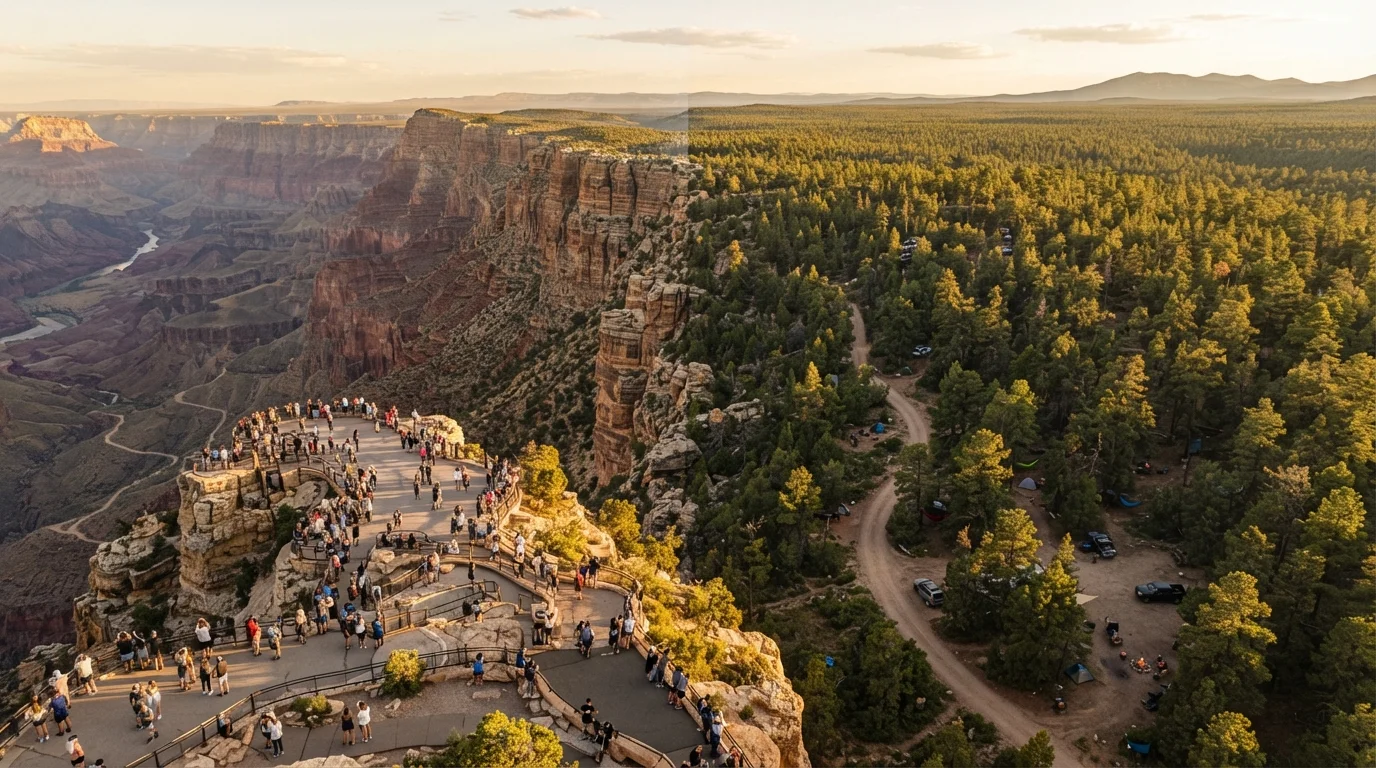
Visitors planning multi-stop road trips — particularly through the Southwest — often find that National Forests surrounding parks like Grand Canyon or Zion offer overflow camping and less-crowded trails with equivalent scenery. For Southwest road trip planning specifically, see our guide to planning a multi-stop Southwest National Parks road trip. More outdoor activity guides are available to help you plan your next adventure.