

Key Takeaways
Option A
Whole Grains
The complete, minimally processed grain kernel.
Best for: People looking to maximize fiber, micronutrients, and sustained energy from their grain foods.
Option B
Refined Grains
The streamlined, fast-digesting alternative.
Best for: Situations requiring longer shelf life, lighter texture, or specific culinary results - consumed as part of an otherwise balanced diet.
If you want to support digestive health and steady blood sugar
Whole Grains
The intact bran and germ deliver fiber and slow-digesting starches that moderate glucose spikes and feed beneficial gut bacteria.
If you need a lighter texture for specific baking or cooking
Refined Grains
Refined flour produces the structure and crumb expected in many classic recipes; enjoying these foods occasionally within a varied diet is reasonable for most people.
If long-term heart health is a priority
Whole Grains
Multiple large cohort studies associate regular whole grain intake with lower risks of cardiovascular disease, independent of other dietary factors.
If you're managing daily grain intake across a busy lifestyle
Whole Grains
Simple swaps - whole wheat bread, brown rice, oats - maintain familiar meal patterns while substantially improving nutrient density.
What Processing Actually Does to a Grain
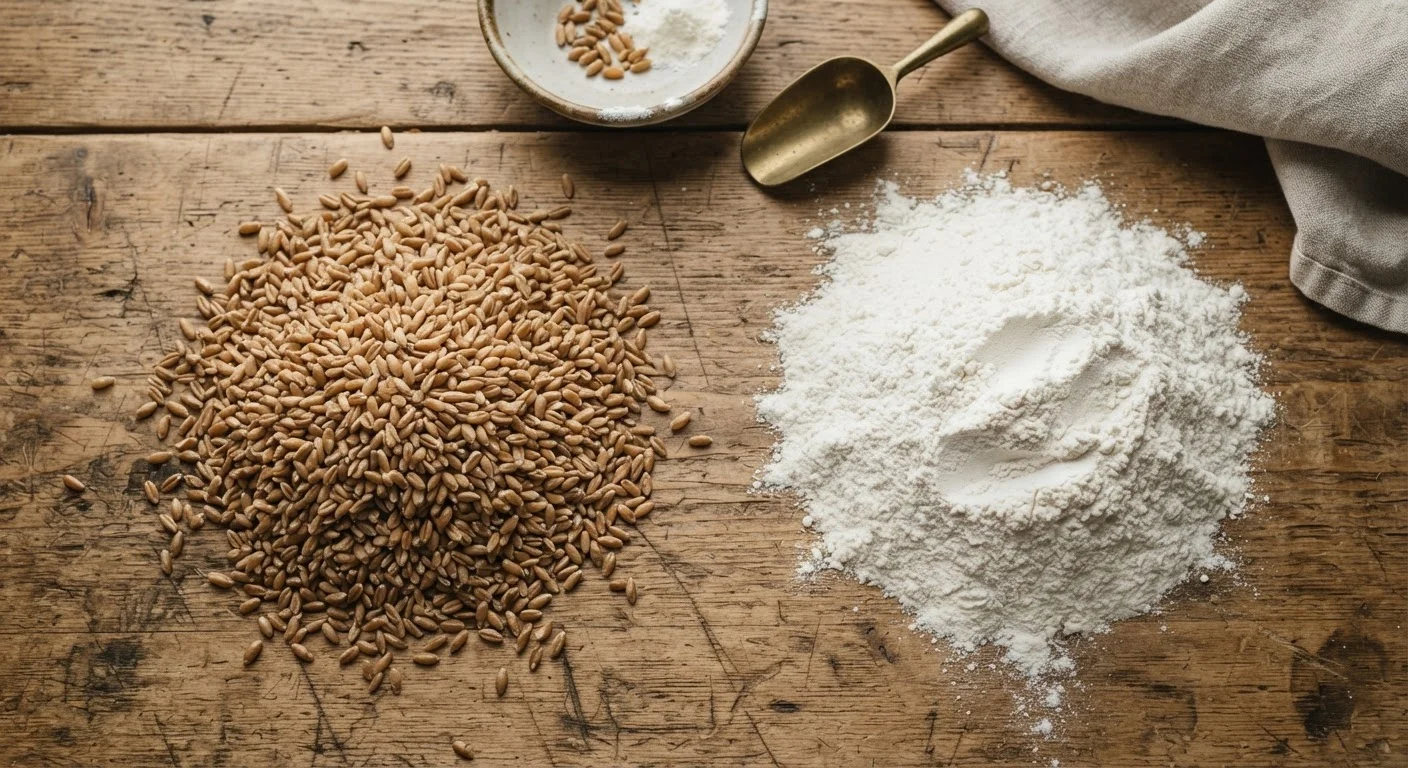
A whole grain kernel has three distinct layers: the bran (outer shell), the germ (nutrient-rich embryo), and the endosperm (starchy interior). When wheat is milled into white flour, rollers and sifters remove the bran and germ entirely, leaving only the endosperm. That's where the term "refined" comes from - the grain has been reduced to its starchy core.
What leaves with the bran and germ is substantial. The bran contributes the majority of the grain's dietary fiber and houses B vitamins such as thiamine, niacin, and folate. The germ adds vitamin E, healthy fats, and additional minerals including iron and magnesium. The endosperm, though rich in carbohydrates and some protein, provides relatively little fiber or micronutrient density on its own. For a deeper look at what each milling stage removes, see what's lost when grains are refined.
| Criterion | Whole Grains | Refined Grains |
|---|---|---|
| Grain layers retained | Bran, germ, and endosperm | Endosperm only |
| Dietary fiber | High (bran intact) | Very low |
| B vitamins | Naturally present | Partially added back (enrichment) |
| Vitamin E & magnesium | Present (from germ) | Largely removed, not restored |
| Glycemic response | Lower, slower rise | Higher, faster rise |
| Shelf life | Shorter (germ oils can oxidize) | Longer |
| Texture in baking | Denser, heartier crumb | Lighter, finer crumb |
Blood Sugar, Fiber, and How Your Body Responds
Because refined grains lack significant fiber, they are digested and absorbed rapidly. The starch in white bread or white rice breaks down quickly into glucose, producing a faster and higher rise in blood sugar compared to an equivalent serving of a whole grain food. This difference is captured by the concept of the glycemic index (GI) - a measure of how quickly a food raises blood glucose relative to pure glucose.
Fiber, particularly the soluble type found in oats and barley, slows gastric emptying and blunts this glucose spike. Insoluble fiber found in wheat bran adds bulk to digestion and supports regularity. Understanding how these two fiber types behave differently is valuable - soluble vs. insoluble fiber work in very different ways in the gut. Consistently elevated post-meal blood sugar, over years of dietary patterns, is associated in epidemiological research with increased risk of type 2 diabetes and cardiovascular disease.
25%
Lower cardiovascular disease risk with whole grains
A pooled analysis of prospective studies published in the BMJ found that higher whole grain intake was associated with roughly a 25% lower risk of cardiovascular disease compared to low intake.
~3×
More fiber in whole wheat vs. white bread
Per USDA nutrient data, a slice of whole wheat bread contains approximately three times the dietary fiber of an equivalent slice of white enriched bread.
50%
Of daily grain servings should be whole grain
The 2020-2025 Dietary Guidelines for Americans recommend making at least half of all daily grain servings whole grains for adults.
Enrichment: What Gets Added Back - and What Doesn't
In the United States, most refined grain products sold commercially are enriched - a process regulated by the FDA that requires manufacturers to add back specific B vitamins (thiamine, riboflavin, niacin, folic acid) and iron lost during milling. Folic acid enrichment, mandated since 1998, has been credited with a meaningful reduction in neural tube defects nationally.
However, enrichment does not restore everything. Fiber is not replaced. Vitamin E, magnesium, zinc, and dozens of phytochemicals present in the bran and germ are not required to be added back. So while enriched white bread is nutritionally improved compared to unenriched versions, it still differs substantially from whole wheat bread in its overall nutrient profile.
What 'Enriched' Means on a Label
When you see "enriched" on a grain product, it means the FDA requires specific nutrients lost during milling - thiamine, riboflavin, niacin, folic acid, and iron - to be added back at regulated levels. This is a meaningful improvement over unenriched white flour, particularly for folic acid intake. However, enrichment is a partial restoration, not a full replacement of the bran and germ's nutrient profile. Fiber, vitamin E, and many phytonutrients remain absent.
It's also worth situating refined grains within the broader conversation about food processing. Products that layer refined flour with added sugars, emulsifiers, and artificial flavors represent a further category that food researchers classify differently - what "ultra-processed" actually means goes beyond simple refining.
Making Practical Choices at the Grocery Store
The 2020-2025 Dietary Guidelines for Americans recommend that at least half of all grains consumed be whole grains, equivalent to roughly three one-ounce servings per day. Reading labels is the most reliable way to make that swap: look for "whole wheat," "whole oat," or "whole grain" as the first ingredient, since ingredient lists are ordered by weight. A brown color alone does not indicate a whole grain product - some breads are colored with molasses.
Common whole grain options available in most U.S. grocery stores include: whole wheat bread and pasta, oats (rolled or steel-cut), brown rice, barley, farro, bulgur, and popcorn. Each of these retains its bran and germ and delivers fiber alongside its starch. For a broader framework on understanding how your food is categorized and why it matters, the Food Science hub offers additional context on ingredients and processing.
The goal isn't to eliminate refined grains entirely - it's to shift the balance. A diet built predominantly on whole grains, fruits, vegetables, and lean proteins, with refined grain foods eaten in moderation, aligns with current evidence on long-term health outcomes. How ultra-processed food is defined is a related question worth exploring as you think about overall diet quality.
This article is for general informational and educational purposes only and does not constitute medical or dietary advice. Consult a qualified healthcare professional or registered dietitian for guidance tailored to your individual health needs.