

Key Takeaways
Option A
Whole Grains
The nutritionally complete, minimally processed kernel.
Best for: Readers looking to maximize fiber intake, support blood sugar balance, and get a broader range of vitamins and minerals from grain-based foods.
Option B
Refined Grains
The stripped-down, widely available alternative.
Best for: Situations where texture, shelf life, or digestive tolerance is a priority, though enrichment partially restores some lost nutrients.
If you want to maximize daily fiber and micronutrient intake
Whole Grains
Whole grains deliver fiber, magnesium, B vitamins, and antioxidants in a single food package that refined grains simply cannot match, even after enrichment.
If you have certain digestive sensitivities or need a transitional option
Refined Grains
Some individuals with specific gastrointestinal conditions find lower-fiber refined grains easier to tolerate; always discuss dietary changes with a healthcare provider.
If you are managing blood sugar levels
Whole Grains
The intact bran and fiber in whole grains slow glucose absorption, contributing to more gradual blood sugar rises compared to refined grain products.
If you are focused on long-term cardiovascular health
Whole Grains
Research consistently links whole grain intake to lower LDL cholesterol and reduced cardiovascular disease risk, benefits attributed largely to soluble fiber and phytochemicals.
What Happens Inside the Mill
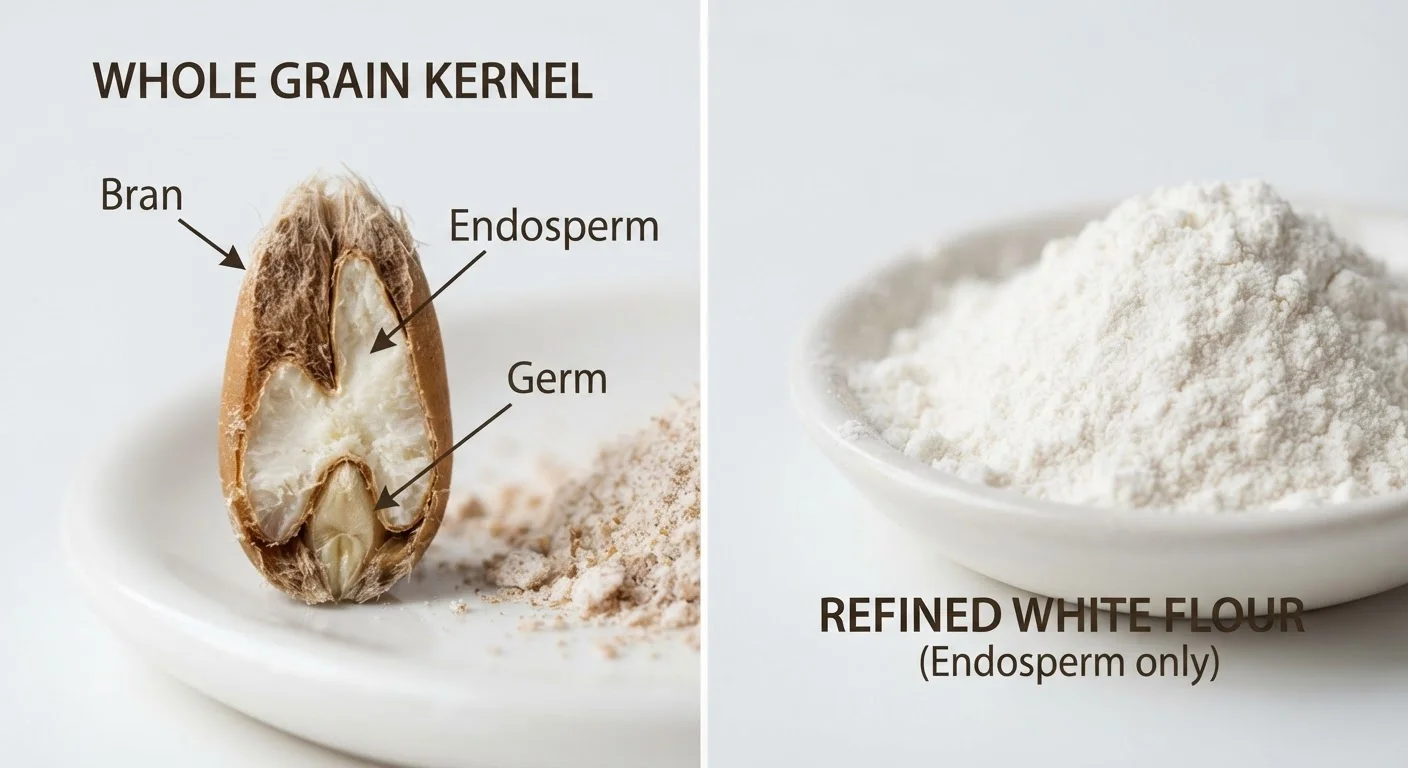
A grain kernel has three distinct layers: the outer bran, the nutrient-rich inner germ, and the starchy central endosperm. Whole grains, by definition, keep all three intact. Refined grains-white flour, white rice, degermed cornmeal-have had the bran and germ mechanically removed, leaving almost exclusively the endosperm.
That single processing step has substantial nutritional consequences. The bran holds the majority of a grain's dietary fiber, as well as B vitamins like thiamin, niacin, riboflavin, and folate, plus minerals including iron, magnesium, and zinc. The germ contributes healthy fats, vitamin E, and additional B vitamins. When both layers are milled away, roughly 25 percent or more of a grain's protein and the majority of its micronutrients leave with them, according to figures cited by the Whole Grains Council.
For a deeper look at how processing shapes food nutrition broadly, see what ultra-processed really means and how food scientists evaluate these changes.
| Criterion | Whole Grains | Refined Grains |
|---|---|---|
| Kernel parts retained | Bran, germ, and endosperm | Endosperm only |
| Dietary fiber | High (bran intact) | Very low (bran removed) |
| B vitamins | Naturally present | Mostly removed; some added back via enrichment |
| Magnesium & zinc | Naturally present | Largely lost; not restored by enrichment |
| Vitamin E | Present in germ | Mostly removed; not restored |
| Phytochemicals & antioxidants | Broad spectrum retained | Substantially reduced |
| Blood sugar impact | More gradual rise (higher fiber) | Faster glucose absorption |
| Shelf life | Shorter (germ oils can go rancid) | Longer, more stable |
The Enrichment Question: Does Fortification Close the Gap?
In the United States, refined grain products sold commercially are generally required to be enriched-meaning manufacturers add back specific nutrients lost during milling, typically thiamin, riboflavin, niacin, folic acid, and iron. This policy has meaningfully reduced certain nutrient deficiencies at the population level.
However, enrichment is selective. Fiber, magnesium, zinc, vitamin E, selenium, and the dozens of naturally occurring phytochemicals and antioxidants found in bran and germ are not restored. Think of enrichment as replacing a handful of the tools lost when a workshop is gutted-useful, but not equivalent to the original.
75%+
Fiber lost during grain refining
The Whole Grains Council notes that refining can remove more than three-quarters of a grain's dietary fiber content along with the bran.
3 servings/day
Whole grain intake linked to lower heart disease risk
Research reviewed by the American Heart Association associates consuming around three servings of whole grains daily with meaningfully reduced cardiovascular disease risk.
It is also worth noting that enrichment adds isolated nutrients, not the food matrix in which they originally appeared. Nutritional science increasingly recognizes that whole foods deliver nutrients in combinations and physical structures that may influence how effectively the body absorbs and uses them-a concept sometimes called the "food matrix effect."
Blood Sugar, Fiber, and Long-Term Health Outcomes
One of the most clinically relevant differences between whole and refined grains is their effect on blood glucose. The intact fiber in whole grains slows the digestion and absorption of starch, producing a more gradual rise in blood sugar. Refined grains, stripped of fiber, are digested more rapidly, which can lead to sharper glucose spikes followed by faster drops.
Fiber also plays a central role in digestive health and satiety. The soluble and insoluble fiber found in whole grains perform distinct functions: soluble fiber forms a gel that can help lower LDL cholesterol, while insoluble fiber adds bulk that supports regular bowel movements.
Large observational studies, including research summarized by the American Heart Association, consistently associate higher whole grain intake with lower rates of cardiovascular disease, type 2 diabetes, and certain digestive disorders. These associations are not proof of direct causation, but the consistency across populations strengthens the evidence base. For a fuller breakdown of fiber types and food sources, the Food Science hub offers additional context.
How to Spot a True Whole Grain on a Label
Look for the word "whole" as the first ingredient-"whole wheat flour," "whole oats," or "whole grain corn." Terms like "multigrain," "stone-ground," "100% wheat," or "wheat flour" do not guarantee a whole grain product. The Whole Grains Council's whole grain stamp can also be a useful marker, though checking the ingredient list directly remains the most reliable method.
This article is for general informational purposes only and is not a substitute for personalized medical or dietary advice. Consult a qualified healthcare provider or registered dietitian before making significant changes to your diet.