

Key Takeaways
Pan Temperature Control
Pan temperature control is the practice of managing how hot your cooking surface is before and during cooking. It determines how food browns, whether it sticks, and how evenly it cooks through. Most kitchen failures - from rubbery eggs to gray, steamed meat - trace back to heat problems, not ingredient problems.
Heat transfer in a pan involves conduction (direct contact), and the rate depends on both pan material and the temperature differential between pan and food. Cast iron holds heat more steadily; stainless steel responds faster to burner changes.
The Variable Recipes Don't Teach You
A recipe tells you what to cook and for how long. It rarely tells you what your pan should sound, look, or feel like before the food ever touches it. That omission is responsible for more kitchen frustration than any missing ingredient.
Pan temperature is the invisible hand behind searing, browning, and even moisture retention. When it's wrong - and it's frequently too low - you get food that steams rather than sears, sticks when it should release, and turns gray instead of golden. Understanding heat as a variable you control, not a dial you set and forget, is one of the most transferable skills in cooking.
This connects to a broader principle: recipes are a starting point, not a guarantee. Just as tasting as you cook requires active adjustment, so does managing your pan's heat throughout the process.
What Heat Actually Does to Food
When food hits a properly heated pan, several things happen almost simultaneously. Proteins on the surface begin to denature and contract. Moisture evaporates rapidly at the contact point. The Maillard reaction - a chemical process between amino acids and sugars - begins producing hundreds of flavor compounds and that familiar brown crust.
None of this happens efficiently in a cold or lukewarm pan. Instead of evaporating, surface moisture pools around the food, and you get steaming rather than searing. The result is a gray exterior, no crust, and often food that bonds stubbornly to the pan surface.
310°F
Approximate temperature where Maillard browning begins
Food scientists generally place the onset of the Maillard reaction - responsible for browning and complex flavor - at around 280-330°F at the food's surface.
~400°F
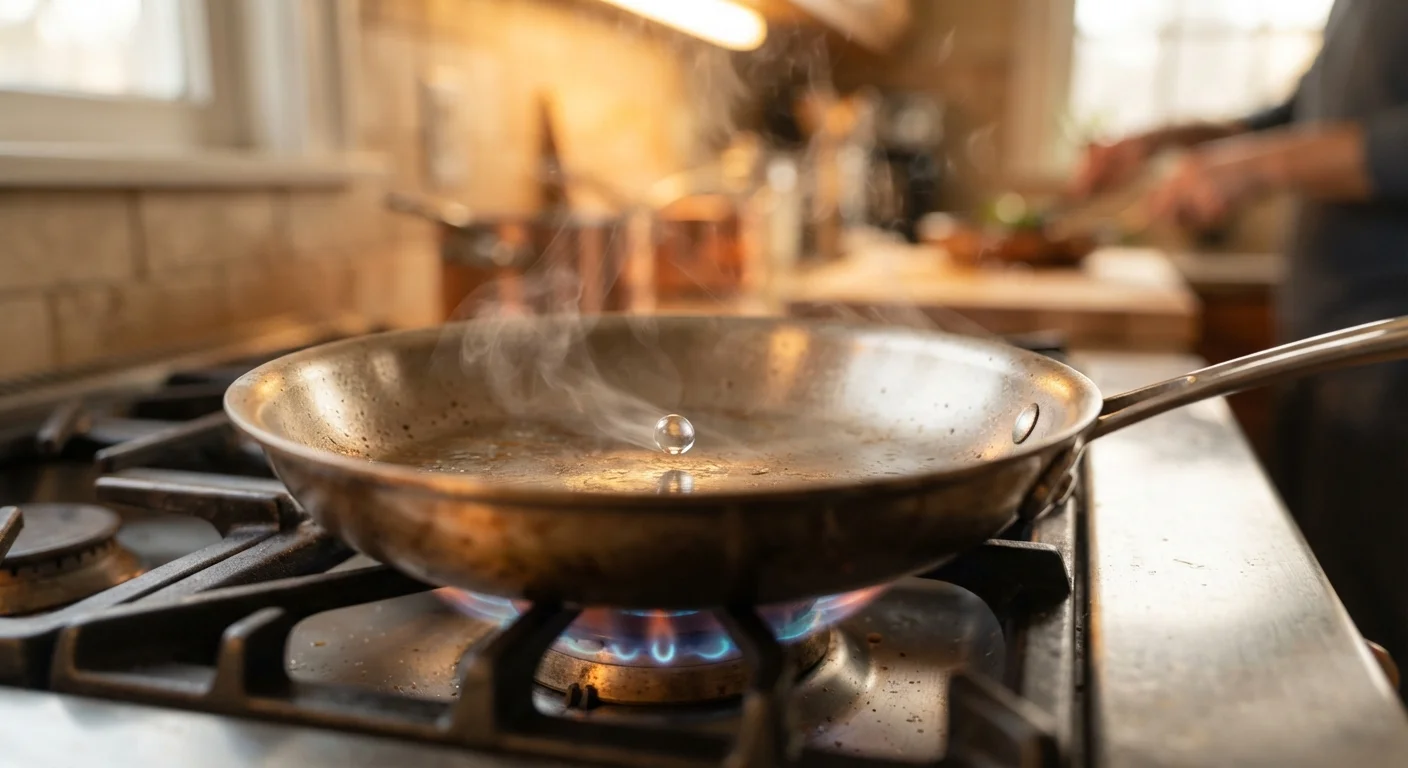
Leidenfrost effect threshold in a stainless steel pan
At this temperature, water droplets form a vapor layer beneath them and skitter across the surface rather than evaporating flat, signaling the pan is ready for searing.
2-3 min
Typical preheat time for stainless steel on medium heat
Most home cooking guides and culinary educators recommend allowing stainless steel pans 2-3 minutes to preheat before adding oil or food, a step many home cooks skip.
Heat also plays a role in nutrient outcomes. While this article focuses on texture and technique, it's worth knowing that cooking method and temperature affect nutritional content too - something covered in depth in our piece on how cooking affects nutrients.
Reading Your Pan Before You Cook
The most reliable way to test pan readiness doesn't require a thermometer. It requires a few drops of water.
- Stainless steel: Water drops should bead and skitter across the surface - a phenomenon called the Leidenfrost effect, caused by a thin vapor layer forming beneath the droplet. This indicates the surface is around 400°F and ready for most searing tasks.
- Cast iron: Water should evaporate almost instantly with a sharp pop. Cast iron holds heat well but takes longer to get there - give it 4-5 minutes over medium heat before adding food.
- Nonstick: Use the butter test instead. A small pat of butter should foam gently and spread without immediately browning. High heat and nonstick surfaces don't mix well.
Preheat Before the Oil Goes In
A common mistake is adding oil to a cold pan, then waiting for the oil to heat up. Instead, heat the empty pan first, then add oil just before your food. The oil will shimmer and spread quickly, signaling it's ready - and you'll avoid oil sitting over prolonged heat, which can degrade it before cooking even starts.
Different pans behave very differently, and understanding your equipment matters. Our comparison of cast iron vs. stainless steel walks through each material's real-world trade-offs.
Matching Heat to What You're Cooking
Not every ingredient needs the same temperature. Using a rough guide helps calibrate your approach:
- High heat (450°F+)
- Thick steaks, burgers, scallops - anything where a deep, fast crust is the goal and the interior can finish over residual heat or in the oven.
- Medium-high heat (375-425°F)
- Chicken thighs, pork chops, most vegetables - enough heat to brown without burning before the interior cooks through.
- Medium heat (300-375°F)
- Eggs, fish fillets, tofu, and delicate proteins that need controlled, even heat to avoid toughening or overcooking.
- Medium-low to low (below 300°F)
- Sweating aromatics like onions and garlic, melting butter, warming sauces - situations where color and crust are not the goal.
When eggs stick, it's almost never the pan - it's the temperature. Our explainer on why eggs stick unpacks exactly how heat, fat, and timing interact.
And while oven cooking involves a different set of heat dynamics, the underlying principle - heat source, air circulation, and food response - is equally important to understand. See how roasting, baking, and broiling differ to round out your heat literacy.