

Key Takeaways
Our Verdict
Roasting, baking, and broiling are not interchangeable - each manipulates oven heat in a fundamentally different way to achieve a specific textural and flavour result. Roasting prioritises exterior browning and concentrated flavour in proteins and vegetables, baking builds internal structure through even surrounding heat, and broiling delivers rapid surface caramelisation when time is short. Recognising these distinctions turns guesswork into deliberate technique.
| Best for | Recommended |
|---|---|
| Cooking whole proteins and dense vegetables with rich, browned exteriors | Roasting |
| Bread, cakes, pastries, and dishes that need even internal setting | Baking |
| Quick surface browning, finishing gratins, or crisping thin cuts | Broiling |
How Each Method Moves Heat
All three methods use the same appliance, but they deliver heat to food through different mechanisms and directions - and that distinction is what drives each technique's results.
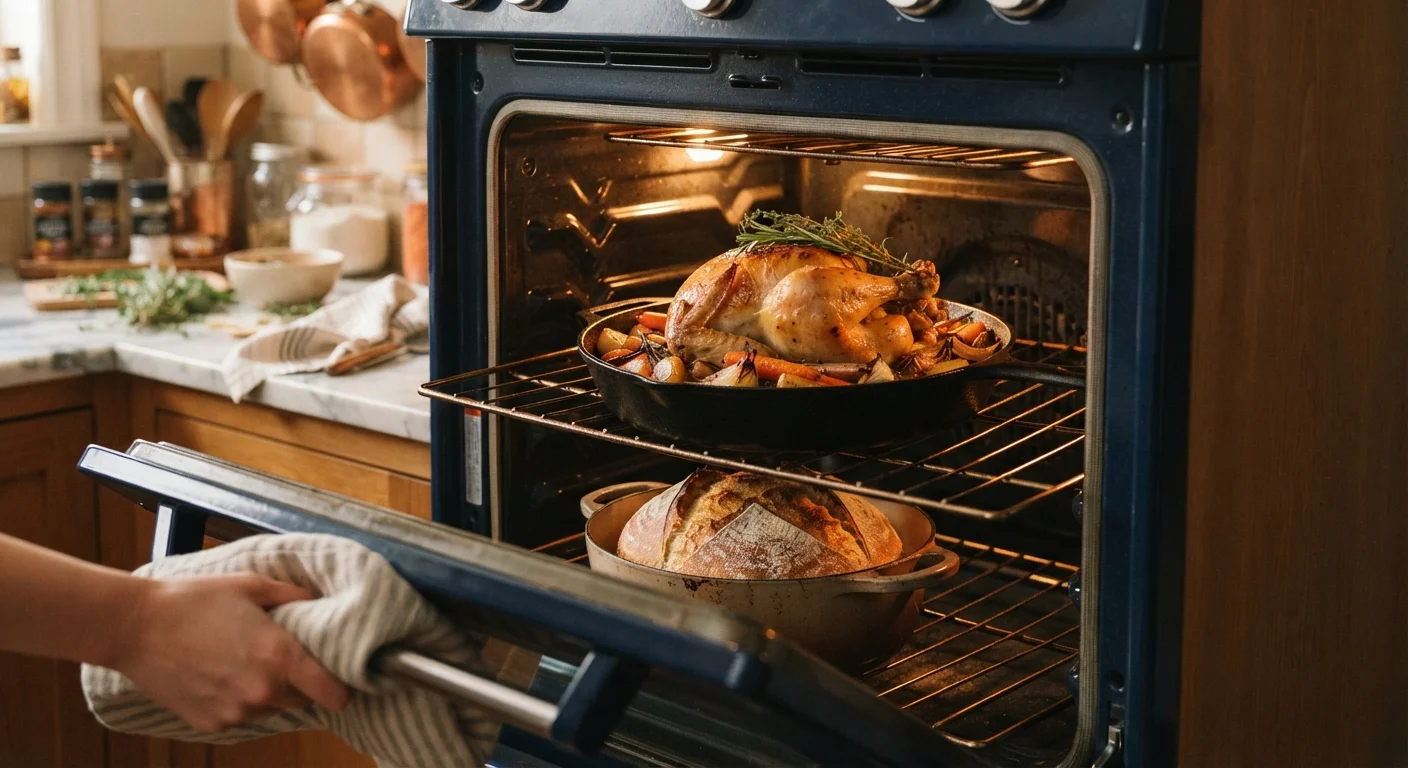
Roasting fills the entire oven cavity with hot, dry air, typically between 375°F and 450°F. Food sits uncovered on a rack, exposed on all sides to circulating heat. The exterior dries out and browns first through a combination of convection (moving air) and some radiant heat from the oven walls, while the interior gradually cooks through. This is why a roasted chicken has crackling skin and juicy meat inside.
Baking uses a similar ambient-heat principle but at lower, more controlled temperatures - usually 300°F to 375°F. The goal is not aggressive surface browning but even, gentle heat that penetrates the food and sets its internal structure. Bread rises and firms; a custard sets without curdling; a cake builds its crumb. The oven air surrounds the food uniformly, cooking it from all sides at a measured pace. For more on how heat changes what's inside your food, see why cooking affects nutrients differently.
Broiling is radically different in direction. The broiler element - positioned at the top of the oven - emits intense infrared radiation aimed downward at the food's surface. Temperatures directly under the element can exceed 500°F. Broiling is essentially an upside-down grill: food browns within two to five minutes, making it useful for finishing dishes or cooking thin items fast. The interior receives far less heat, so thick cuts can char outside before cooking through.
Side-by-Side: Roasting vs. Baking vs. Broiling
The table below captures the core practical differences across the three methods.
| Roasting | Baking | Broiling | |
|---|---|---|---|
| Primary heat source | Ambient hot air (convection + radiation) | Ambient hot air, lower intensity | Direct top-element infrared radiation |
| Typical temperature range | 375°F - 450°F | 300°F - 375°F | 500°F+ (element surface) |
| Heat direction | All sides, surrounding | All sides, surrounding | Top-down, one surface |
| Ideal rack position | Middle to lower-middle | Center | Top (4-6 inches from element) |
| Speed | Moderate to slow | Moderate to slow | Very fast (2-10 minutes) |
| Best for | Meats, dense vegetables | Bread, pastries, casseroles | Finishing, thin cuts, cheese |
| Surface browning | Strong, gradual | Moderate, even | Intense, rapid, one side |
Notice that rack position matters significantly. For roasting, a middle or lower-middle rack gives balanced heat. Baking often calls for center placement to avoid hot spots. Broiling requires the top rack - typically within four to six inches of the element - to achieve the rapid surface effect. If you want to decode other recipe instructions that seem unclear, our guide to common cooking terms breaks them down plainly.
The Science Behind the Browning
All three methods can produce a browned surface, but they achieve it through different conditions and timescales. The flavour-creating chemistry involved is the Maillard reaction - a series of interactions between amino acids and reducing sugars that occur above roughly 280°F, producing hundreds of flavour compounds and that characteristic golden-to-dark crust. Understanding the Maillard reaction explains why dry-heat methods are so flavourful.
Roasting creates Maillard browning gradually across the whole surface as ambient air dries and heats the exterior. Broiling triggers the same reaction almost instantly on one face of the food because the radiant heat is concentrated and extreme. Baking can produce browning too - think bread crusts and pie edges - but it's generally slower and less intense because temperatures are lower and steam from the food itself keeps surfaces slightly moist early in the cooking process.
Dry the Surface for Better Browning
Before roasting or broiling, pat food thoroughly dry with paper towels. Surface moisture turns to steam in the oven, which delays the Maillard reaction and keeps food from browning efficiently. Even a few minutes of air-drying on a rack in the refrigerator can make a noticeable difference in final crust quality.
Moisture is the enemy of browning in all three methods. Patting proteins dry before roasting, leaving baked goods uncovered for crust development, or positioning food close enough to the broiler element all reduce surface moisture and accelerate the Maillard reaction. The same principle of heat management applies whether you're at the stovetop or inside the oven.
Practical Rules for Choosing the Right Method
Matching a technique to a food type isn't guesswork once you understand what each method does well.
- Use roasting for whole chickens, bone-in meats, root vegetables, and anything that benefits from deep surface browning and extended cook time without drying out.
- Use baking for bread, muffins, casseroles, frittatas, and any dish with a wet batter or egg-based structure that needs even, gentle heat to set properly.
- Use broiling for finishing a gratin, crisping the skin on fish fillets, melting and browning cheese, or cooking thin steaks and chops when you want char without extended cooking time.
Many recipes intentionally combine methods - roasting a pork shoulder low and slow, then broiling the final few minutes to crisp the fat cap, for example. Understanding each technique independently lets you read that instruction with confidence rather than confusion. When selecting your cookware for oven work, material matters too: cast iron vs. stainless steel is a useful comparison if you're unsure which pan handles oven temperatures best.