

Key Takeaways
Why Sticking Happens: The Science in Plain Terms
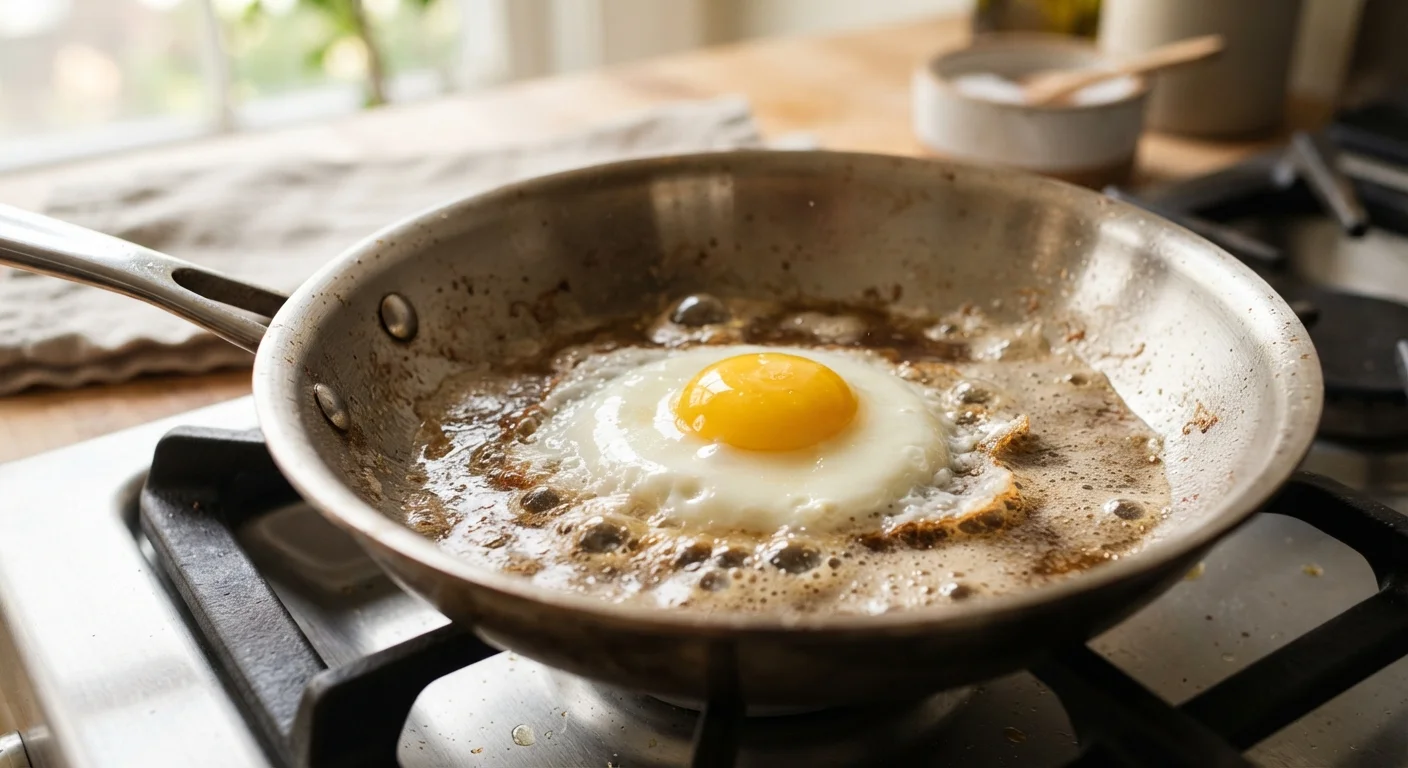
Eggs stick to pans for one fundamental reason: the proteins in egg whites bond to the metal surface when they meet it in the wrong conditions. Metal cookware - even nonstick surfaces to some degree - has microscopic pores and imperfections. When an egg hits a pan that isn't properly preheated or coated with fat, those proteins flow into the pores and essentially weld themselves as they cook.
The good news is that this process is entirely preventable. The variables that determine whether your egg slides out cleanly or tears apart are temperature, fat, and patience - not luck, and usually not the pan itself. Whether you're cooking on stainless steel or cast iron, the same principles apply. (Curious how those two surfaces compare overall? See our guide to cast iron vs. stainless steel for a side-by-side breakdown.)
Technique Matters More Than Equipment
A well-seasoned cast iron, a nonstick, or a stainless steel pan can all produce perfectly cooked eggs that release cleanly. The pan material is rarely the culprit. If your eggs stick consistently, the issue almost always comes down to heat management and timing - both of which are fully within your control.
The Most Common Mistakes - and How to Fix Them
The mistakes below account for the overwhelming majority of stuck-egg frustrations in home kitchens. Each one is fixable with a small adjustment to your routine.
Adding eggs to a pan that hasn't been properly preheated.
Why it happens: Most home cooks put the pan on the burner, add fat right away, and crack the egg in within 30-60 seconds - before the surface has reached a stable cooking temperature.
Using too little fat, or adding fat to a cold pan.
Why it happens: Cooks trying to reduce calories often cut fat too aggressively, or they add butter the moment the pan goes on the burner without waiting for it to melt and heat evenly.
Attempting to move or flip eggs before they are ready to release.
Why it happens: Impatience is the main driver. Cooks try to check whether the egg is sticking by nudging it early, which tears the still-setting proteins before they've had a chance to pull away from the surface on their own.
Cooking eggs on heat that is too high.
Why it happens: Many people default to medium-high or high heat because that's what's used for searing meat or boiling water. Eggs require a much gentler environment.
Crowding multiple eggs or ingredients into a pan that's too small.
Why it happens: It's tempting to cook everything at once to save time, but a crowded pan changes the cooking dynamic significantly.
Don't Crank the Heat to Compensate
A common reaction to stuck eggs is to turn up the burner, assuming more heat will help them cook faster and release. This usually makes things worse. High heat causes egg proteins to seize and bond aggressively to the pan surface, making tears and residue almost inevitable. Medium-low to medium heat is the reliable range for most egg preparations.
Getting egg cookery right is a foundational kitchen skill that pays off in dozens of other preparations - and it builds the kind of confidence that makes meal prep more sustainable over time.
~280
Eggs consumed per American annually
According to USDA estimates, average per-capita egg consumption in the U.S. hovers around 280 eggs per year, making egg cookery one of the most frequently practiced kitchen skills.
~180°F
Temperature at which egg proteins fully set
Egg whites begin to coagulate around 144-149°F, but fully firm up near 180°F - cooking too quickly at high heat bypasses the gradual setting process that allows clean release.
Putting It Into Practice
The practical sequence is straightforward: preheat the pan, add fat and let it come to temperature, then add your eggs and leave them alone until they release naturally. That's it. No special coating, no expensive equipment, and no need to replace perfectly functional cookware.
Where most home cooks struggle is in trusting the process - particularly the patience required to let the egg sit undisturbed. A gentle pan shake after 60-90 seconds will tell you everything you need to know. If the egg moves, it's ready to flip or plate. If it resists, give it another 20-30 seconds. Forcing it is always the wrong move.
Once you have these fundamentals down, you'll find that the same principles - controlled heat, adequate fat, patience - transfer directly to cooking fish fillets, sautéed vegetables, and delicate proteins. Mastering eggs is, in many ways, a master class in the pan itself.
This article is for informational purposes only. Individual results in the kitchen may vary based on equipment, heat source, and ingredient variations.