

Key Takeaways
Start here
Why Knife Skills Matter More Than the Knife Itself
Next
The Two Grips That Change Everything
Then practice
Core Cutting Techniques Explained
Stay safe
Safety Habits That Prevent Most Kitchen Injuries
Maintain it
Keeping Your Knife Ready to Use
Why Knife Skills Matter More Than the Knife Itself
Many home cooks assume the path to better prep work runs through buying a better knife. In practice, technique accounts for far more than equipment. A skilled cook with a modest chef's knife will outperform an untrained one with an expensive blade nearly every time.
Good knife skills make prep faster and more consistent - and consistency matters in cooking. When vegetables are cut to a uniform size, they cook evenly. When herbs are properly chiffonaded rather than crushed, they retain more flavor and look better on the plate. Before you pick up a knife, it also helps to read through your recipe completely so you know what cuts are needed and in what order.
Pinch grip
A knife-holding technique where you pinch the blade between your thumb and bent index finger for better control and less fatigue.
Claw grip
A way of holding food with your non-knife hand, fingers curled so knuckles guide the blade and fingertips stay safely tucked away.
Honing
Using a honing steel or rod to realign a knife blade's edge - not the same as sharpening, which removes metal.
Rocking chop
A cutting motion where the knife tip stays on the board and the heel rocks up and through food, useful for herbs and rough chopping.
Chiffonade
A technique of stacking leafy herbs or greens, rolling them tightly, then slicing into thin ribbons.
Bolster
The thick band of metal between a knife's blade and handle that adds balance and acts as a finger guard.
The Two Grips That Change Everything
Most home cooks grip the knife handle the way they'd hold a hammer. This limits control and creates fatigue. Two grips fix most issues immediately.
The Pinch Grip
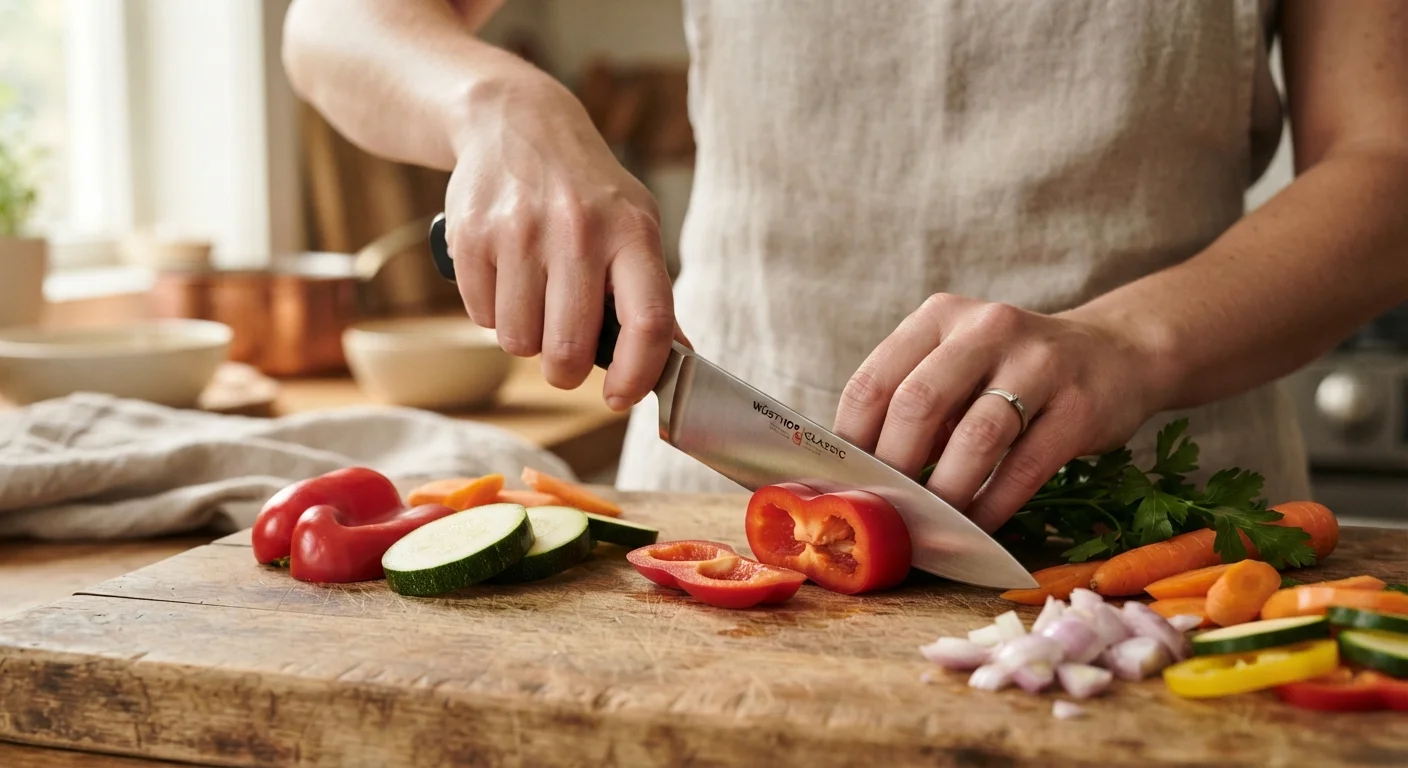
Pinch the blade itself - not the handle - between your thumb and the side of your bent index finger, just where the blade meets the bolster. Wrap your remaining three fingers around the handle. This lowers the knife's center of gravity, giving you far more precision and reducing wrist strain during long prep sessions.
The Claw Grip
Use this with your non-knife hand to hold food. Curl your fingertips inward so they tuck safely behind your knuckles. Rest the flat of the blade lightly against your knuckles as you cut. Your knuckles act as a guide - and a physical barrier between the blade and your fingertips. Practice this with every cut until it becomes automatic.
Practice on a forgiving vegetable first
Zucchini, cucumbers, and carrots are ideal for drilling grips and cuts - they're firm, stable, and inexpensive. Spend five minutes practicing the claw grip and push cut before you need to use them under time pressure during an actual meal.
Core Cutting Techniques Explained
Three fundamental cuts cover the overwhelming majority of what a home cook needs to do at a cutting board.
The Rocking Chop
Keep the tip of the knife on the board and rock the heel up and forward through the food. This is efficient for herbs, garlic, and rough chopping vegetables. The tip acts as a pivot, giving you a continuous, controlled motion.
The Push Cut
Push the blade forward and slightly down as it passes through food, then lift and reset. This produces cleaner, more precise cuts - ideal for onions, carrots, and anything where uniform slices matter. It is the workhorse cut in most kitchens.
The Pull Cut
Draw the blade toward you through food rather than pushing forward. This is useful for scoring meat, cutting delicate items like fish fillets, or breaking down bread without crushing it. Use it deliberately rather than as a default.
Pairing consistent cuts with a well-organized workspace makes prep dramatically smoother - a practice covered in depth in our article on mise en place habits.
Safety Habits That Prevent Most Kitchen Injuries
The claw grip is your first line of defense, but a few additional habits reduce risk significantly.
- Never cut on a slippery surface. Place a damp towel or non-slip mat under your cutting board before you start.
- Create a flat surface. Round vegetables like potatoes or onions roll. Slice off one side to create a stable flat base before proceeding with further cuts.
- Never run your finger along a blade to test sharpness - use the paper test (slice through a sheet of paper) or the tomato test (press the blade gently against a tomato's skin without sawing).
- Don't catch a falling knife. Step back and let it drop. Attempting to catch it nearly always results in a cut.
Cross-contamination during prep is another overlooked hazard. Our food safety guide covers which cutting practices put cooks at real risk.
Keeping Your Knife Ready to Use
A dull knife is genuinely more dangerous than a sharp one. When a blade is dull, cooks apply more force - and more force means less control. The blade is also more likely to slip off a curved surface like a tomato or an apple.
Honing vs. Sharpening
Honing (using a honing steel or ceramic rod) realigns the blade's edge without removing metal. Do this frequently - even before each use if you cook regularly. Sharpening removes a small amount of steel to rebuild an edge that has degraded past what honing can correct. Most home cooks need to sharpen a chef's knife only a few times per year.
Storage and Care
Store knives on a magnetic strip, in a knife block, or with blade guards - never loose in a drawer where edges dull against other utensils. Wash knives by hand and dry them immediately; dishwashers are harsh on blades and handles alike.
Building this maintenance habit is part of caring for the kitchen tools that genuinely earn their space - a topic covered in our essential kitchen tools overview.