

Key Takeaways
Our Verdict
Neither highway nor city driving is inherently more dangerous, but each exposes gaps in different skill sets. Drivers who primarily commute in one environment often lack practice in the other - and that unfamiliarity is a genuine safety risk. Consciously developing competence in both contexts is what separates a well-rounded driver from one who is only comfortable on familiar roads.
| Best for | Recommended |
|---|---|
| Drivers building long-distance or interstate travel skills | Highway driving practice |
| Drivers navigating dense urban areas, parking, and pedestrian zones | City driving practice |
| New drivers seeking the most comprehensive skill development | Structured practice in both environments |
The Core Difference: Speed vs. Complexity
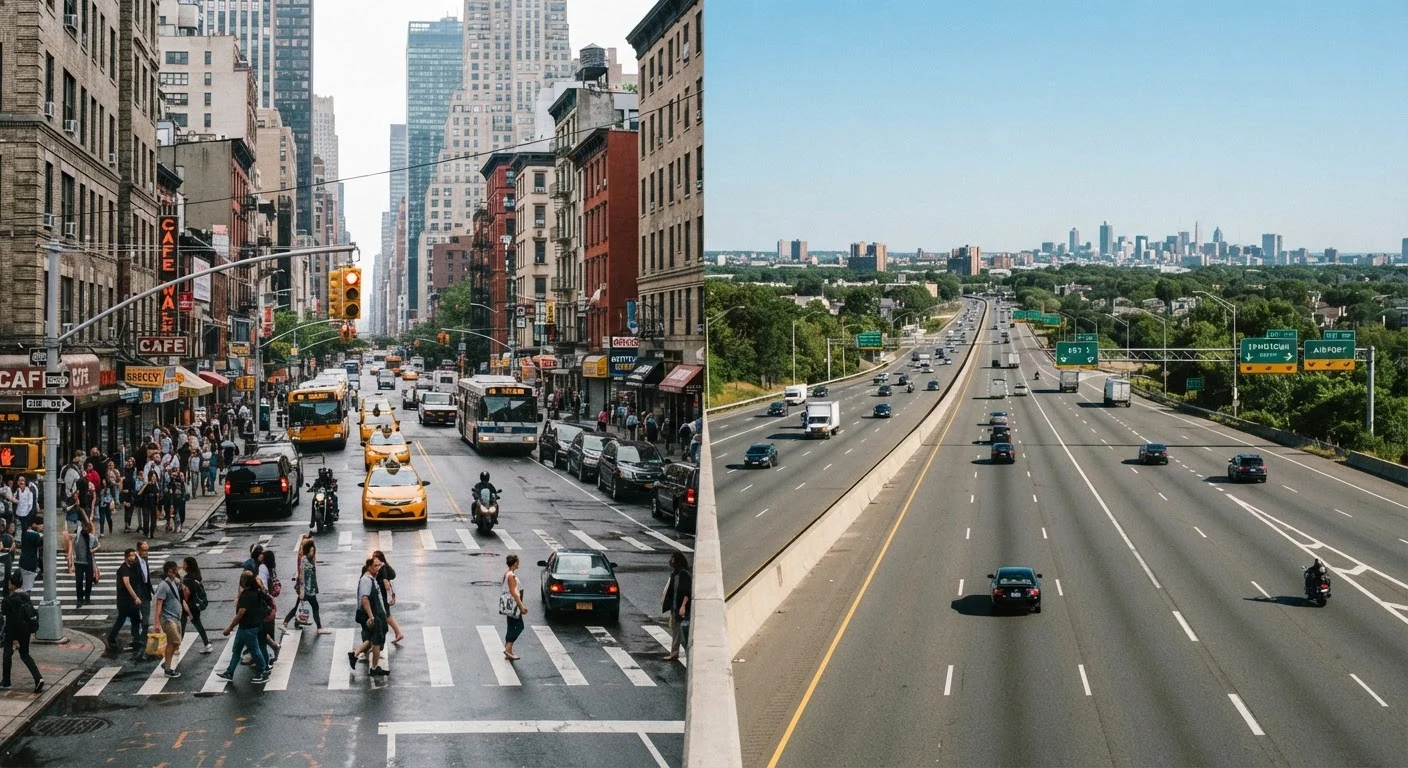
The fundamental distinction between highway and city driving isn't just speed - it's the nature of the mental work involved. On a highway, a driver's primary job is sustaining consistent speed, maintaining lane position, and anticipating conditions far ahead. In a city, the job is rapidly processing a dense, constantly shifting environment at close range.
Highway driving is often described as low-event but high-consequence. Fewer decisions per mile, but each one - an abrupt lane change, a missed exit approach, misjudging closing speeds - can unfold at 65-75 mph where reaction time is compressed. City driving is high-event and close-quarters: a driver may encounter a dozen decision points in a single block, from a cyclist cutting left to a pedestrian stepping off a curb between parked cars.
These aren't just different intensities of the same skill. They genuinely draw on different attention patterns, hazard categories, and vehicle control techniques.
What Highway Driving Actually Demands
Experienced city commuters who rarely travel highways often underestimate the specific skills involved. Here's what highway driving actually requires:
- Merging under speed: Entering a highway safely means matching traffic speed on the ramp - not stopping at the end and hoping for a gap. Misjudging this is a leading cause of highway entry crashes.
- Following distance management: At 70 mph, a vehicle travels roughly 103 feet per second. The three-second rule (or greater) isn't optional - it's the minimum buffer to react to sudden stops.
- Lane discipline: Proper lane usage - keeping right except to pass, not camping in the left lane - is both a legal requirement in many states and a core safety habit that keeps traffic flowing predictably.
- Exit planning: Highway exits require early awareness. Missing a high-speed exit and cutting across lanes late is dangerous. Experienced highway drivers identify their exit well in advance.
- Vigilance against monotony: Highway hypnosis - reduced alertness from repetitive, low-stimulus driving - is a real hazard. Taking breaks on long drives and staying aware of fatigue cues matters more here than in stop-and-go traffic.
See our guide to speed limits vs. safe speed for more on judging appropriate velocity based on conditions rather than posted signs alone.
| Highway Driving | City Driving | |
|---|---|---|
| Primary hazard type | High-speed closing distances, lane conflicts | Pedestrians, cyclists, intersections |
| Decision frequency | Low per mile | Very high per mile |
| Following distance needed | 3+ seconds minimum | 2 seconds; stops frequent |
| Fatigue mechanism | Monotony and highway hypnosis | Cognitive overload from complexity |
| Key scanning technique | Far-field, wide-angle ahead | Close-field, lateral, multilayer |
| Speed management | Sustained, consistent speed control | Frequent acceleration and braking |
| Navigation demands | Exit planning well in advance | Frequent turns, lane changes, signals |
What City Driving Actually Demands
City driving asks drivers to process far more inputs per mile, at shorter range, with less margin for error on spacing. The key demands:
- Scanning for pedestrians and cyclists: Urban environments require a close-field scan - doorways, crosswalks, bike lanes, and gaps between parked cars where people appear suddenly.
- Intersection awareness: Red-light runners, left-turn conflicts, and pedestrians crossing against signals are disproportionately city hazards. Treating a green light as unconditionally safe is a common mistake.
- Low-speed vehicle control: Parallel parking, navigating narrow lanes, and maneuvering in congested areas require precise, unhurried vehicle control that highway driving rarely develops.
- Cognitive load management: Processing GPS directions, traffic signals, lane markings, and pedestrian activity simultaneously is genuinely fatiguing. Distraction - including phone use - carries outsized risk in this environment.
Defensive driving habits are especially valuable in urban environments, where unpredictable behavior from other road users is the norm rather than the exception.
Practice the Environment You Avoid
Most drivers unconsciously route around unfamiliar driving environments - choosing surface streets over highways, or avoiding downtown areas. Deliberately practicing in your weaker environment during low-traffic periods is one of the most efficient ways to close skill gaps. Even a handful of intentional sessions builds real competence.
Fatigue and Attention: Different Failure Modes
Both environments tire drivers, but through different mechanisms. Highway monotony can cause attention to drift without any single demanding event triggering it - a driver may feel alert but have degraded hazard awareness. City driving causes cognitive saturation: too many inputs, too fast, creating decision fatigue that leads to errors of omission (missing a stop sign, failing to check a blind spot before opening a door).
Recognizing which environment you're in - and which fatigue risk applies - helps drivers take the right countermeasures. On long highway stretches, scheduled rest stops and avoiding driving during natural drowsiness windows (early afternoon and late night) are key. In city traffic, minimizing in-car distractions and avoiding multitasking is the priority.
Conditions that compound both risks - rain, fog, and low visibility - intensify these failure modes in different ways. See our guide to low-visibility driving for environment-specific adjustments.
Building Competence in Both Environments
Most drivers develop strong habits in whichever environment they use daily - and notable gaps in the other. A suburban commuter comfortable on surface streets may tense up merging onto a busy interstate. A highway-accustomed driver may struggle with the rhythm of urban stop-and-go, scanning for cyclists, or navigating multi-lane city intersections.
Deliberate exposure is the straightforward fix. If you rarely drive highways, plan occasional interstate trips specifically to practice merging, exit approaches, and following distance judgment. If city driving is unfamiliar, start during off-peak hours and low-density streets before working up to busier areas.
The mindset that ties both environments together is anticipation over reaction. Whether you're watching a distant highway exit or reading a pedestrian's body language at a crosswalk, the best drivers are always processing what might happen next - not just responding to what's already happening.
This article is for general educational purposes only. Always follow local traffic laws and regulations, and consider formal driver education or refresher courses if you want structured skill development.