

Key Takeaways
Option A
Posted Speed Limit
The legal ceiling - set for ideal conditions.
Best for: Establishing a maximum lawful speed under standard, clear-weather, good-visibility conditions.
Option B
Safe Speed
The context-driven choice - what conditions actually demand.
Best for: Maintaining control and reaction time when weather, traffic, visibility, or road geometry introduce real hazards.
If you're driving in clear daylight on a straight, dry, low-traffic road
Posted Speed Limit
When all conditions align with what engineers assumed when setting the limit, the posted number reflects a genuinely appropriate speed.
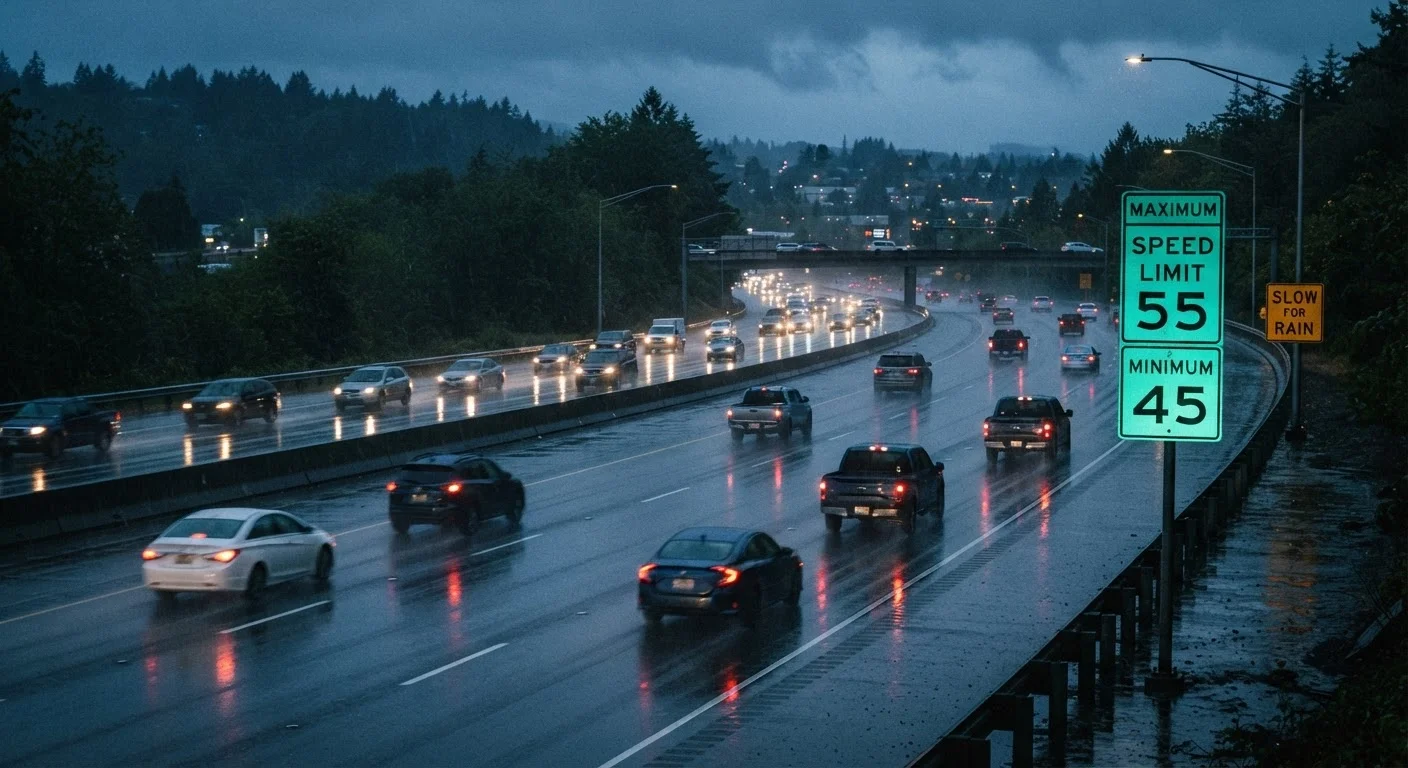
If visibility has dropped due to fog, rain, or snow
Safe Speed
Reduced sight lines shorten your effective reaction window; the posted limit almost certainly exceeds what's safe in these conditions.
If you're navigating heavy stop-and-go urban traffic
Safe Speed
Dense, unpredictable traffic requires a buffer that posted limits don't automatically account for.
If you're driving at night on an unfamiliar rural road
Safe Speed
Headlight range often limits effective stopping distance to well below what the posted limit demands - overdriving your lights is a common and serious error.
What Speed Limits Actually Represent
Speed limits are engineering standards set by state and local authorities based on road geometry, typical traffic volumes, pedestrian activity, and - critically - ideal conditions. The 45 mph sign on a rural two-lane road was likely calibrated on a dry, clear afternoon with good sightlines. It does not update itself when a thunderstorm rolls in or frost forms before dawn.
In most U.S. states, traffic law also includes what's commonly called a basic speed law: a driver must operate at a speed that is reasonable and prudent given actual conditions, regardless of the posted limit. That means driving at 55 mph on an icy interstate posted at 65 mph could still be considered reckless if conditions warrant slower travel - and conversely, driving the posted limit in a blizzard offers no legal shield if a collision results.
Think of the posted number as a ceiling in perfect circumstances, not a target speed for every situation.
| Criterion | Posted Speed Limit | Safe Speed |
|---|---|---|
| Set by | Government engineers and planners | Driver judgment based on conditions |
| Assumes conditions | Clear weather, dry pavement, daylight | Whatever is actually present |
| Legal status | Maximum lawful speed | Governed by basic speed laws in most states |
| Changes with weather | No - fixed on the sign | Yes - must drop in poor conditions |
| Changes at night | No | Often yes, to match headlight range |
| Liability in a crash | Compliant, but not a full shield | Driving to conditions reduces liability exposure |
| Driver input required | None - read and obey the sign | Constant active assessment |
The Real-World Factors That Lower Your Safe Speed
Several concrete conditions routinely require speeds well below the posted limit. Understanding each one helps you make deliberate, informed choices rather than defaulting to the number on the sign.
Weather and Surface Conditions
Wet pavement can double stopping distances compared to dry asphalt. Ice and packed snow can multiply them further. If you're traveling in rain, fog, or winter conditions, see our companion guide on adjusting your habits for low-visibility conditions for technique-specific guidance. The core principle: if you cannot stop within the distance you can see clearly, you are going too fast.
Stopping Distance Physics
Most drivers significantly underestimate how much road a vehicle needs to stop. At 60 mph, total stopping distance - combining reaction time and braking - routinely exceeds 240 feet under ideal conditions. On wet or degraded surfaces, that figure climbs substantially. Our article on the stopping distance problem breaks down the physics in full. Speed compounds this non-linearly: doubling your speed quadruples braking distance.
Nighttime and Limited Visibility
Standard low-beam headlights illuminate roughly 160-200 feet ahead. If you're driving at 55 mph, your stopping distance at that speed already approaches or exceeds that range - meaning you could be overdriving your headlights, a dangerous situation where you can't stop before reaching something you can see. Night driving mistakes explores this hazard in more depth.
Traffic Density and Road Complexity
Posted limits on highways assume a certain flow and predictability. In heavy congestion or on unfamiliar winding roads, the dynamics change entirely. Highway and city driving demand genuinely different skills, and safe speed choices in each environment reflect that difference.
2×
Stopping distance increase on wet pavement
Research by highway safety engineers consistently shows wet roads roughly double braking distance compared to dry conditions at the same speed.
240+ ft
Estimated total stopping distance at 60 mph
Under ideal dry conditions, the NHTSA estimates total stopping distance (reaction plus braking) at 60 mph exceeds 240 feet for a typical passenger vehicle.
4×
Braking distance increase when speed doubles
Because kinetic energy increases with the square of velocity, doubling speed quadruples the braking distance required - a relationship confirmed by basic physics.
Applying the Right Speed: A Practical Framework
Rather than anchoring to the posted number, experienced drivers apply a layered mental check before settling on a cruising speed:
- Can I stop within my visible distance? This is the non-negotiable baseline. If the answer is no, slow down until it is.
- What is the surface doing? Wet, gravelly, or uneven pavement reduces traction and extends stopping distances. Adjust before you need to, not during an emergency.
- What is traffic doing around me? Matching the flow of traffic (within legal limits) is generally safer than being a significant outlier - but flowing traffic can also be moving unsafely as a group.
- What are my headlights covering at night? If you're moving faster than your lights can keep up with, ease off the accelerator.
- Am I fatigued or distracted? Reaction time degrades with fatigue. A lower speed provides more margin for a slower-than-normal response.
Speed choice is one of the few real-time variables entirely within the driver's control. Using it deliberately - rather than treating every posted sign as a default cruise-control setting - is one of the clearest markers of a skilled, safe driver.
Basic Speed Law: Know Your State's Rules
The vast majority of U.S. states have some form of basic speed law requiring drivers to travel at a speed that is 'reasonable and prudent' given current road, weather, and traffic conditions. This exists independently of posted limits. Drivers can be cited or found liable in civil proceedings even when traveling at or below the posted speed if conditions clearly warranted slower travel. Check your state's DMV or traffic code for the specific language applicable to you.