

Key Takeaways
Option A
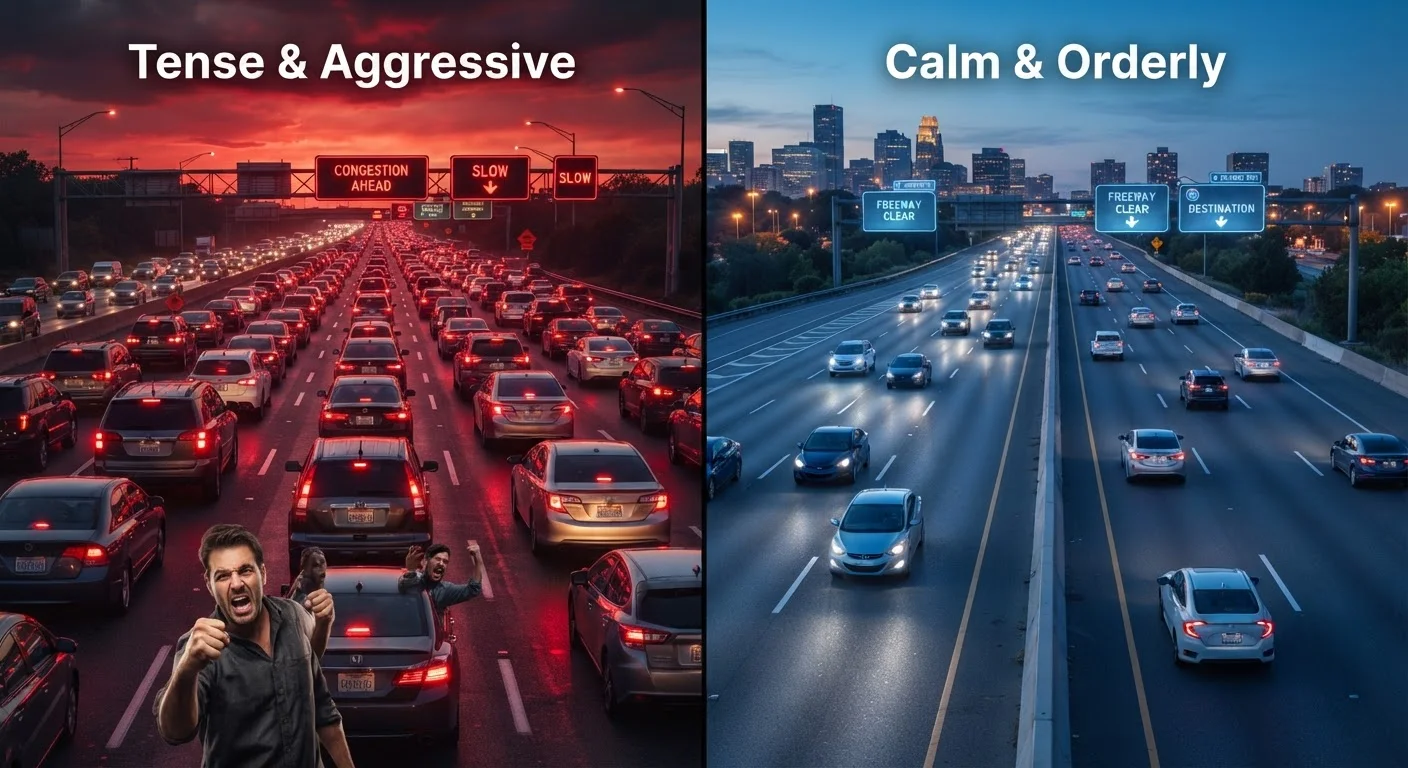
Road Rage
The emotional, reactive response to driving frustration.
Best for: No legitimate use case - road rage is a dangerous behavior pattern that escalates risk for everyone on the road.
Option B
Defensive Driving
The disciplined, anticipatory approach to managing traffic hazards.
Best for: Any driver who wants to reach their destination safely regardless of what other motorists do around them.
If you want to reduce your personal crash risk on congested roads
Defensive Driving
Defensive habits - maintaining safe following distance, scanning ahead, and avoiding confrontation - give you more time to react and fewer opportunities for collisions.
If you frequently drive in high-stress urban or highway environments
Defensive Driving
Dense traffic amplifies the consequences of aggressive behavior. Defensive techniques are specifically designed for exactly these high-pressure conditions.
If you've noticed yourself reacting with anger or aggression while driving
Defensive Driving
Recognizing emotional triggers behind the wheel is the starting point. Defensive driving gives you a concrete, structured framework to replace reactive habits with safer ones.
The Same Trigger, Two Very Different Outcomes
Someone cuts you off on the highway. Your pulse spikes, your jaw tightens, and you have a split second to decide how to respond. That moment - repeated thousands of times a day across American roads - is where road rage and defensive driving diverge completely.
Road rage is not simply frustration. It's a pattern of aggressive behavior triggered by perceived slights on the road: tailgating to retaliate, flashing lights, honking repeatedly, making threatening gestures, or even brake-checking another driver. According to the NHTSA, aggressive driving behaviors contribute to a significant share of serious injury crashes on U.S. roads each year.
Defensive driving, by contrast, starts from the same frustration but channels it differently. A defensive driver acknowledges the provocation - and then deliberately deprioritizes it. The goal shifts from winning the exchange to arriving safely. These two responses are not personality types you're born with; they're habits that can be recognized, examined, and changed.
| Criterion | Road Rage | Defensive Driving |
|---|---|---|
| Core mindset | Reactive - responds to perceived injustice | Anticipatory - focuses on outcomes, not slights |
| Following distance | Often reduced to intimidate or retaliate | Deliberately maintained or increased under stress |
| Response to a cut-off | Accelerate, tailgate, or gesture | Ease off throttle, create space, move on |
| Effect on crash risk | Significantly increases risk for all nearby drivers | Actively reduces personal and surrounding risk |
| Emotional state | Escalating anger or adrenaline | Calm focus; stress acknowledged and managed |
| Legal exposure | Can result in citations, criminal charges, civil liability | Minimizes legal and insurance risk |
What Road Rage Actually Looks Like
Road rage often feels justified in the moment, which is part of what makes it so persistent. When another driver does something dangerous or inconsiderate, anger is a natural human response. The problem is what happens next.
Aggressive drivers tend to take the infraction personally - as if the other driver specifically targeted them - and respond by trying to reassert control or punish the perceived offender. Common road rage behaviors include following too closely after being cut off, accelerating to block a merging vehicle, or engaging in prolonged honking and gesturing. In more extreme cases, drivers exit their vehicles or deliberately use their car as a weapon.
Beyond the obvious safety hazards, road rage creates a feedback loop. One aggressive act tends to provoke another. A driver who feels threatened may brake suddenly; the car behind them - already too close - has no time to stop. The original grievance is forgotten; the collision is very real.
80%
Drivers who admit to road rage
An AAA Foundation for Traffic Safety study found roughly 8 in 10 U.S. drivers reported engaging in at least one aggressive driving behavior in the prior year.
~30
Annual U.S. road rage-related deaths
Everytown for Gun Safety has tracked dozens of road rage incidents resulting in fatalities each year across the United States, with firearms involved in a growing share.
3 sec
Minimum recommended following distance
Traffic safety educators and NHTSA generally recommend maintaining at least a three-second gap behind the vehicle ahead under normal driving conditions.
The Core Principles of Defensive Driving
Defensive driving is a specific, teachable set of habits - not just a vague instruction to "be careful." It rests on three core ideas: anticipation, space management, and emotional control.
Anticipation means constantly reading the road ahead for potential hazards rather than reacting only once danger is immediate. A defensive driver notices a vehicle drifting between lanes early enough to create an exit route - well before it becomes a crisis. This same habit applies when adjusting to low-visibility conditions, where reaction time shrinks significantly.
Space management means maintaining enough following distance that you have time to stop or maneuver regardless of what the car ahead does. The standard guidance is at least three seconds of following distance in good conditions - more in poor weather or at highway speeds.
Emotional control is the hardest part. It means accepting that not every bad driver is worth engaging. If another motorist is behaving aggressively toward you, the defensive response is to create distance and disengage - not to match their energy. For a deeper look at what this approach involves in practice, see what defensive driving actually means.
Recognizing Your Own Triggers - And Resetting
Most drivers who exhibit road rage don't think of themselves as aggressive people. They think of themselves as responding reasonably to unreasonable behavior. That gap between self-perception and actual behavior is where the real work happens.
Common triggers include running late, general life stress carried into the car, fatigue, and environments with particularly dense or unpredictable traffic. Highway and city driving each create distinct stress patterns - understanding which environment raises your frustration most can help you prepare mentally before you pull out of the driveway.
Practical reset strategies include giving yourself extra travel time to reduce pressure, keeping the radio or music at a calm level, and mentally pre-committing to a non-engagement policy before you encounter a difficult driver. If you find yourself genuinely enraged while driving, pulling off the road safely and taking a few minutes to de-escalate is not a sign of weakness - it's the rational choice. Driving while emotionally flooded carries many of the same hazard characteristics as distracted driving: your attention narrows, your decision-making degrades, and your reaction time suffers.
The goal is not to become a passive driver who tolerates every hazard without response. Defensive driving involves active, confident decision-making. It simply routes that energy into managing risk - not manufacturing more of it.