

Key Takeaways
Option A
Open Shelving
The visually inviting, high-maintenance option.
Best for: Households with curated, uniform dishware collections and tidy daily habits who want easy grab-and-go access.
Option B
Closed Cabinets
The reliable, clutter-concealing workhorse.
Best for: Busy households with mixed kitchen gear who prioritize low-effort tidiness and dust protection.
If you want low daily maintenance and an easy-to-tidy kitchen
Closed Cabinets
Cabinets contain mess behind closed doors and require less day-to-day effort to keep looking neat.
If you have uniform dishware and strong organizational habits
Open Shelving
When your items are visually cohesive and you restock consistently, open shelves are both practical and attractive.
If you cook heavily and generate a lot of grease and steam
Closed Cabinets
Enclosed storage protects dishes and cookware from the grease residue and dust that accumulate quickly in active kitchens.
If you share your kitchen with multiple household members
Closed Cabinets
Cabinets are more forgiving when different people have different standards for putting things away neatly.
If you want everyday items genuinely within reach without searching
Open Shelving
A small section of open shelving for frequently used mugs, plates, or glasses can meaningfully speed up daily routines.
The Promise vs. the Reality
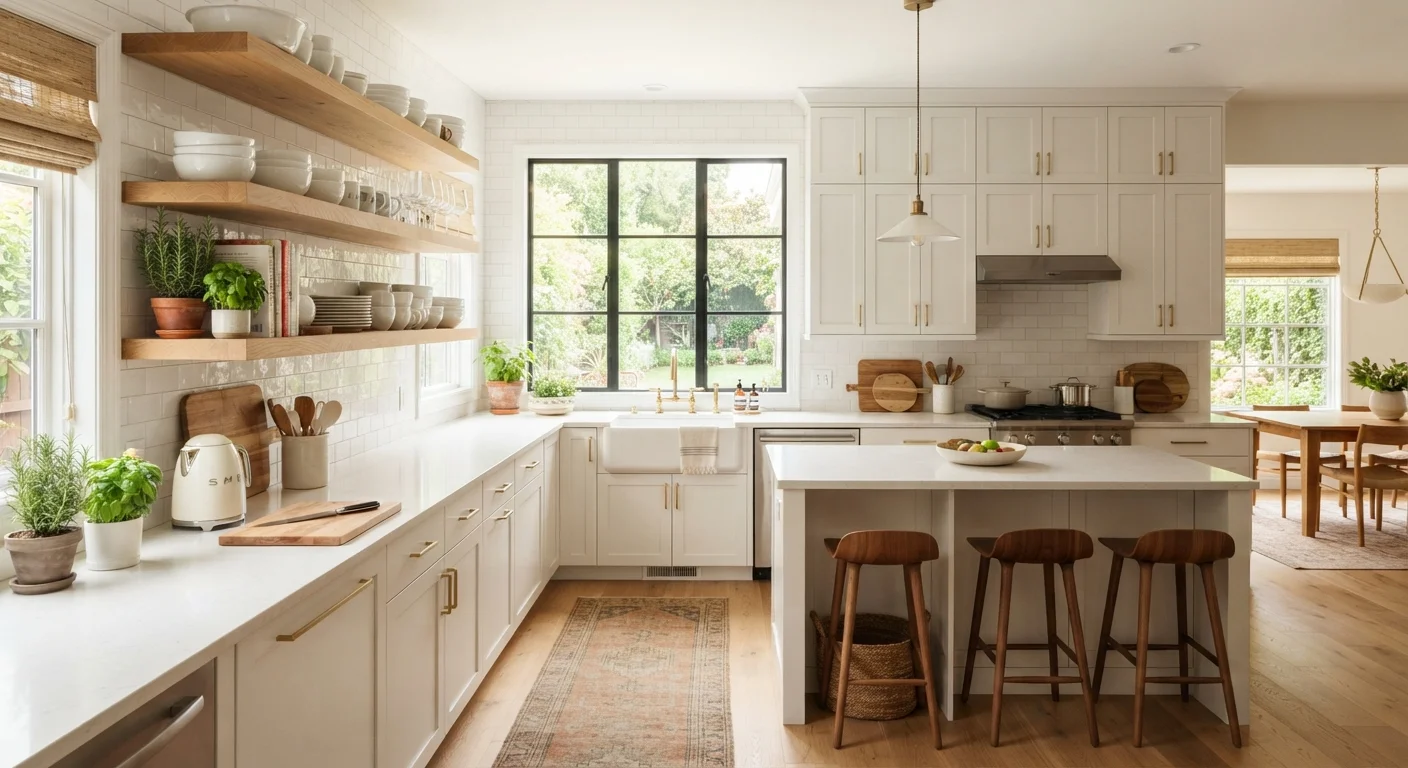
Open shelving has dominated kitchen inspiration boards for years. The visual appeal is real: rows of matching white bowls, evenly spaced glasses, a few trailing plants. It looks effortless. It rarely stays that way.
Closed cabinets, meanwhile, get less attention in design conversations but quietly do the heavy lifting in most American kitchens. They hide the cereal boxes, the mismatched mugs, the half-empty bags of lentils. No one photographs them, but they work.
The honest question isn't which looks better - it's which one keeps your specific kitchen tidier with the habits you actually have, not the habits you plan to develop. As our guide to what keeps organized homes organized explains, the systems that hold up long-term are ones built around real behavior, not aspirational behavior.
| Criterion | Open Shelving | Closed Cabinets |
|---|---|---|
| Visual tidiness | High when maintained; obvious when not | Consistent; mess is hidden |
| Daily maintenance required | High - every misplaced item shows | Low - inside disorder stays hidden |
| Dust and grease buildup | Significant in active kitchens | Minimal; items are protected |
| Accessibility | Excellent for visible, reachable items | Varies by shelf height and layout |
| Works well for mixed or mismatched items | No - clutter is amplified | Yes - conceals visual inconsistency |
| Risk of internal overcrowding | Low - visible limits enforce discipline | High - out of sight, out of mind |
| Best storage candidates | Daily-use dishes, mugs, glasses | Appliances, pantry staples, bulk items |
Where Open Shelving Fails (and Where It Succeeds)
Open shelves demand consistency. Every item placed back in the wrong spot, every mismatched cup, every stack that leans - all of it is immediately visible. For people who naturally put things back in order, this isn't a problem. For households where different people have different standards, it creates constant low-grade visual noise.
Dust and grease are the other underappreciated enemies of open shelving. In a kitchen where you cook regularly, items on open shelves will accumulate a fine film of airborne grease within weeks. That means more frequent washing of dishes you haven't even used.
Where open shelving genuinely works: a single focused section for items you reach for multiple times a day. Mugs near the coffee maker. Everyday plates directly above the dishwasher unload zone. The logic is friction reduction, not decoration. When open shelves hold only frequently rotated items, the dust problem shrinks and the visual chaos stays manageable.
If your household struggles to keep shared spaces consistently tidy, you might also find the strategies in organizing a home when household members disagree useful before committing to fully open storage.
62%
Homeowners who cite kitchen clutter as a top stress source
According to a survey by the National Association of Professional Organizers, kitchen disorganization consistently ranks among the most stressful household issues for American homeowners.
3-4 weeks
Time before open-shelf dishes accumulate noticeable grease film
Home organization experts and cleaning professionals commonly note that open kitchen shelves in regularly used kitchens require cleaning every three to four weeks to maintain hygiene.
Where Closed Cabinets Fall Short (and Where They Excel)
Closed cabinets solve the visibility problem - but they can create an out-of-sight, out-of-mind trap. When storage is hidden, it tends to fill past its functional limit. Stacking gets precarious. Items get pushed to the back and forgotten. A cabinet that looks tidy from the outside can be genuinely chaotic on the inside.
Accessibility is the other friction point. If a frequently used item lives behind a closed door on a high shelf, people will find workarounds - leaving it on the counter instead. That workaround becomes permanent, and counter clutter grows. Good cabinet organization means placing everyday items at eye level and within easy reach, with lesser-used items taking the harder-to-access spots.
Where closed cabinets excel is straightforward: bulk storage, appliances used only occasionally, pantry staples, cleaning supplies, and anything visually mismatched. The cabinet earns its keep precisely when contents don't need to look good. For a useful complement to cabinet pantry organization, consider running a pantry audit to identify what you actually use versus what's just taking up space.
Cabinets also pair well with drawer dividers and shelf risers inside - small interventions that prevent the internal pile-up that makes closed storage frustrating. More ideas for maximizing hidden storage appear in our guide to underused storage spots most homes overlook.
Cabinet Depth Matters More Than You Think
Standard upper cabinets are typically 12 inches deep - shallow enough that items stay accessible with a basic one-row, one-item-per-slot system. Base cabinets run 24 inches deep, which is where items disappear to the back. Lazy Susans, pull-out shelves, and deep drawer inserts are practical solutions for base cabinet depth, and many are available as aftermarket additions that don't require cabinet replacement.
The Hybrid Approach Most Kitchens Actually Need
Very few kitchens benefit from going entirely one direction. A fully open kitchen requires near-constant maintenance most households can't realistically sustain. A fully closed kitchen can make everyday cooking feel slower and more cumbersome than it needs to be.
A practical middle ground: reserve open shelving for a defined, limited zone - one or two shelves holding items that are used daily and visually cohesive. Use closed cabinets for everything else. This keeps the visual appeal manageable while protecting the bulk of your storage from dust and public scrutiny.
The zone logic matters. Open shelves work best close to where the items are actually used - plates above the dishwasher, glasses near the sink, coffee supplies near the kettle. Cabinets work best for appliances you use a few times a week, pantry staples, and anything that doesn't benefit from easy visual access. The goal is reducing the number of steps between a task and the tool needed for it, which is the same principle that applies whether your kitchen is open, closed, or somewhere in between.
Clutter in any kitchen storage - open or closed - tends to trace back to habit loops rather than the storage type itself. Our piece on why clutter keeps coming back explores the behavioral side of that pattern in more depth.