

Key Takeaways
The Real Reason the Drawer Never Stays Empty
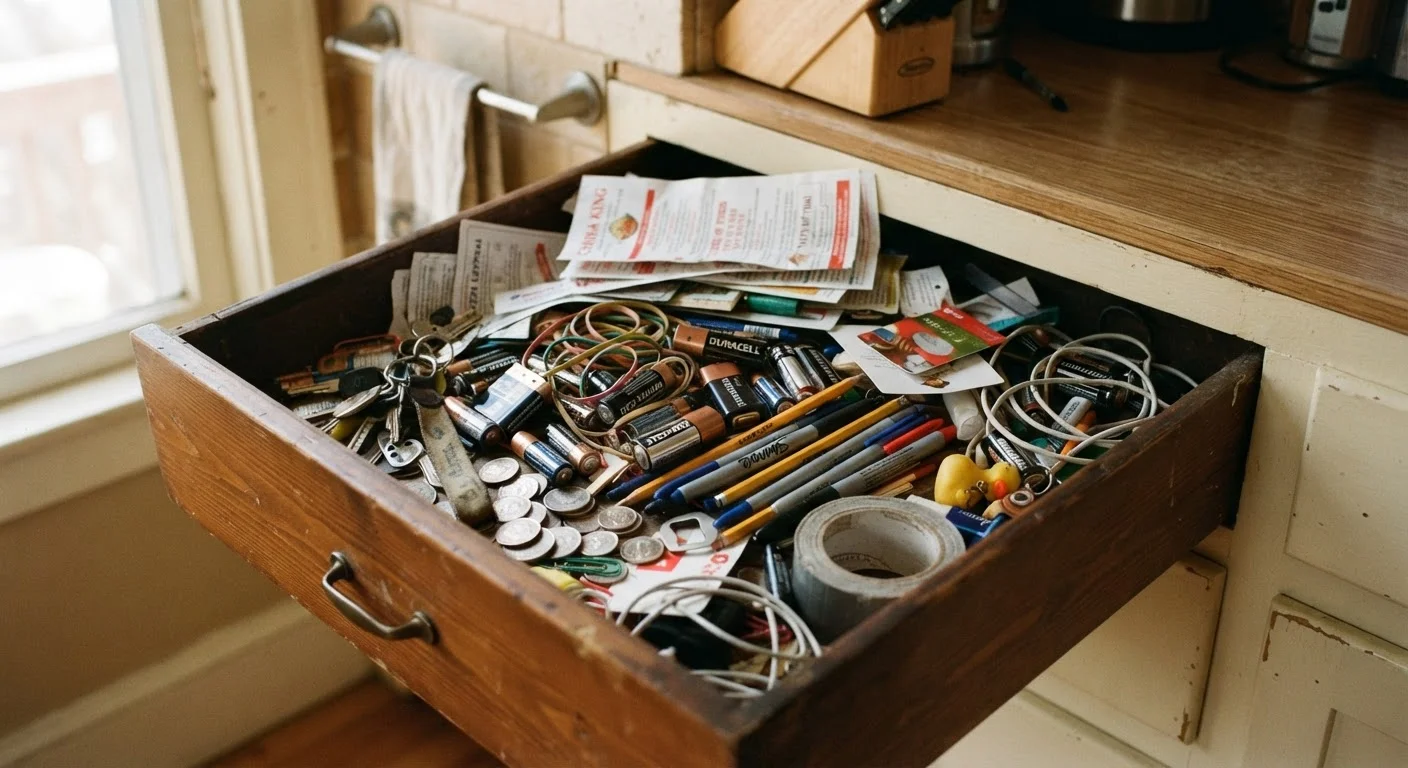
You've cleaned it out before. Sorted the rubber bands, tossed the dead batteries, returned the mystery keys to wherever they belong. Two months later, it's full again. If this pattern sounds familiar, the problem isn't the drawer itself - it's the role it's been assigned in your household system.
The junk drawer functions as a default destination: a place where items land when their actual home doesn't exist yet, or when returning them to the right place feels like too many steps in the moment. It's a symptom of gaps in your organizing structure, not a storage failure. As the common organizing myths article explains, adding more bins rarely solves the root problem.
Understanding why clutter accumulates is the necessary first step before any clean-out will stick.
Mistakes That Keep the Cycle Going
These are the patterns that cause junk drawers to refill - and the concrete changes that interrupt them.
Cleaning out the drawer without changing where items go afterward.
Why it happens: A clean-out feels productive and complete, so it's easy to assume the work is done - but without redirecting incoming items, the same objects return within weeks.
Treating the drawer as the only home for 'miscellaneous' items throughout the entire house.
Why it happens: When one catch-all spot exists, everything ambiguous gets routed there by default. Its convenience makes it the path of least resistance for any unclassified object.
Keeping items 'just in case' without evaluating whether you'd realistically use them.
Why it happens: Loss aversion makes it feel safer to hold onto things than to discard them, even when those items haven't been touched in over a year.
Skipping the 'quick return' habit when items drift out of place.
Why it happens: Small misplacements feel too minor to act on immediately, but each one is a micro-decision that gets deferred and deposited into the drawer over days or weeks.
Using the drawer as a staging area for decisions you're not ready to make.
Why it happens: Some items end up in the drawer not because they're homeless, but because deciding what to do with them requires a moment of thought that feels inconvenient in the moment.
23 min
Average daily time lost to disorganization
Research cited by organizational behavior studies suggests disorganized environments can cost individuals roughly 23 minutes of productive time per day searching for misplaced items.
80%
Of clutter is caused by delayed decisions
Professional organizers commonly cite that the vast majority of household clutter accumulates not from lack of space but from postponed choices about where items belong.
Building a System That Actually Holds
Clearing the drawer is easy. Making the fix last requires addressing the habits that filled it in the first place. The habits that keep organized homes organized come down to one principle: every item needs a designated place that's at least as convenient as the junk drawer.
A One-Time Purge Won't Stick Without a System
Spending an afternoon organizing a junk drawer feels satisfying, but without changing the habits that fill it, most drawers return to their previous state within 60-90 days. The clean-out is only step one. Reassigning item homes and building a brief weekly reset habit are what determine whether the results last.
Start by auditing what actually lives in your drawer right now. Group items by category - writing tools, batteries, tools, paper, cords. For each group, ask: Is there a more logical home for this elsewhere in the house? A small toolkit belongs near your workbench or utility closet. Takeout menus can be digitized or moved to a recipe binder. Spare batteries deserve a labeled box in a closet near devices that use them.
What remains after reassigning categories - maybe a tape measure, a notepad, a few pens - is the legitimate contents of a useful catch-all drawer. That's fine. The goal isn't to eliminate the drawer; it's to shrink its scope so it doesn't become a landfill for unprocessed decisions. For parallel thinking about how cabinet choices affect clutter in other areas, see open shelving vs. closed cabinets.
Finally, schedule a five-minute monthly reset - not a full reorganization, just a quick return of misplaced items. This small habit prevents slow drift from becoming a full-scale accumulation again.