

Key Takeaways
Option A
Simmering
The patient, flavor-building technique.
Best for: Best for soups, braises, stocks, and sauces that need depth, clarity, and tender textures over time.
Option B
Boiling
The fast, high-heat workhorse.
Best for: Best for cooking pasta, blanching vegetables, reducing liquids quickly, and bringing water up to temperature fast.
If you're making homemade stock or bone broth
Simmering
A sustained simmer extracts collagen and flavor compounds without agitating the liquid into a cloudy, greasy mess.
If you're cooking pasta or grains
Boiling
A full rolling boil keeps starchy foods moving, prevents sticking, and cooks them evenly throughout.
If you're building a tomato or pan sauce
Simmering
Gentle heat melds flavors, reduces liquid gradually, and prevents scorching or over-concentration.
If you're blanching vegetables for quick cooking or freezing
Boiling
Rapid boiling sets color and cooks vegetables quickly before an ice-bath stops carryover cooking.
If you're braising tougher cuts of meat
Simmering
Low, steady heat slowly breaks down connective tissue into gelatin without seizing or drying the muscle fibers.
What's Actually Happening in the Pot
At its core, the difference between simmering and boiling is temperature - and that temperature gap produces dramatically different physical and chemical outcomes in your food.
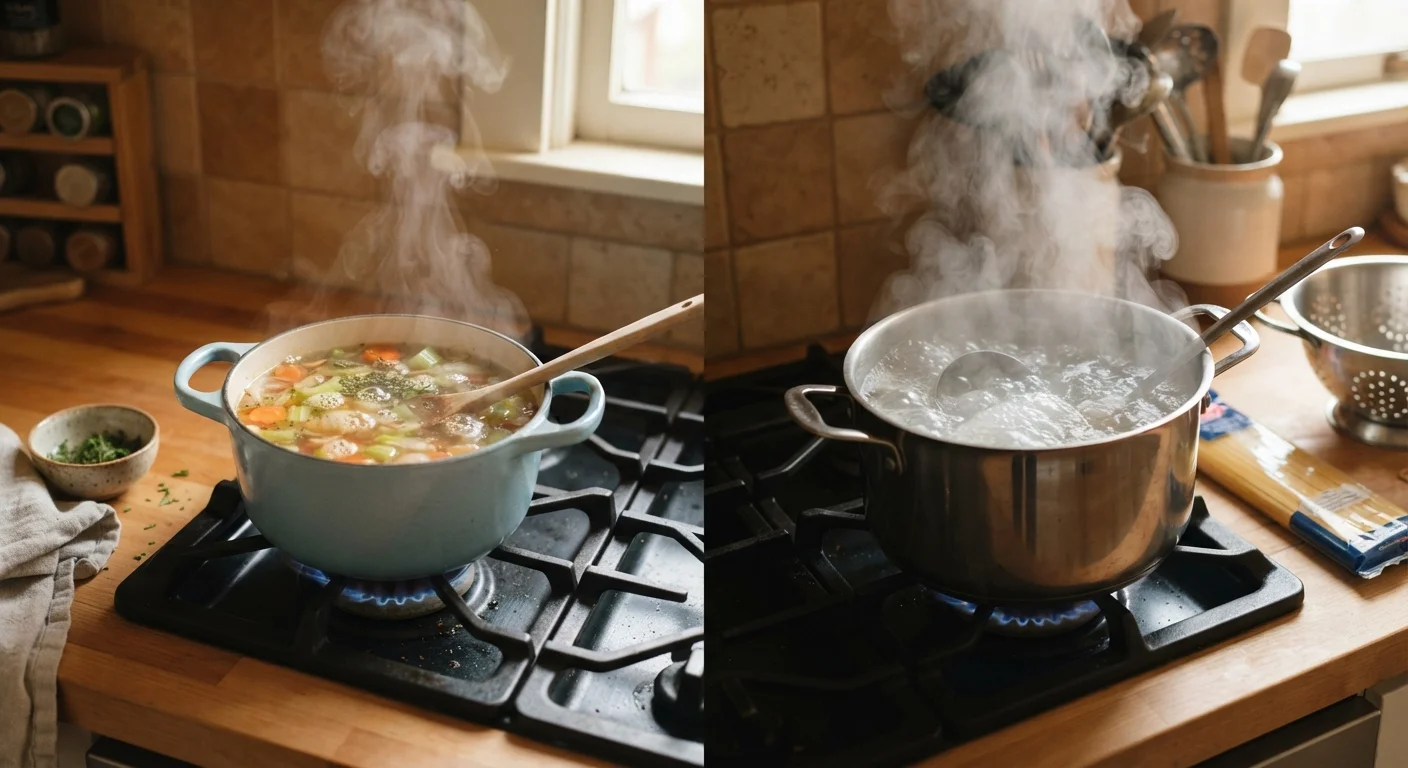
Boiling occurs at 212°F (100°C) at sea level. The water is in full, turbulent motion - large bubbles break the surface constantly and the liquid churns aggressively. There's no mistaking it. Simmering sits in a gentler range, roughly 180-205°F, where small bubbles rise lazily and occasionally break the surface. Some cooks describe a true simmer as the liquid "breathing" rather than churning.
Between those two states lies a middle ground sometimes called a vigorous simmer or brisk simmer - useful for reducing sauces faster without reaching a full boil. Understanding where your pot sits on that spectrum is one of the most useful skills you can develop. For a broader look at how heat shapes outcomes, see our guide to pan temperature control.
| Criterion | Simmering | Boiling |
|---|---|---|
| Temperature range | 180-205°F | 212°F (at sea level) |
| Bubble activity | Small, lazy, intermittent | Large, constant, vigorous |
| Effect on proteins | Keeps tender, relaxed | Can toughen and seize |
| Stock clarity | Maintains clear broth | Clouds and emulsifies fat |
| Speed | Slow, controlled reduction | Fast, aggressive cooking |
| Best uses | Soups, stocks, braises, sauces | Pasta, grains, blanching |
| Risk of scorching | Low with monitoring | Higher, especially for sauces |
How Each Method Affects Flavor and Texture
Temperature isn't just a technical detail - it directly shapes what ends up on your spoon.
What simmering does well
Gentle heat gives proteins time to relax and release flavor without tightening. Collagen in chicken bones or beef shanks slowly converts to gelatin, enriching broth with body and silkiness. Aromatics - onion, garlic, herbs - gradually surrender their volatile compounds into the surrounding liquid. The result is layered, cohesive flavor that a short, high-heat cook simply can't replicate.
Simmering also keeps stocks clear. Vigorous boiling emulsifies fat droplets into the liquid and breaks down particles, turning a stock cloudy and greasy. A classic French consommé or a clean chicken broth depends entirely on disciplined, low-heat simmering.
What boiling does well
Boiling excels at speed and starch. Pasta needs a rolling boil to cook evenly - the turbulence keeps pieces from clumping and ensures uniform heat exposure. Blanching vegetables in aggressively boiling, well-salted water sets their color and parcooks them rapidly before a cold-water stop halts further cooking. Reducing a large volume of liquid quickly - say, after deglazing a pan - can also justify a short, hard boil before you dial it back.
~25°F
Temperature gap between simmer and boil
Though the difference is only about 25°F, the physical and chemical effects on food are dramatically distinct at each threshold.
180-205°F
Ideal simmer range for stocks and soups
Culinary science sources consistently place the ideal simmering range here, where collagen conversion and flavor extraction occur without agitation.
The critical mistake most home cooks make: leaving a soup or braise at a boil for the entire cook time. Proteins like chicken breast or white fish seize and toughen within minutes at 212°F. Beans can burst their skins. A sauce can concentrate so rapidly it scorches before you notice. Building genuine depth in a pot requires patience, not just heat.
Reading Your Pot and Adjusting on the Fly
Recipes that say "bring to a boil, then reduce to a simmer" are giving you a critical two-step instruction, not a formality. The boil gets you to temperature; the simmer is where the real cooking happens.
On most home stovetops, a simmer sits between low and medium-low. But every burner behaves differently, so learn to watch the liquid rather than trust a dial setting. If you see large, constant bubbles, turn it down. If the surface is completely still and you can see no movement at all, nudge the heat up slightly - you want gentle activity, not stagnation.
A few practical cues to watch for:
- Lazy small bubbles rising intermittently - true simmer, ideal for soups and long braises
- Steady stream of medium bubbles - vigorous simmer, good for sauce reduction
- Full rolling boil you can't stir down - boiling, appropriate for pasta and blanching
Lid position also matters: covering a pot traps steam and raises internal temperature, often pushing a simmer toward a boil. If a recipe calls for a covered simmer, check the heat every 15-20 minutes and adjust. Tasting as you cook works hand in hand with heat management - your palate will often catch over-reduction or under-seasoning before your eyes do.
Altitude Changes the Math
At higher elevations, water boils at temperatures below 212°F - roughly 202°F at 5,000 feet above sea level. This means pasta, grains, and blanched vegetables take longer to cook through. Simmering temperatures are also affected, shifting the range slightly lower. If you live or cook at altitude, rely on visual cues and doneness testing rather than strict time guidelines from recipes written at sea level.
Altitude is worth keeping in mind: water boils at lower temperatures at higher elevations (around 202°F at 5,000 feet), which means pasta takes longer and simmering temperatures shift slightly. If you cook at elevation, allow extra time and rely on visual and texture cues over the clock. For more on how seasoning interacts with all of this, our article on salting at the right moment covers timing in detail.