

Key Takeaways
The Maillard Reaction
The Maillard reaction is a chemical process that occurs when heat causes amino acids (the building blocks of protein) and certain sugars in food to react with each other. The result is the browning you see on seared meat, toasted bread, roasted coffee, and baked cookies - along with hundreds of new flavor and aroma compounds. It is responsible for much of what makes cooked food taste more complex and satisfying than raw food.
Named after French chemist Louis-Camille Maillard, who first described the reaction in 1912, it typically begins around 280-330°F (140-165°C) and is distinct from caramelization, which involves only sugars breaking down without protein involvement.
The Science Behind the Sizzle
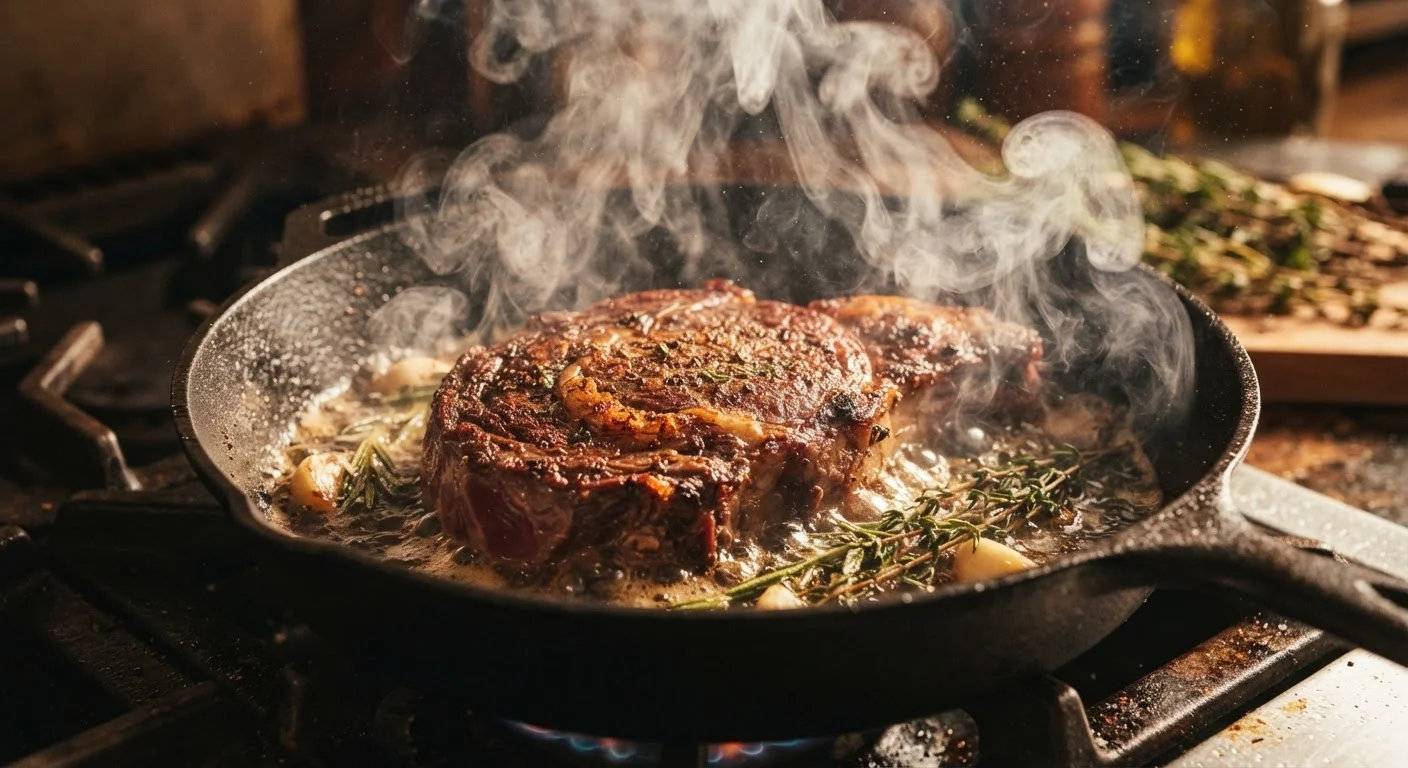
When a piece of chicken hits a hot cast iron pan and that satisfying sizzle erupts, something profound is happening at a molecular level. Amino acids - the chemical units that make up protein - are colliding with reducing sugars present in the food's surface. Under sufficient heat, these molecules rearrange and form entirely new compounds: hundreds of them simultaneously. Those compounds produce the brown color, the roasted aroma, and the savory depth that raw or boiled food simply cannot replicate.
This is the Maillard reaction - and understanding it is one of the most practical upgrades any home cook can make. It explains why a properly seared pork chop tastes richer than a poached one, why toast smells better than plain bread, and why the fond (the brown bits stuck to the bottom of a pan after cooking) is worth scraping up and building into a sauce. For a deeper look at how browning connects to overall flavor strategy, see building flavor through technique.
280-330°F
Minimum surface temperature for Maillard browning
This temperature range is widely cited in food science literature as the threshold at which the Maillard reaction becomes visually and aromatically significant.
100s
New flavor compounds created per reaction
Food scientists have identified hundreds of distinct volatile and non-volatile compounds produced during the Maillard reaction, depending on the food's composition and cooking conditions.
212°F
Maximum temperature of boiling water
Because boiling water cannot exceed 212°F at sea level, moist-heat cooking methods like poaching and steaming are physically incapable of triggering the Maillard reaction on food surfaces.
What You Need for Browning to Happen
Three conditions must be in place for the Maillard reaction to work in your kitchen:
- The right ingredients: The food must contain both amino acids (found in protein-rich foods like meat, eggs, and dairy, but also in many grains and legumes) and reducing sugars (found naturally in many foods). Most whole foods contain enough of both.
- Sufficient heat: Surface temperature needs to reach roughly 280-330°F. A boiling pot of water never gets there. A preheated skillet, a hot oven, or a broiler can.
- A dry surface: This is the most commonly overlooked factor. Moisture on the food's surface absorbs energy and converts it to steam before the temperature can climb high enough for browning. The food effectively steams itself rather than browning.
This is why patting meat dry with a paper towel before searing is not a fussy chef trick - it is basic chemistry. Similarly, roasting vegetables at a lower temperature in a crowded pan leads to soggy, pale results because released moisture creates a steaming environment.
Pat It Dry Before You Cook
One of the highest-impact habits you can build is thoroughly drying protein before applying heat. Use paper towels to remove surface moisture from meat, poultry, and fish. For best results with thicker cuts, leave them uncovered on a rack in the refrigerator for an hour or overnight - the air circulation further dries the surface and promotes more even, deep browning.
The Maillard Reaction in Everyday Cooking
Once you recognize this reaction, you see it everywhere. Toast browning in the toaster, the crust forming on a loaf of sourdough, the dark skin of a roasted chicken, the grill marks on a burger, the mahogany color of roasted coffee beans - all are Maillard in action. Even soy sauce develops its characteristic dark color partly through a form of the reaction during fermentation and heating.
Understanding how oven methods use heat differently helps explain why broiling (intense top-down heat) produces rapid browning while a low roast at 300°F on a crowded pan may not. The method determines whether conditions for the Maillard reaction are met.
Practical Ways to Make It Work
Knowing the science translates directly into better results. A few reliable techniques:
- Preheat your pan fully before adding fat or food. A cold pan prolongs the time food sits in the temperature danger zone, releasing more moisture before browning begins.
- Don't move food too soon. Food sticking to a pan is often a sign the Maillard reaction is still underway. Once a proper crust forms, the food typically releases naturally.
- Give food space. Overcrowding a pan drops the temperature and traps steam. Cook in batches when necessary.
- Use higher-heat cooking methods strategically. Braising and poaching are excellent for tenderness but will not produce browning. Brown meat first, then finish with liquid - you keep the texture benefit of moist heat while preserving the flavor depth of the crust.
For a broader vocabulary around these techniques, a plain-language guide to common cooking terms provides useful context. And once your food is in the pan, tasting critically as you cook helps you assess whether the browning is delivering the flavor depth you're after.
“The Maillard reaction is perhaps the most widely consumed chemical reaction on the planet - and most people cooking dinner have no idea it has a name.”
— Harold McGee, Food science author and culinary chemistry writer