

Key Takeaways
Our Verdict
No single water treatment method is universally superior — each has meaningful strengths and real limitations. Filters excel in most North American backcountry settings; purifiers are essential in regions with higher viral risk; UV devices reward prepared, well-resourced travelers; and chemical tablets serve as reliable backup. The safest approach is to match your method to your destination's actual threat profile and carry a backup.
| Best for | Recommended |
|---|---|
| Most domestic backpacking trips (US wilderness, national forests) | Hollow-fiber or squeeze filter |
| International backcountry travel or areas with human sanitation concerns | Purifier (filter + virus protection) |
| Ultralight or fast-and-light travelers with clear water sources | UV purification device |
| Emergency backup or minimalist day trips | Chemical treatment tablets |
Why Backcountry Water Is Never Automatically Safe
Clear, cold, fast-moving water looks pristine — and can still carry microorganisms capable of causing serious illness. Waterborne pathogens fall into three categories: protozoa (such as Giardia lamblia and Cryptosporidium), bacteria (including E. coli and Campylobacter), and viruses (such as norovirus and hepatitis A). Each category differs in size, resistance to treatment, and prevalence by region.
In most US wilderness areas, viral contamination of surface water is considered uncommon, because the primary contamination sources — human waste in densely settled areas — are relatively limited. Protozoa and bacteria represent the more typical risk on domestic trails. However, internationally, or in areas heavily impacted by livestock or high human traffic, viruses become a genuine concern.
Understanding this threat profile is the foundation for choosing the right treatment. For deeper trip-planning context, see our first overnight backpacking primer.
Comparing the Four Main Treatment Methods
Each treatment approach works differently at the physical or chemical level, and those differences determine what it can — and cannot — remove.
| Filter | Purifier (Filter+) | UV Device | Chemical Tablets | Boiling | |
|---|---|---|---|---|---|
| Removes protozoa | Yes | Yes | Yes | Yes | Yes |
| Removes bacteria | Yes | Yes | Yes | Yes | Yes |
| Neutralizes viruses | No | Yes | Yes | Yes (chlorine dioxide) | Yes |
| Requires batteries/power | No | No | Yes | No | No |
| Works in turbid water | Yes (pre-filter recommended) | Yes (pre-filter recommended) | No — needs clear water | Yes | Yes |
| Typical weight | 2–4 oz | 3–6 oz | 3–5 oz | Under 1 oz | N/A (stove required) |
| Treatment time | Near-instant | Near-instant | 60–90 seconds | 15–60 minutes | 5+ minutes at altitude |
| Best use case | US backcountry | International/high-risk | Fast travel, clear water | Emergency backup | Camp with stove & fuel |
Note that boiling remains a universally reliable method when fuel is available: bringing water to a rolling boil kills protozoa, bacteria, and viruses. It requires no gear beyond a stove and pot, but is slower and fuel-intensive for high-volume use.
Filters: The Workhorse for Most US Trips
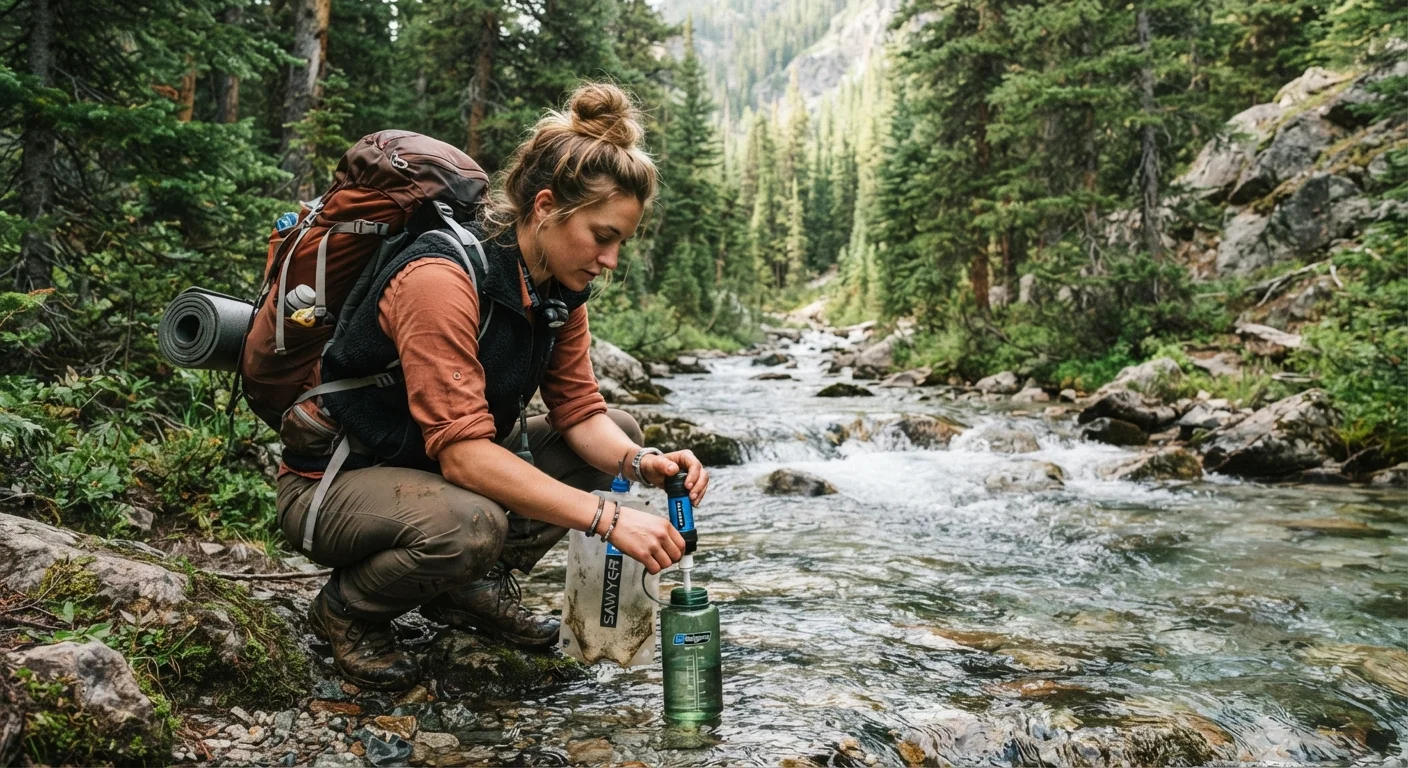
Mechanical filters — including hollow-fiber squeeze filters, pump filters, and gravity filters — physically strain pathogens out of water through tiny pores, typically rated at 0.1 to 0.2 microns. This size range captures protozoa and bacteria effectively. Viruses (roughly 0.02–0.03 microns) pass through most standard filters, which is why filters alone are not classified as purifiers.
For most backpacking in US national forests, wilderness areas, and national parks, a quality hollow-fiber filter is appropriate. These devices are durable, require no batteries, and can process significant water volumes before needing a backflush. Flow rate slows as the filter loads with sediment — pre-filtering turbid water through a bandana or coffee filter extends filter life noticeably.
Pre-Filter Murky Water First
If collecting from a cloudy or silty source, let the water settle in a container for several minutes, or pour it through a piece of tightly woven fabric before running it through your filter. Sediment and particulates clog filter membranes quickly, reducing flow rate and shortening the usable life of the device. This simple step can dramatically extend your filter's performance across a long trip.
Purifiers: When Viral Risk Matters
A purifier addresses all three pathogen categories: protozoa, bacteria, and viruses. This broader protection is achieved through two main approaches: combination filter-purifiers that add an electrostatic or chemical stage after mechanical filtration, and chemical purification (iodine, chlorine dioxide) that disinfects via chemical action alone.
Purifiers are the appropriate choice for international backcountry travel, areas near densely populated watersheds, or any destination where sanitation infrastructure is limited. If you're unsure about your destination's risk profile, checking advisories from the CDC or your local health authority before departing is a practical step — always verify current conditions with official sources.
See our trail-ready safety checklist for a broader pre-trip preparation framework.
UV Devices and Chemical Treatments: Specialized Roles
UV purification devices use ultraviolet light to destroy pathogens' DNA, rendering them unable to reproduce. They're effective against protozoa, bacteria, and viruses — but require clear water. Turbid or silty water scatters UV light, reducing effectiveness. These devices also depend on batteries or charging, making them less reliable in extended remote settings unless you carry backup power.
Chemical tablets (chlorine dioxide is the current standard) are excellent as lightweight backups. Chlorine dioxide is effective against all three pathogen categories, including Cryptosporidium, though treatment times extend to 30–60 minutes for that organism. Iodine-based tablets are less effective against Cryptosporidium and are not recommended as a primary method. Chemical treatments add minimal pack weight and have long shelf lives, making them sound emergency options.
Experienced backcountry travelers often carry a primary filter alongside chemical tablets as a redundant system — a straightforward precaution on longer or more remote trips. Our article on habits that make hikers safer covers this layered-safety mindset in more depth.
3–4 weeks
Typical onset-to-recovery time for giardiasis
According to the CDC, symptoms of Giardia infection can begin 1–3 weeks after exposure and may last several weeks without treatment.
0.1 micron
Standard hollow-fiber filter pore size
Most backpacking hollow-fiber filters use a 0.1-micron absolute pore rating, sufficient to block Giardia and bacteria but not viruses.