

Key Takeaways
Smartwatch Sensors
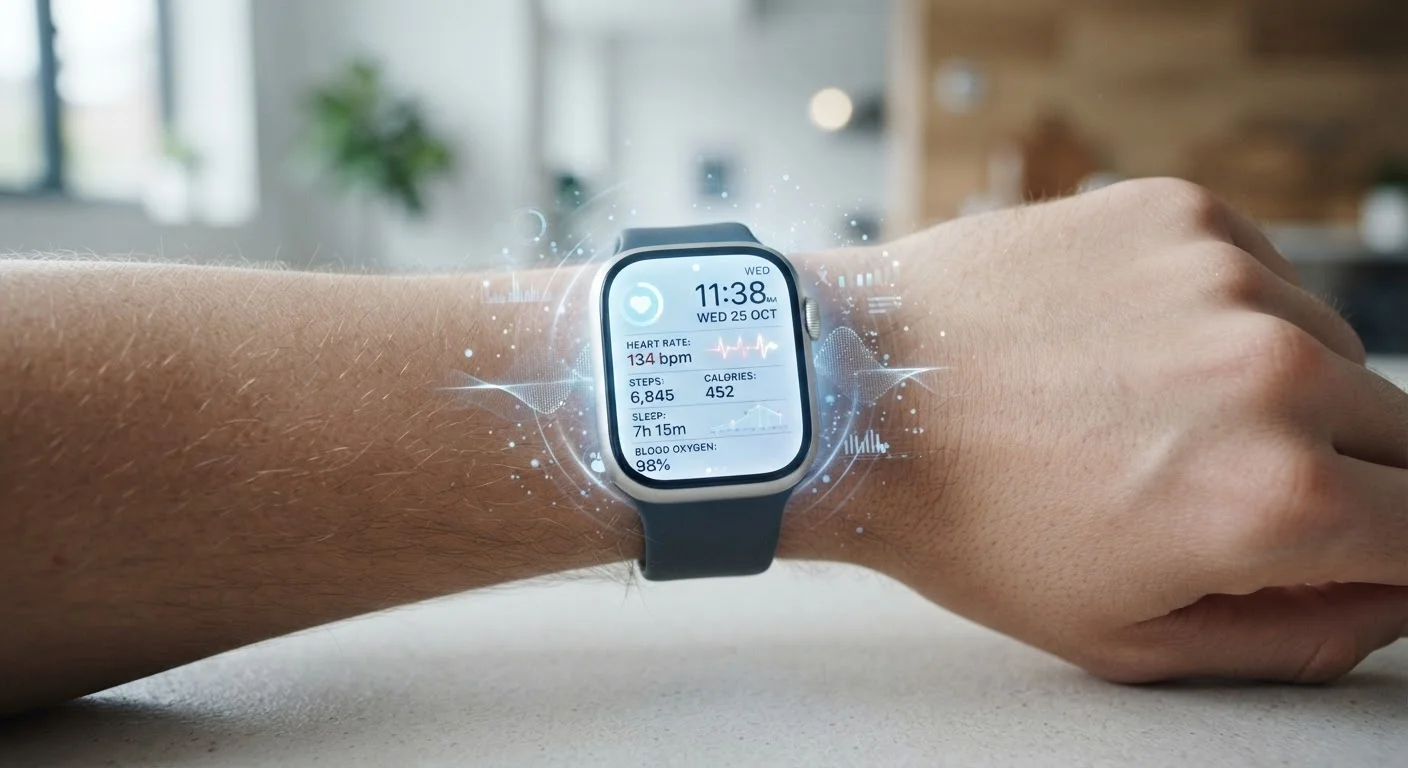
Smartwatch sensors are the small hardware components embedded in your watch that collect biological and environmental data - things like your heart rate, blood oxygen level, and physical movement. Each sensor uses a specific measurement method to capture a signal, convert it into data, and feed that data to the watch's software. What shows up on your wrist display is an interpreted reading, not a raw signal.
Most consumer smartwatch sensors operate passively and continuously, but their accuracy depends heavily on fit, skin tone, ambient light, and movement - factors that can introduce meaningful variation from clinical measurements.
The Optical Heart Rate Sensor (PPG)
The most common sensor in any smartwatch is the photoplethysmography (PPG) sensor - the green (and sometimes red and infrared) light cluster on the underside of the device. It works by shining light into your skin and measuring how much is reflected back. Blood absorbs more light when it pulses through your vessels, so the sensor detects those volume changes and calculates your heart rate from the rhythm.
PPG-based heart rate is reliable for resting and moderate-intensity tracking, but it struggles when you're moving quickly or when the watch shifts on your wrist. A tighter, consistent fit - on a flat part of your wrist, not directly over a bone - meaningfully improves accuracy.
Get a Better Heart Rate Reading
Position your watch about one finger-width above your wrist bone, snug but not cutting off circulation. During workouts, tighten the band slightly - a looser fit during vigorous movement is the most common cause of inaccurate optical heart rate readings.
SpO2: Blood Oxygen Estimation
SpO2 (peripheral oxygen saturation) uses red and infrared wavelengths of light. Oxygenated and deoxygenated blood absorb these wavelengths differently, and the sensor calculates the ratio to estimate how much of your hemoglobin is carrying oxygen. A reading of 95-100% is considered normal for most healthy adults.
The key word here is estimate. Skin tone, poor circulation, cold fingers, and motion can all affect the reading. Smartwatch SpO2 is useful for spotting trends - like a consistent overnight dip that might prompt a conversation with your doctor - but it is not equivalent to the pulse oximetry used in clinical settings.
SpO2 and Skin Tone Accuracy
Research has raised legitimate concerns that optical SpO2 sensors - both clinical and consumer - can be less accurate on people with darker skin tones, because melanin affects how light is absorbed and reflected. Device manufacturers have acknowledged this and are working on calibration improvements. Factor this in when interpreting your own readings.
ECG: When the Watch Reads Electrical Signals
Some smartwatches include an electrocardiogram (ECG) feature, which is fundamentally different from PPG. Instead of light, it measures the tiny electrical impulses that trigger your heartbeat. You typically activate it by holding a finger on a metal crown or electrode, completing a circuit across your chest. The watch records a single-lead electrical reading - useful for detecting irregular rhythms like atrial fibrillation (AFib), but far less detailed than the 12-lead ECG a cardiologist uses.
The FDA has cleared several consumer ECG features as screening tools, not diagnostic ones. If your watch flags an irregular rhythm, that's a cue to follow up with a healthcare provider - not a diagnosis in itself.
1 in 3
Adults with undiagnosed AFib who could benefit from screening
The American Heart Association has noted that atrial fibrillation often goes undetected; consumer ECG tools have been discussed as a potential aid in identifying at-risk individuals, though medical confirmation is always required.
~3%
Average heart rate error rate in PPG-based smartwatches during moderate exercise
Independent studies of consumer wearables have generally found optical heart rate monitors to be within a few percentage points of chest-strap readings during steady moderate activity, with error increasing during high-intensity movement.
GPS, Accelerometers, and Motion Sensors
Built-in GPS uses signals from satellites to calculate your position, speed, and route without relying on your phone. It's what enables accurate pace data on a run or a mapped trail hike. GPS accuracy depends on satellite visibility - it works best outdoors with a clear sky view and may drift in dense urban areas or under heavy tree cover.
The accelerometer measures changes in velocity across three axes and is the core of step counting, sleep tracking, and fall detection. Working alongside it, the gyroscope detects rotational movement, helping the device distinguish between a wave of your hand and a genuine fall. Together, these sensors also power automatic workout detection - the watch notices that your movement pattern matches a known activity and starts logging it.
For a broader look at how connected devices work together in your daily life, the complete guide to understanding your home's connected devices puts smartwatches in useful context alongside other smart hardware.
What Your Data Actually Means
Smartwatch readings are most valuable as personal trend data over time, not as single-point clinical measurements. A resting heart rate that gradually drops over several weeks of regular exercise is a meaningful signal. A single SpO2 reading of 94% at 2 a.m. is far less meaningful on its own than a pattern of consistently low overnight readings.
Understanding what these sensors measure - and where their limits lie - helps you use the data constructively rather than reactively. Much like learning to read what your apps are actually sharing, knowing what your smartwatch is actually tracking puts you in control of how you interpret and act on that information.
This article is for informational purposes only and is not medical advice. Consult a qualified healthcare professional for any personal health concerns or before making decisions based on smartwatch health data.