

Key Takeaways
Why Room-by-Room Works Better Than a Whole-Home Blitz
Pulling everything out of your entire home at once is a recipe for exhaustion and abandoned piles. The room-by-room method gives you a clear starting point, a defined finish line, and a tangible win before you move on. Each completed space builds momentum for the next.
Before you begin, gather four containers: Keep, Donate/Sell, Relocate (items that belong in another room), and Discard. Work one zone at a time, emptying surfaces and drawers before deciding what goes back. This reset approach forces an active choice about every item rather than passive acceptance of the status quo.
1 in 4
Americans with clutter-related garage issues
According to a survey by the U.S. Department of Energy, about one in four American households cannot park a car in their garage due to clutter and stored items.
40%
Housework that clutter adds on average
Research cited by the National Soap and Detergent Association has suggested that clutter is responsible for roughly 40% of the housework in an average home.
Entryway and Mudroom
The entryway is the first and last space you encounter each day - and one of the fastest to re-clutter. Focus on three categories: daily-use items (keys, bags, shoes), seasonal gear (coats, umbrellas), and items that don't belong here at all.
- Limit hooks to the number of household members, plus one spare. Remove hooks that hold items nobody reaches for.
- Keep a small tray or bowl for keys and mail only - not a catch-all for everything that comes through the door.
- Rotate seasonal items to a closet or storage area when not in active use.
If your entryway tends to absorb clutter from the rest of the house, it's worth reading our guide on managing shared spaces when household members have different organizing standards - different habits under one roof often start at the front door.
Set a Timer, Not a Mood
You don't need to feel motivated to start - you need a 20-minute block and a clear zone. Set a timer, work only the defined area, then stop. Consistent short sessions outperform infrequent marathon efforts for most households.
Kitchen and Pantry
Kitchens accumulate clutter in predictable places: the countertop, the junk drawer, and the back of the pantry. Work through each zone separately rather than the kitchen as one big task.
Countertops
Keep only appliances used at least three times a week. Everything else earns cabinet space or leaves the kitchen entirely.
Pantry and Cabinets
Check expiration dates on shelf-stable foods - most households find at least a few years' worth of expired goods. Group similar items together (grains, canned goods, snacks) so you can see what you actually have and avoid buying duplicates.
Drawers and Utensils
Remove duplicates and single-use gadgets. If a tool requires explanation before a guest can use it, question whether it earns a drawer slot.
When decluttering the pantry, group everything by category on the counter first - seeing the full quantity of any single item makes it immediately obvious what's excessive.
Organizing by category rather than by location reveals true inventory levels and prevents the common habit of buying duplicates of things you already own but can't see.
Before adding any new organizer or storage bin to a room, finish the decluttering first - buying storage for clutter just relocates the problem.
A frequent organizing mistake is purchasing containers before culling, which leads to neatly stored items that are never actually used or needed.
Living Room and Common Areas
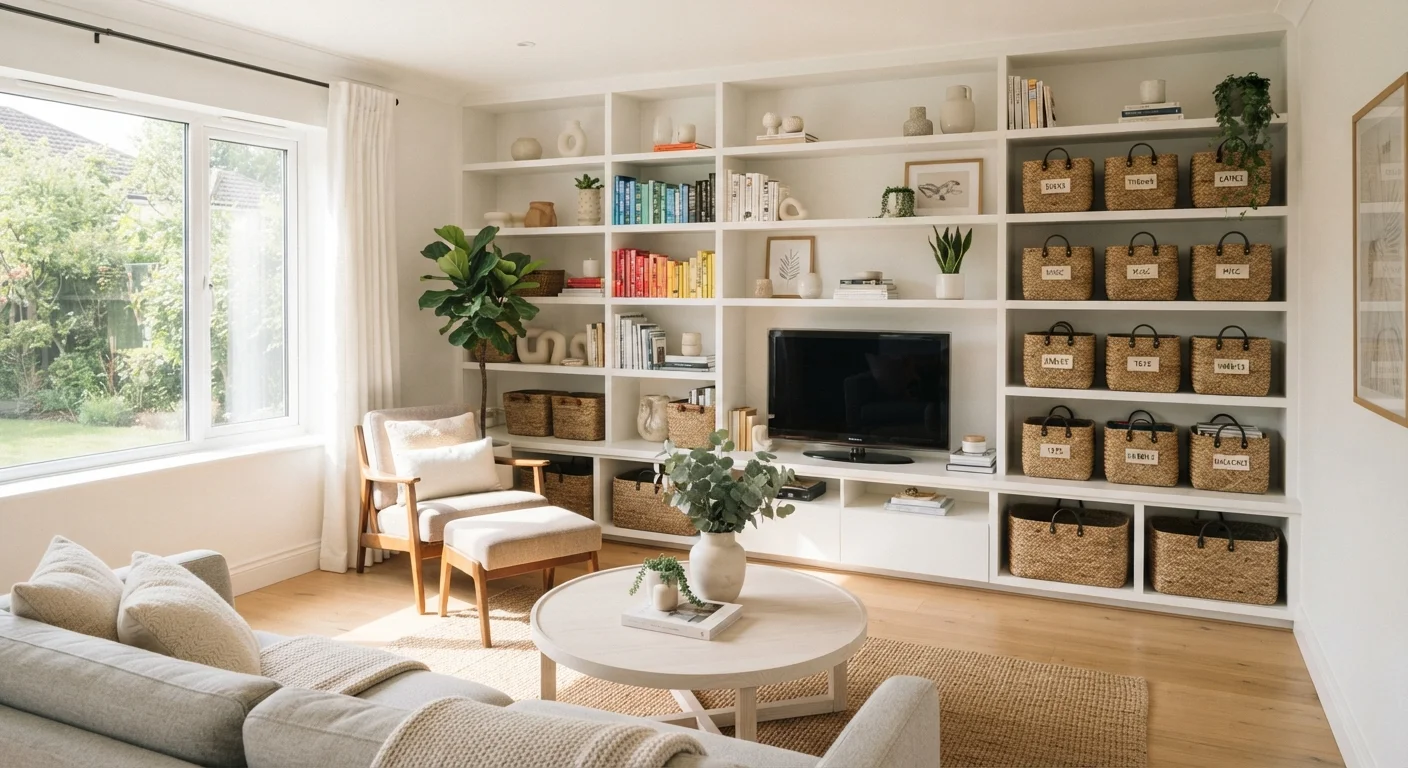
Living rooms accumulate items from every household member, which is why surface clutter tends to resurface quickly here. The goal is to create natural homes for common items so putting them away takes less effort than leaving them out.
- Media and remotes: Consolidate to a single tray or drawer. Discard remotes for devices you no longer own.
- Books and magazines: Keep a defined shelf or basket. When it's full, one item out for every new one in.
- Children's toys: Rotate toys in and out of storage rather than keeping all of them accessible - this reduces visible clutter and often re-engages kids with toys they'd tuned out.
Flat surfaces like coffee tables and media consoles are clutter magnets. Assign each surface a single purpose and enforce it consistently.
“Clutter is not just physical stuff. It's old ideas, toxic relationships, and bad habits. Clutter is anything that does not support your better self.”
— Eleanor Brownn, Author and motivational speaker
Bedrooms and Closets
Bedroom clutter is often emotional - items associated with identity, aspiration, or memory. A practical approach: evaluate items by whether they serve your current life, not a past or imagined future version of it.
For clothing, work through the closet by category (tops, bottoms, outerwear) rather than by location. Items that don't fit, haven't been worn in over a year, or require repair you've been putting off are strong candidates for donation.
If closet space is the underlying issue - not just the volume of items - our guide on organizing strategies for small closets covers how to maximize what you have.
Under-bed storage is legitimate - but only for items used seasonally, not as a secondary junk drawer. Use flat bins with lids and label them.
Bathrooms
Bathrooms are often the smallest rooms but among the most cluttered per square foot. Start by emptying every cabinet, drawer, and surface before putting anything back.
- Discard expired medications through a local drug take-back program - never flush medications unless the label specifically directs it, per FDA guidance.
- Remove duplicate products. Most households accumulate far more shampoos, lotions, and cosmetics than they'll use.
- Establish one drawer or basket per person if multiple people share a bathroom - it reduces friction and keeps individual items contained.
Dispose of Medications Safely
Do not flush unused or expired medications down the toilet or drain unless the label explicitly instructs it. The FDA recommends using authorized drug take-back programs as the preferred disposal method. Many pharmacies and local law enforcement agencies host take-back events - check DEA's website for locations near you.
Home Office and Paper Clutter
Paper is one of the most persistent forms of household clutter because it arrives daily and decisions about it are easy to defer. Set up a simple three-folder inbox: Action (needs a response or task), File (keep for reference), and Recycle/Shred. Process this inbox weekly.
For guidance on how long to keep specific documents - tax records, insurance policies, warranties - see our reference guide to paper clutter. Many documents can be scanned and stored digitally, freeing physical space while preserving access.
Digital clutter on desktops, downloads folders, and email inboxes deserves the same attention as physical paper - apply the same keep/action/discard logic.
Garage, Basement, and Storage Areas
These spaces become repositories for everything that doesn't have a clear home elsewhere. That's why they require the strictest approach: if an item is in storage because it has no other place, ask whether it needs to exist in your home at all.
Sort into zones: automotive, tools, sports and recreation, seasonal décor, and true storage (items used less than once a year). Label bins clearly. Anything without a zone assignment should be evaluated for donation or disposal.
Safety note: garages and basements frequently contain hazardous materials - old paint, solvents, pesticides, and batteries. Check with your local municipality for household hazardous waste drop-off programs rather than disposing of these items in regular trash.
If you're preparing to move and tackling these spaces under a deadline, our walkthrough on what to declutter before a move offers a prioritized checklist for exactly this situation.
Keeping the Progress Going
Decluttering is a project; staying organized is a practice. Once each room is reset, the challenge shifts from clearing to maintaining. Small consistent habits - a five-minute evening reset, a one-in-one-out rule for new purchases, a seasonal review of closets - do more long-term work than any single deep-clean session.
For the daily and weekly habits that keep organized homes from reverting, see the habits that keep organized homes organized. And when it's time for an annual check-in across every room, the annual home organization audit checklist is a structured way to catch creeping clutter before it takes hold again.
The room-by-room process you've just completed is a strong foundation - what you build on it over time is what makes it stick.