

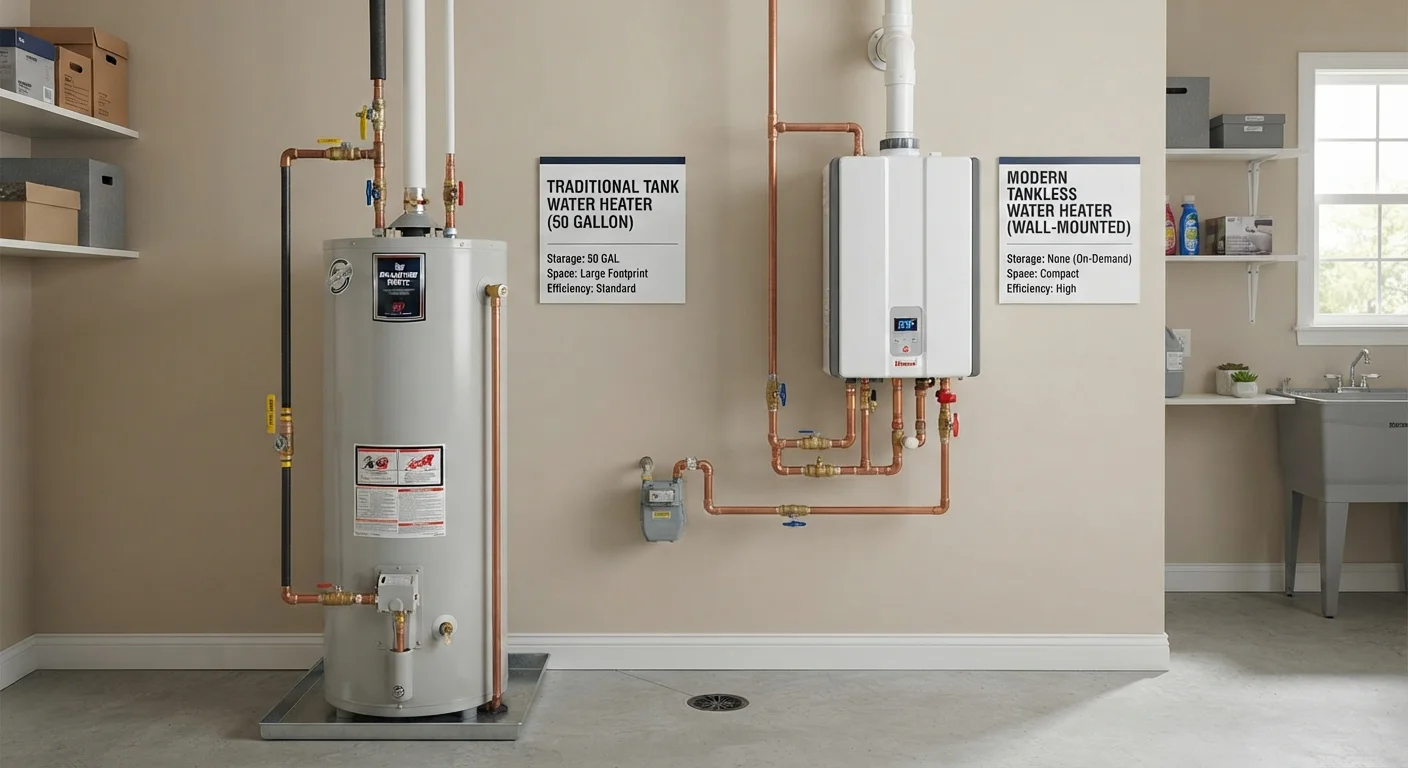
Key Takeaways
Option A
Tankless Water Heater
The on-demand, wall-mounted alternative.
Best for: Homeowners who want energy efficiency and have hard water or the budget for periodic professional servicing.
Option B
Traditional (Tank) Water Heater
The familiar, straightforward workhorse.
Best for: Homeowners seeking simple, low-cost upkeep and predictable DIY-friendly maintenance routines.
If you prefer simple, DIY-friendly upkeep
Traditional (Tank) Water Heater
Flushing sediment, testing the pressure-relief valve, and replacing the anode rod are tasks most handy homeowners can handle without specialized tools or training.
If long-term energy savings are your priority
Tankless Water Heater
Tankless units heat water only on demand, which can reduce energy consumption - provided the unit is serviced regularly to maintain efficiency.
If you live in an area with very hard water
Traditional (Tank) Water Heater
Hard water accelerates scale buildup inside tankless heat exchangers, increasing servicing frequency and cost; tank units are generally more forgiving with basic flushing.
If you want the longest possible unit lifespan
Tankless Water Heater
Well-maintained tankless heaters can last 20 years or more, compared to a typical 8-12 year lifespan for traditional tank models.
How Each System Works - and Why It Matters for Maintenance
Understanding what happens inside each type of water heater clarifies why their maintenance needs differ so sharply. A traditional tank water heater stores a large volume of water - commonly 40 to 80 gallons - and keeps it heated continuously. Sediment naturally settles at the bottom of the tank over time, and a sacrificial anode rod slowly corrodes to protect the tank lining from rust.
A tankless (on-demand) water heater heats water instantly as it flows through a heat exchanger - there's no stored supply. Because water flows through narrow internal passages at high temperatures, mineral scale from hard water builds up faster and in more concentrated areas than in a tank unit.
Both systems are vulnerable to the same underlying culprits - sediment, scale, and corrosion - but the design differences mean those threats manifest differently and call for different responses. As with most home systems, a little consistent upkeep prevents much larger problems. See our guide to common water heater maintenance mistakes for a broader look at what gets overlooked.
Maintenance Tasks Compared: Side by Side
The table below summarizes the core maintenance tasks for each type, giving you a clear picture of what you'll need to do - and how often.
| Criterion | Tankless Water Heater | Traditional Tank Water Heater |
|---|---|---|
| Primary maintenance task | Annual descaling of heat exchanger | Annual tank flush to remove sediment |
| Anode rod inspection | Not applicable | Every 2-3 years; replace when depleted |
| Pressure-relief valve test | Annual | Annual |
| Filter cleaning (inlet screen) | Every 6-12 months | Not typically required |
| Hard-water impact | High - scale clogs heat exchanger quickly | Moderate - sediment builds at tank bottom |
| DIY-friendliness | Moderate to low - often needs a technician | High - most tasks manageable for DIYers |
| Typical unit lifespan | Up to 20+ years with proper upkeep | 8-12 years with regular maintenance |
One important distinction: most tankless maintenance tasks, particularly descaling, require either a flush kit and some plumbing familiarity or a qualified technician. Traditional tank maintenance is more accessible for general DIYers, though tasks like anode rod inspection still require turning off the water supply and working around hot components - always follow safety precautions or hire a plumber if you're uncertain. Our guide on DIY vs. professional plumbing repairs can help you gauge your comfort level.
The Hard Water Factor
Water hardness - the concentration of dissolved calcium and magnesium - is arguably the single biggest variable in water heater maintenance planning. Hard water accelerates scale buildup in both systems, but tankless units are more immediately affected because scale clogs narrow heat-exchanger channels, reducing flow and efficiency quickly.
85%
US homes affected by hard or very hard water
According to the U.S. Geological Survey, approximately 85% of American homes receive hard water, making scale management a widespread maintenance concern.
20+ years
Potential lifespan of a well-maintained tankless unit
Industry guidance generally cites 20 years or more as achievable for tankless heaters that receive consistent annual servicing.
8-12 years
Average lifespan of a traditional tank water heater
The U.S. Department of Energy notes that conventional storage water heaters typically last between 8 and 12 years under normal use and maintenance conditions.
If your home has hard water (common across much of the Midwest, Southwest, and parts of the South), tankless units may need descaling twice a year rather than annually. A water softener or a dedicated pre-filter can reduce this burden significantly. For traditional tank heaters in hard-water areas, flushing every six months rather than annually helps prevent a thick layer of sediment from hardening at the bottom - which can become difficult to remove and insulates the burner, wasting energy.
Check with your local water utility if you're unsure of your water hardness level; many publish water quality reports annually. Incorporating water heater maintenance into a broader seasonal schedule is also a practical approach - our seasonal home maintenance guide maps out when to tackle these tasks throughout the year.
Lifespan, Cost of Upkeep, and When to Call a Professional
Traditional tank heaters typically last 8-12 years with routine care. Tankless units, when properly maintained, can last 20 years or more - but that longevity depends heavily on consistent servicing. Deferred maintenance on a tankless unit often shortens that advantage considerably.
The cost of upkeep also differs. For tank heaters, DIY flushing costs almost nothing beyond your time; anode rod replacement is an inexpensive part. For tankless units, professional descaling service typically runs higher due to the time and specialized equipment involved, and some manufacturers recommend annual service by a certified technician to preserve the warranty.
When to Call a Licensed Plumber
Any task involving gas line connections, significant water pressure changes, or unfamiliar electrical components should be handled by a licensed plumber or qualified technician. This applies to both tankless and tank-style units. Many municipalities also require permits for water heater replacement - always verify local code requirements before undertaking major work. When in doubt, a professional inspection is a worthwhile investment.
If you're new to owning a home and still building a maintenance routine, both water heater types fit within a broader system of regular upkeep. Our home maintenance guide for first-time owners is a useful starting point for understanding all the systems you'll need to monitor. Think of water heater care - whatever type you have - as a small, regular investment that protects a major household appliance.