

Why Right-of-Way Rules Trip Up Even Careful Drivers
Right-of-way rules exist to prevent collisions at every point where vehicle paths cross. The problem is that many of these rules are counterintuitive, inconsistently taught across states, and rarely reinforced after a driver's test. The result: well-meaning drivers operating on habit and guesswork instead of actual law.
This reference breaks down the situations that generate the most confusion - four-way stops, uncontrolled intersections, roundabouts, and merge scenarios - so you can make legally correct, predictable decisions. Understanding these rules also ties directly into broader safe-driving habits, like proper lane discipline and hazard awareness covered in our guide on highway vs. city driving skills.
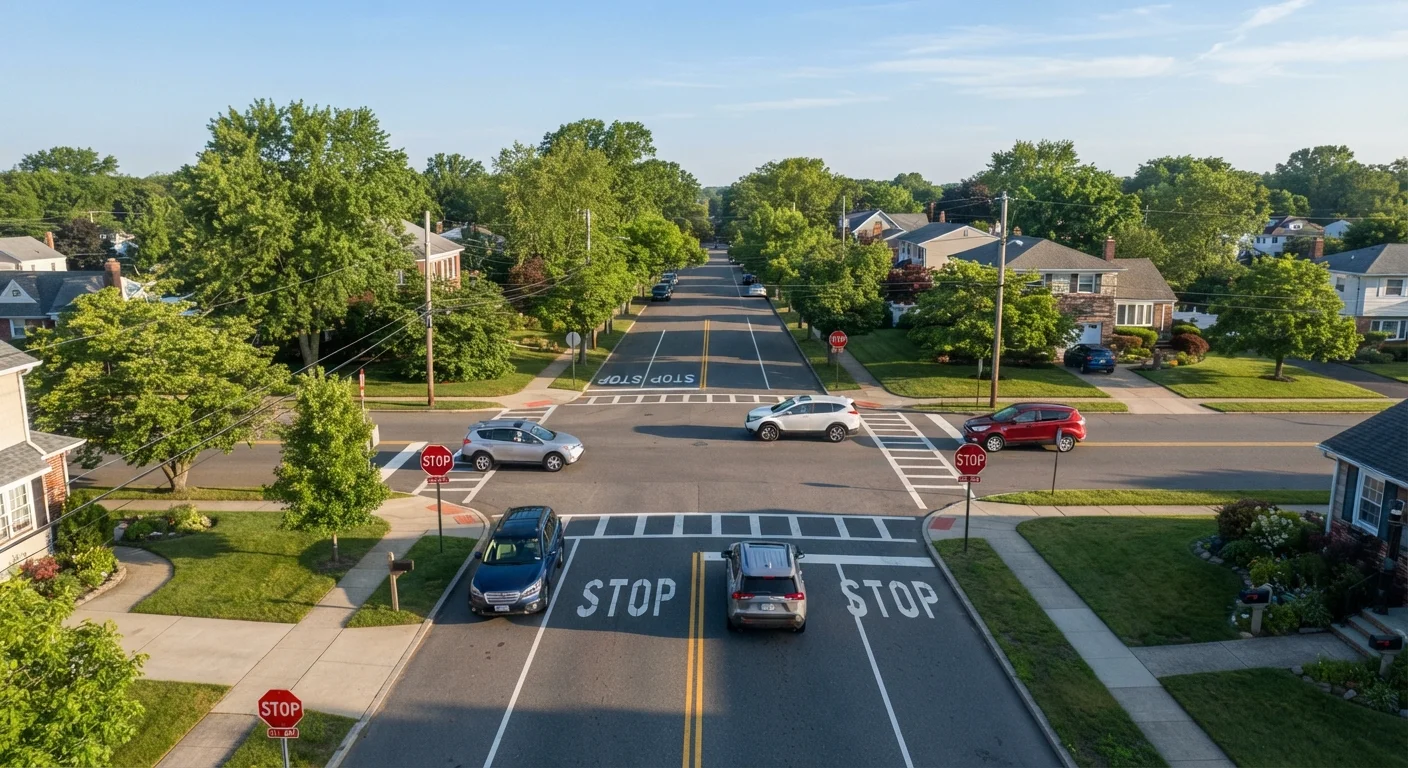
Four-Way Stops: The Priority Order Explained
Four-way stops follow a clear hierarchy, though drivers often misapply it under pressure:
- First to stop, first to go. The vehicle that came to a complete stop first has priority. If you arrived before the driver across from you, you proceed first.
- Simultaneous arrival: yield to the right. If two vehicles stop at the same time, the driver on the left yields to the driver on the right. This applies regardless of the direction each intends to travel.
- Simultaneous arrival facing each other: straight or right beats left turns. When two cars arrive at the same time directly across from each other, the one going straight or turning right has priority over the one turning left. The left-turning driver must wait for oncoming traffic to clear.
- Three-vehicle ties are rare but resolved the same way - each driver yields to the vehicle on their right, working around the stop in turn.
The most common error at four-way stops is waving other drivers through out of politeness. This creates unpredictability. Follow the rule, not the gesture.
Right-of-way
The legal right of one driver, cyclist, or pedestrian to proceed before others in a given situation. It is granted by law, not negotiated on the spot.
Uncontrolled intersection
An intersection with no traffic signs or signals governing any approach. Drivers must use the yield-to-the-right rule and existing traffic priority.
T-intersection
A junction where one road ends and meets another at a right angle, forming a T shape. The terminating road always yields to the through-road.
Roundabout
A circular, one-way intersection where traffic flows continuously around a central island. Entering drivers yield to vehicles already circulating inside.
Move Over law
Legislation requiring drivers to change lanes away from, or reduce speed near, stationary emergency, utility, or maintenance vehicles on the roadside. All 50 US states have enacted a version of this law.
Uncontrolled Intersections and T-Intersections
An uncontrolled intersection has no stop sign, yield sign, or traffic signal for any approach. These appear frequently in residential areas and rural roads. The general rule: yield to vehicles already in the intersection, and if no one is there, yield to the driver on your right.
At a T-intersection - where a road ends and meets a through-road - drivers on the terminating road must always yield to through-traffic. This rule holds even when no signage is present. The through-road has right-of-way by default.
A common misconception: many drivers assume the larger or faster road always has priority. That assumption can be dangerous. The legally correct behavior is to treat any unmarked intersection as a yield situation and look both ways before proceeding, regardless of road size.
Roundabouts, Merge Situations, and Emergency Vehicles
Roundabouts: Traffic already inside the roundabout always has right-of-way. Entering drivers yield to circulating traffic, then proceed when there is a clear gap. Do not stop inside the roundabout unless traffic forces it - stopping disrupts flow and increases rear-end risk.
Highway merges: The vehicle on the highway (the through-lane) generally has right-of-way over the merging vehicle. However, cooperative merging - where highway drivers adjust speed to allow safe entry - is both legal in most states and safer for everyone. See our detailed breakdown on merging onto a highway without creating a hazard for technique and timing.
Emergency vehicles: Federal and state laws require drivers to pull to the right and stop when an emergency vehicle with active lights and sirens approaches from any direction. In most states, this also applies when you are in an intersection - clear it first, then pull over. The Move Over law, now active in all 50 states, requires drivers to change lanes or slow down when passing stationary emergency, utility, or maintenance vehicles on the roadside.
For drivers who want to sharpen their overall situational awareness, reviewing blind spot and head-check technique is a natural complement to understanding right-of-way - both depend on knowing where other vehicles are before you act.