

Key Takeaways
Why Battery Warnings Are Easy to Miss
A car battery rarely fails all at once. It degrades gradually, and the early signals are subtle enough that most drivers chalk them up to cold weather, a fluke, or just "one of those days." By the time the engine refuses to turn over in a parking lot, the battery has usually been signaling distress for weeks - sometimes months.
The good news: you don't need a mechanic's expertise to spot the common warning signs. Most are things you can notice during a normal morning start or a quick look under the hood. Knowing what to watch for gives you time to act on your terms rather than the battery's.
Check Your Battery Before Road Trips
Long drives put sustained demands on your electrical system, especially if you're running GPS, phone chargers, and climate control simultaneously. Before any extended trip, take five minutes to inspect the battery terminals for corrosion and consider a quick voltage check. Catching a marginal battery at home is far less stressful than discovering it fails at a highway rest stop two states away.
If you're already paying attention to dashboard warnings, check out our guide on what your car's warning lights are actually telling you - the battery light has specific triggers worth understanding.
Warning Signs to Watch For
Slow or labored engine crank
When you turn the key or press the start button, the starter motor draws a large burst of current from the battery. If the engine turns over slowly - a dragging, sluggish sound rather than a crisp, quick start - the battery is struggling to deliver that current. This is one of the earliest and most consistent symptoms of a weakening battery, especially noticeable on cold mornings when battery output naturally drops.
A dragging, sluggish crank is the battery's most consistent early distress signal.
Headlights that dim at idle
Your alternator recharges the battery while the engine runs, but a deteriorating battery has trouble holding that charge. One telltale sign: headlights or interior lights that appear noticeably dimmer when the engine is idling compared to when you rev it slightly. If brightness visibly shifts with engine speed, the battery isn't maintaining consistent voltage - a sign its capacity has declined.
Lights that dim at idle suggest the battery can no longer hold a steady charge.
Frequent need for jump-starts
A single jump-start after leaving your lights on overnight is a user error, not a battery problem. But if you've needed a jump-start twice or more without an obvious cause - no lights left on, no accessories running - the battery is failing to hold enough charge between drives. Needing repeat jump-starts is a clear signal the battery has moved past its useful service life.
Repeated unexplained jump-starts are a reliable sign the battery has passed its useful life.
Battery age beyond three to five years
Most conventional lead-acid car batteries are designed to last roughly three to five years under normal driving conditions. Extreme heat, frequent short trips, and parasitic electrical loads can shorten that lifespan further. If your battery is approaching or has passed the four-year mark, treat it as a maintenance item worth monitoring closely - even without obvious symptoms. Many auto parts stores will test a battery for free.
After four years, even a symptom-free battery deserves a professional load test.
Corrosion on the terminals
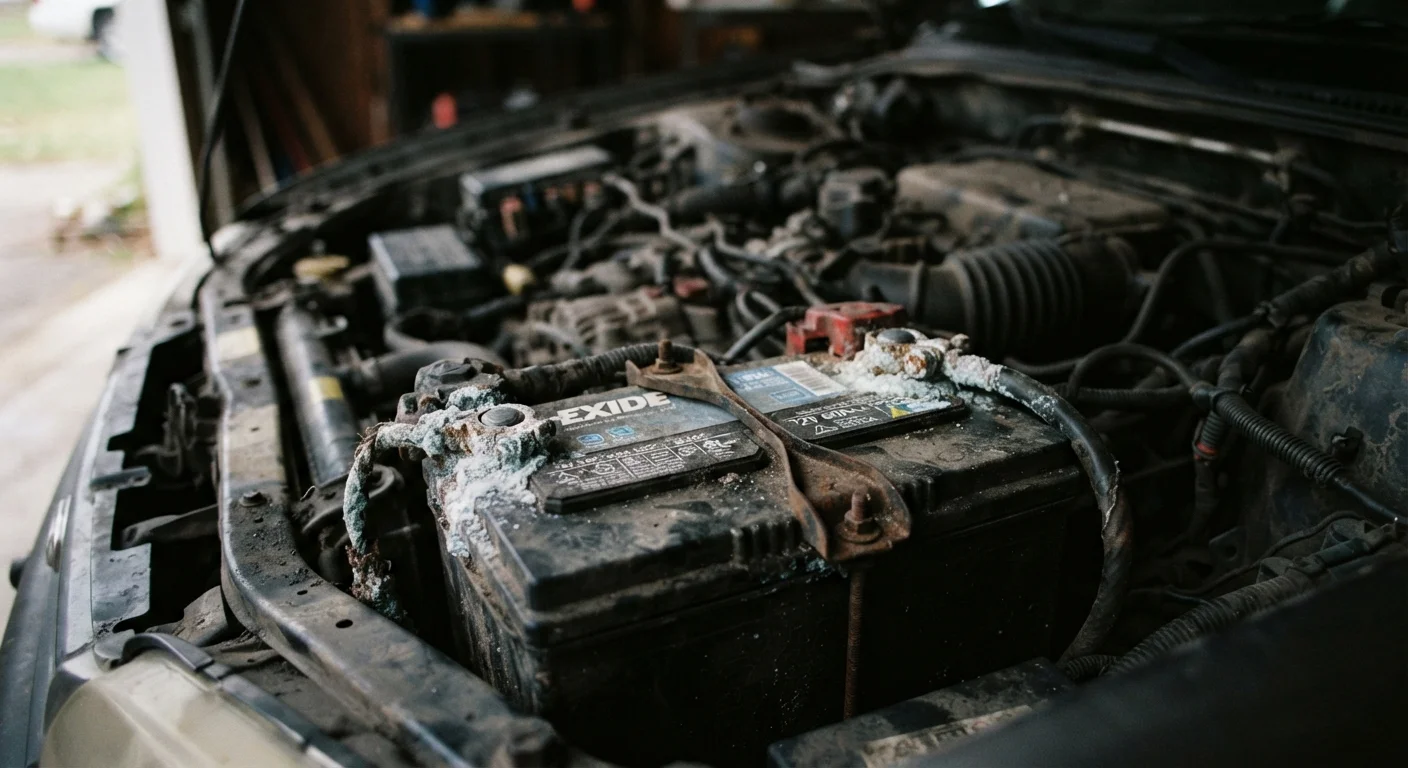
White or bluish-gray crusty buildup around the battery terminals is a sign of off-gassing - a natural but accelerated process when a battery is aging or slightly overcharging. Moderate terminal corrosion can be cleaned and may not indicate imminent failure on its own, but heavy or recurring buildup often signals the battery is nearing the end of its service life. It's also worth checking that terminals are tight, since a loose connection can mimic battery failure symptoms.
Heavy or recurring terminal corrosion often accompanies a battery nearing the end of its life.
A swollen or misshapen battery case
A battery case that looks bloated, bulging, or warped has been exposed to excessive heat - common in climates with very high summer temperatures. Swelling is a physical sign that internal damage has occurred, and a swollen battery should be inspected by a qualified mechanic promptly. Do not attempt to test or handle a visibly damaged battery without proper precautions; battery acid is corrosive and poses a safety risk.
A swollen battery case signals internal heat damage - have it inspected by a professional promptly.
Low resting voltage on a multimeter
A fully charged 12-volt lead-acid battery should read approximately 12.6 volts at rest - meaning the engine has been off for at least an hour. A reading below 12.4 volts suggests the battery isn't holding a full charge; below 12.0 volts indicates a significantly discharged or failing battery. A basic digital multimeter costs under $20 at most hardware stores and gives you a quick, objective snapshot of battery health you can check yourself in under two minutes.
A resting voltage below 12.4 volts is an objective sign the battery is losing capacity.
What to Do Once You Spot the Signs
Identifying a warning sign doesn't mean the battery is dead yet - it means you have a window to act. A qualified mechanic or auto parts store can perform a load test, which checks how the battery holds up under real demand rather than just measuring resting voltage. This gives a more accurate picture of remaining life than a voltage reading alone.
If your battery is more than four years old and showing even one of the signs above, replacement is worth factoring into your near-term maintenance budget. And before any extended driving, consider running through a full pre-trip check - our guide to preparing your car for a long road trip covers battery health alongside the other systems most likely to cause trouble far from home.
When to Involve a Qualified Mechanic
Battery replacement is a task many experienced DIYers handle themselves, but some modern vehicles - particularly those with advanced stop-start systems or complex battery management electronics - require a mechanic to register the new battery to the vehicle's computer. Skipping this step can cause charging irregularities or trigger warning lights. If you're unsure whether your vehicle has these requirements, ask a qualified technician before replacing the battery yourself.