

Key Takeaways
Why a Maintenance Log Is More Than a Paper Trail
Most drivers think of a service history as something that matters only at resale time. In reality, a well-kept maintenance log is a diagnostic tool, a budgeting aid, and a warranty safeguard - all at once. It gives you a factual record to reference when a symptom reappears, when a shop recommends a service you're not sure you need, or when you want to verify that a previous owner actually maintained the vehicle they're selling you.
Third-party vehicle history reports capture some of this picture, but they have real limitations. As covered in what a vehicle history report actually tells you and what it misses, many routine services - oil changes, brake work, fluid flushes - never appear in those databases at all. Your own log fills exactly those gaps.
The financial case is just as clear. Deferred or missed maintenance has a compounding cost, a pattern explored in why skipping routine maintenance costs more than the service itself. A log makes it harder to lose track of what's overdue.
What to Record and How to Structure It
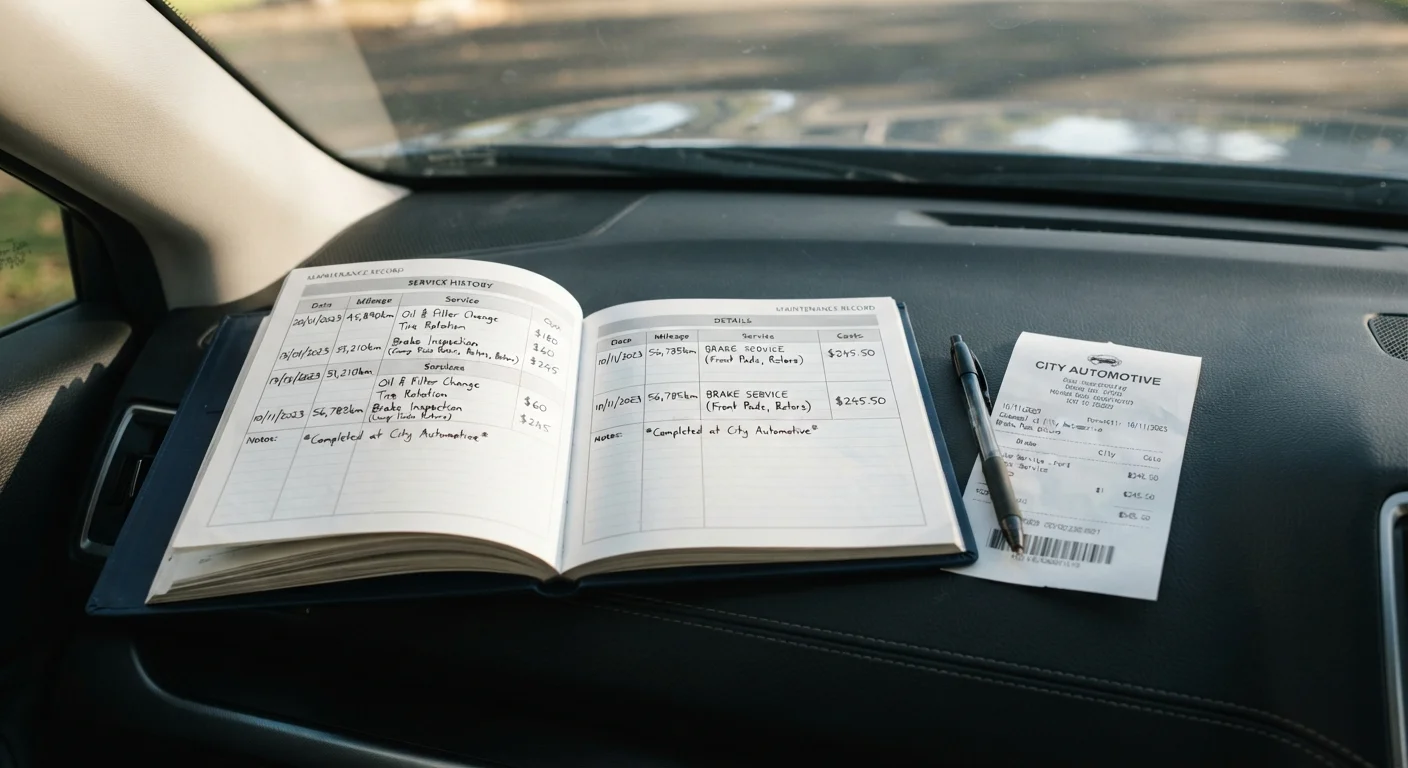
A useful log doesn't require a special format - it requires consistent, complete entries. Every service event should capture five things: the date, the odometer reading, a plain-language description of what was done, the cost, and who performed the work (you, a shop, or a dealer). That combination lets you calculate service intervals accurately, track spending over time, and verify work against your owner's manual schedule.
Paper vs. Digital: Both Work
There is no single correct format for a maintenance log. A simple spiral notebook kept in your glove box, a spreadsheet on your phone, or a dedicated app all accomplish the same goal. The format that you will actually use consistently is the right one. If you switch methods, transfer your historical entries so the record stays complete.
For guidance on what intervals actually apply to your vehicle, understanding your car's scheduled maintenance intervals explains how to read your owner's manual service schedule and why mileage alone isn't always the deciding factor.
Record every service event at the time it happens, not weeks later.
Memory degrades quickly, and approximate dates or mileage reduce the log's usefulness. A timely entry ensures accuracy and prevents gaps that undermine the record's credibility when you need it most.
Include mileage, date, service description, cost, and who performed the work.
These five data points let you reconstruct a complete service timeline, calculate intervals accurately, and verify warranty compliance. Omitting cost data, for instance, makes it harder to budget for future maintenance cycles.
Keep all physical receipts clipped or folded inside the logbook.
Receipts corroborate your entries and provide part numbers, technician notes, and warranty details that a summary entry cannot capture. They also serve as independent evidence if a repair dispute arises.
Note any symptoms or observations, not just completed services.
Patterns in vehicle behavior - a subtle vibration at highway speed, an occasional hard start in cold weather - are far easier to diagnose when a mechanic can see a dated timeline of when they began. Symptom notes can also help rule out causes during diagnosis.
Review your log before each scheduled service appointment.
A quick review helps you confirm what is actually due versus what the shop's default service menu suggests, and surfaces any unresolved symptoms or parts approaching end-of-life. It puts you in a more informed position during the service conversation.
Transfer the log when selling the vehicle.
A documented service history is one of the most verifiable signals of responsible ownership a private seller can offer. It supplements - and fills gaps in - what any third-party report can show.
Turning Your Log Into a Working Habit
The most common reason maintenance logs fail is inconsistency, not format. Starting strong and then abandoning the log after a few entries produces a record full of gaps - which is only marginally more useful than no record at all. The practices below are designed to be low-friction and quick, so the habit sticks regardless of how busy life gets.
If you handle any maintenance tasks yourself, those entries matter just as much as shop visits. Understanding which jobs are reasonable to DIY and which require a professional bay is a related decision - DIY car maintenance vs. taking it to a shop lays out that distinction clearly. Either way, log it.
“The best time to start a maintenance log is when you buy the car. The second best time is today.”
— Autos Editorial Team, Consumer automotive guidance team
Over time, your log becomes a personal maintenance profile for that specific vehicle - something no generic service reminder or app notification can replicate. It reflects your driving patterns, your local conditions, and your actual service history, not an averaged estimate.