

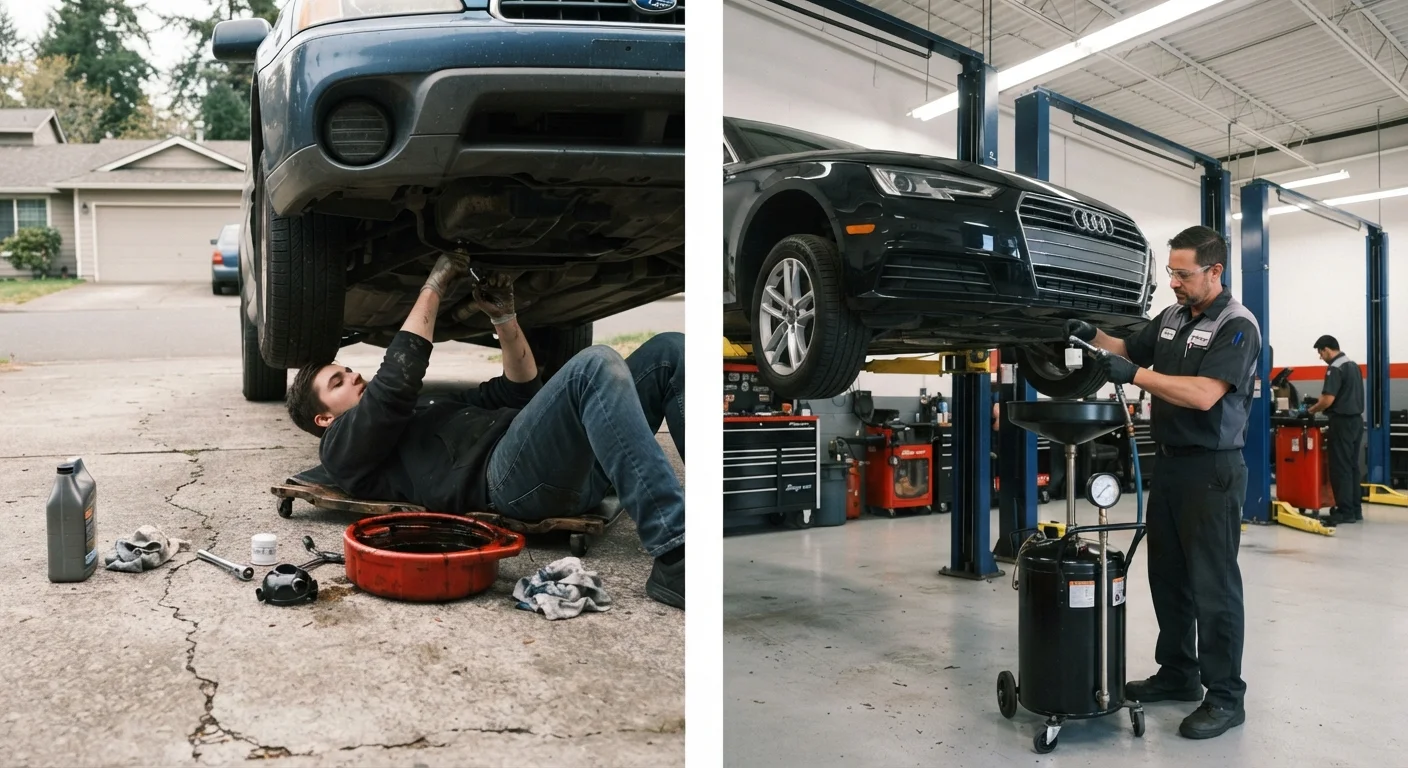
Key Takeaways
Eliminates labor costs on straightforward tasks
Labor often accounts for 50-70% of a basic service bill. Handling simple jobs yourself keeps that money in your pocket without requiring specialized skills.
Builds mechanical familiarity with your vehicle
Regularly checking fluids and inspecting filters gives you a baseline understanding of your car's condition, making it easier to spot developing issues early.
Flexible scheduling with no appointment needed
You work on your own timeline - useful when a shop has a week-long wait or when a minor issue appears the night before a trip.
Satisfaction and confidence in ownership
Completing a maintenance task correctly builds competence and reduces the anxiety of not knowing what's happening under the hood.
Safety risks on complex or critical systems
Errors on brakes, suspension, or fuel systems can have serious consequences. Unlike a stripped drain plug, a brake line improperly reconnected presents a direct safety hazard.
Upfront tool and equipment costs
Basic DIY capability requires a minimum set of quality tools. For infrequent tasks, renting or paying a shop may be more economical than purchasing specialized equipment.
Potential for voiding manufacturer warranties
Using non-OEM parts or incorrect fluid specifications on a vehicle under warranty can complicate claims, though federal law (the Magnuson-Moss Warranty Act) does offer some protections for owners.
Diagnostic limitations without shop equipment
A basic OBD-II reader can pull fault codes, but professional shops have bidirectional scan tools and data logging capabilities that reveal far more about a vehicle's health.
Risk of compounding the original problem
Misdiagnosing an issue and addressing the wrong component wastes money and time, while potentially masking the real problem until it becomes more serious.
Our Verdict
DIY maintenance makes sense for routine, low-risk tasks where the tools are affordable and the consequences of a mistake are minor. For anything that touches braking, steering, fuel, or emissions systems, the professional shop is the safer and often more cost-effective choice when you account for the risk of errors.
Drivers who are comfortable with basic mechanical work, have access to proper tools, and are willing to research their specific vehicle before starting a job.
Where the DIY Case Is Strongest
Certain maintenance tasks are genuinely straightforward - designed to be owner-serviceable - and tackling them yourself can cut labor charges that often exceed the cost of the part itself. The following jobs are commonly completed by everyday drivers with basic tools and a reliable how-to source:
- Engine air filter replacement: Usually a clip or two and no tools required. Most vehicles have filters accessible within minutes.
- Wiper blade replacement: Blades are standardized, instructions are on the packaging, and the job takes under five minutes.
- Fluid top-offs: Windshield washer fluid, coolant (when cold), and power steering fluid are straightforward checks. Consult your owner's manual for specifications.
- Battery terminal cleaning: A wire brush, baking soda, and water handle mild corrosion. Disconnect negative before positive.
- Cabin air filter swap: Often behind the glove box; typically requires no tools and takes less than ten minutes.
These tasks share a common trait: the margin for error is low, and a mistake is unlikely to compromise safety. Before diving in, cross-reference your owner's manual - and don't overlook common maintenance myths that might shape how you approach even simple jobs.
Eliminates labor costs on straightforward tasks
Labor often accounts for 50-70% of a basic service bill. Handling simple jobs yourself keeps that money in your pocket without requiring specialized skills.
Builds mechanical familiarity with your vehicle
Regularly checking fluids and inspecting filters gives you a baseline understanding of your car's condition, making it easier to spot developing issues early.
Flexible scheduling with no appointment needed
You work on your own timeline - useful when a shop has a week-long wait or when a minor issue appears the night before a trip.
Satisfaction and confidence in ownership
Completing a maintenance task correctly builds competence and reduces the anxiety of not knowing what's happening under the hood.
Jobs That Belong in a Professional Bay
Some repairs look approachable on a video tutorial but carry real consequences if done incorrectly. A DIY brake job performed without the right equipment or know-how can lead to brake fade or failure - not an outcome worth the labor savings. These categories warrant professional handling:
- Brake system work: Replacing pads is manageable for some experienced DIYers, but calipers, brake lines, ABS sensors, and bleeding the system introduce serious safety stakes.
- Suspension and steering components: Alignment, ball joints, and tie rod ends require precision equipment that home mechanics rarely have.
- Timing belt or chain service: An error here can cause catastrophic engine damage. Labor is intensive and the tolerance for mistakes is zero.
- Transmission service: Beyond a fluid drain-and-fill on some models, transmission work requires specialized knowledge and tools.
- ADAS calibration (Advanced Driver Assistance Systems): Modern vehicles with lane-keep assist, radar cruise control, and collision warning sensors require shop-level calibration equipment after even minor repairs.
Professional shops also provide documentation - useful if you plan to keep an accurate service log or if warranty questions arise later.
Safety risks on complex or critical systems
Errors on brakes, suspension, or fuel systems can have serious consequences. Unlike a stripped drain plug, a brake line improperly reconnected presents a direct safety hazard.
Upfront tool and equipment costs
Basic DIY capability requires a minimum set of quality tools. For infrequent tasks, renting or paying a shop may be more economical than purchasing specialized equipment.
Potential for voiding manufacturer warranties
Using non-OEM parts or incorrect fluid specifications on a vehicle under warranty can complicate claims, though federal law (the Magnuson-Moss Warranty Act) does offer some protections for owners.
Diagnostic limitations without shop equipment
A basic OBD-II reader can pull fault codes, but professional shops have bidirectional scan tools and data logging capabilities that reveal far more about a vehicle's health.
Risk of compounding the original problem
Misdiagnosing an issue and addressing the wrong component wastes money and time, while potentially masking the real problem until it becomes more serious.
The Real Cost Equation
The appeal of DIY is often framed as saving money, but the math deserves a closer look. Labor rates at independent shops typically range from $80 to $150 per hour, and dealerships run higher - so skipping an hour of labor on an oil change can add up across a year. However, consider the full picture:
~$400
Estimated annual DIY savings on basic maintenance
Consumer automotive research suggests drivers who handle their own oil changes, filters, and fluids can save several hundred dollars annually compared to shop pricing.
$80-$150/hr
Typical independent shop labor rate in the US
Labor rates vary significantly by region and shop type; dealership rates commonly exceed this range, making labor the dominant cost in many service visits.
- Tool investment: A quality floor jack, jack stands, torque wrench, and OBD-II scanner represent upfront costs that take time to recoup.
- Warranty implications: Using non-approved fluids or incorrect parts on a vehicle under manufacturer warranty can create complications. Keep receipts and use spec-compliant products.
- Mistake costs: A stripped drain plug, a misrouted belt, or an improperly torqued wheel lug can create repair bills that far exceed what you saved.
The smarter framework is not "DIY vs. shop" as a blanket rule, but rather a task-by-task assessment. Deferred maintenance of any kind - whether DIY or professional - tends to compound costs over time. Understanding your vehicle's scheduled maintenance intervals is the starting point for making that call wisely.
Know Before You Wrench
Always consult your vehicle's owner's manual before starting any maintenance task - not just a generic tutorial. Fluid types, torque specs, and filter part numbers vary significantly across makes, models, and model years. Using the wrong specification, even on a simple job, can create problems that a correct procedure would have avoided. Your manual is the authoritative source for your specific vehicle.