

Key Takeaways
Credit Score
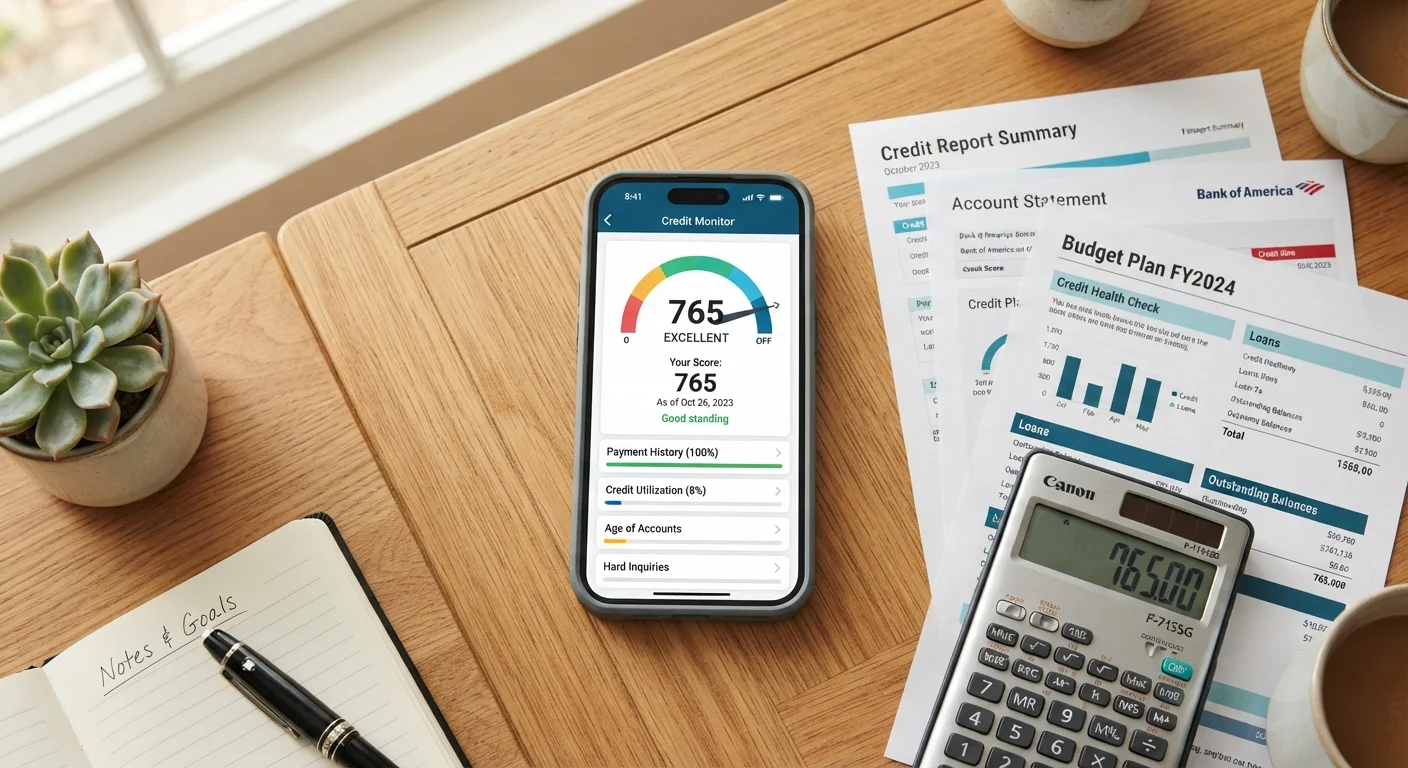
A credit score is a three-digit number, typically ranging from 300 to 850, that summarizes how reliably you've managed borrowed money over time. Lenders use it to quickly estimate the risk of lending to you. The higher your score, the more likely lenders consider you to repay on time.
The most widely used scoring model in the U.S. is the FICO® Score, though lenders may also use VantageScore. Each model weighs the same core data slightly differently, which is why your score can vary across sources.
What a Credit Score Actually Is
Think of a credit score as a snapshot, not a biography. It's calculated from data in your credit report at a specific moment in time, and it answers one narrow question for a lender: based on how you've handled credit in the past, how likely are you to repay a new debt on time?
The score doesn't know your salary, your savings account balance, or whether you're good with money in any broader sense. It only reflects what shows up in your credit file - accounts, balances, payment history, and a handful of other borrowing behaviors. For a fuller picture of what that underlying data looks like, see our walkthrough of a standard credit report.
If you're entirely new to this territory, our plain-language introduction to debt and credit covers the foundational concepts first.
The Five Factors Behind the Number
FICO, the most commonly used scoring model, breaks a score into five weighted categories. Understanding them helps you see which levers actually move the needle.
35%
Weight of payment history in a FICO Score
According to FICO's published scoring model breakdown, payment history is the single largest factor in calculating your score.
300-850
Standard FICO Score range
FICO Scores range from 300 to 850; higher scores reflect lower predicted credit risk according to FICO's methodology.
30%
Weight of amounts owed (utilization)
FICO's published guidelines indicate that how much revolving credit you're using relative to your limits is the second most influential scoring factor.
1. Payment History (≈35%)
This is the biggest slice. Every on-time payment you make reinforces your score; every late or missed payment chips away at it. A single 30-day late payment can noticeably drop a score that was previously strong, and the damage lingers on your report for up to seven years.
2. Amounts Owed / Credit Utilization (≈30%)
This measures how much of your available revolving credit - mostly credit cards - you're currently using. Using a large portion of your limit signals financial strain to lenders, even if you pay your bill in full each month. Keeping this ratio low is widely considered good practice. Learn how utilization is calculated across all your accounts.
3. Length of Credit History (≈15%)
Older accounts and a longer average account age generally help your score. This is why financial educators often suggest keeping old accounts open even if you rarely use them.
4. Credit Mix (≈10%)
Lenders like to see that you can handle different types of credit responsibly - revolving accounts like credit cards alongside installment loans like auto or student loans. You don't need every type, but a mix can provide a modest boost.
5. New Credit / Hard Inquiries (≈10%)
Applying for new credit triggers a hard inquiry, which can temporarily dip your score by a few points. Multiple applications in a short period can signal risk. Rate-shopping for a mortgage or auto loan within a short window is typically counted as a single inquiry by most scoring models.
What Your Score Doesn't Measure
A number of common assumptions about credit scores turn out to be myths. Your score is not affected by your income, your net worth, your employment status, or your bank account balances. It doesn't know if you're responsible with cash or terrible at budgeting.
Scores Vary by Model and Bureau
You don't have a single credit score - you have many, depending on which bureau's data is used and which scoring model is applied. FICO alone has dozens of industry-specific versions. Don't be alarmed if a score you see on a credit monitoring app differs from the one a lender pulls. What matters most is the directional trend and the factors influencing it.
Equally important: checking your own credit score is never penalized. Only a hard inquiry - the kind that happens when you apply for a loan or credit card - has any impact, and even then it's minor and temporary. Several other commonly feared actions turn out to be harmless.
Why Lenders Care About the Number
Lenders use credit scores to make fast, consistent decisions across thousands of applications. A score is an efficient proxy for risk - not perfect, but statistically correlated with repayment behavior at scale.
In practice, a higher score generally unlocks access to more favorable loan terms - lower interest rates, higher credit limits, more lending options. A lower score may mean higher rates, smaller limits, or a denial. The exact cutoffs vary by lender, loan type, and how much risk they're willing to take on.
This article is for general informational purposes only and does not constitute financial advice. For guidance specific to your situation, consult a qualified financial professional.