

Key Takeaways
Why Getting More Vegetables Feels Harder Than It Should
Most Americans fall short of recommended vegetable intake - not because they lack motivation, but because the strategies they've tried don't account for how food preferences actually work. Taste is shaped by texture, preparation method, temperature, and repetition. Dismissing an entire food category based on one unpleasant encounter - usually a sad, overcooked version - leaves a lot of nutritional value on the table.
The good news is that getting more vegetables into your diet doesn't require learning to love raw kale or eating side salads you find joyless. It requires adjusting how you prepare them, where you insert them, and what you pair them with. If you're just beginning to reshape how you eat, the guide to eating healthier without strict rules offers useful grounding before diving into the specifics below.
Roast instead of boil
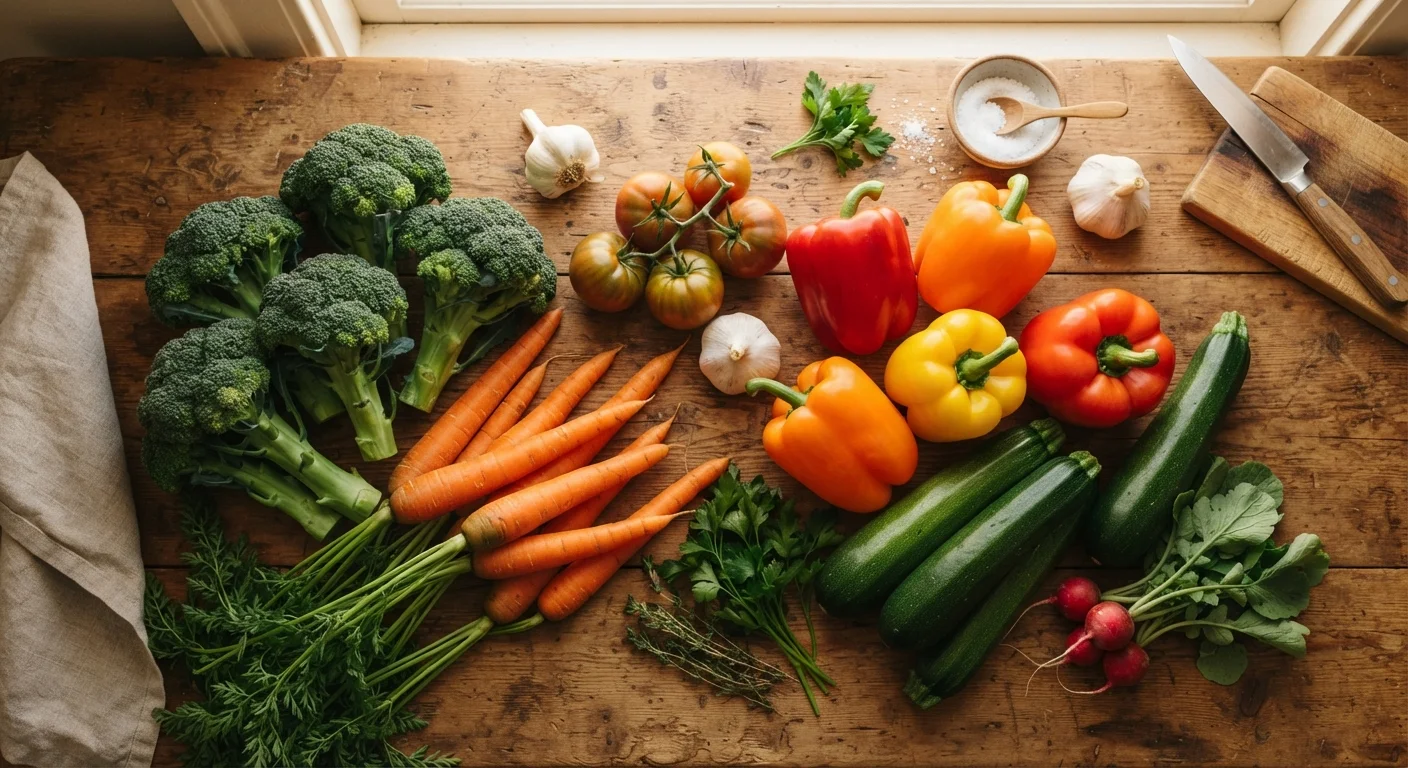
Boiling vegetables drives out water-soluble compounds and often produces a mushy, bland result - a texture many people find unappealing. Roasting at high heat (typically 400-425°F) does the opposite: it draws out natural sugars through caramelization and creates browned, slightly crisp edges that signal richness to the palate. Broccoli, cauliflower, Brussels sprouts, and carrots all transform significantly under dry heat. A light coating of oil and a pinch of salt is often all that's needed. For deeper flavor development, building flavor with minimal ingredients explains the underlying technique.
Roasting unlocks natural sugars in vegetables that boiling simply washes away.
Blend vegetables into dishes you already make
One of the lowest-friction ways to increase vegetable intake is to incorporate them invisibly into meals you already enjoy. Finely diced or grated zucchini disappears into pasta sauce. Spinach wilts into scrambled eggs without altering the flavor. Pureed cauliflower can be stirred into soups or mashed potatoes. This approach sidesteps the psychological resistance to unfamiliar textures and allows you to build a higher vegetable volume without making dramatic changes to your meal patterns. It's especially practical for households where others are resistant to visible vegetables.
Invisible vegetable additions are often the most sustainable starting point for reluctant eaters.
Use dips and sauces strategically
Fat and salt are flavor carriers - and there's nothing nutritionally wrong with using them to make vegetables more appealing. Pairing raw or lightly cooked vegetables with hummus, a yogurt-based dip, tahini, or a simple vinaigrette changes the eating experience meaningfully. Research in food psychology consistently shows that pairing a less-preferred food with a preferred flavor increases consumption and can gradually shift preference over time. Think of condiments and dips not as indulgences but as legitimate tools in building a vegetable habit.
Pairing vegetables with flavors you already enjoy is a well-supported strategy for building lasting habits.
Keep frozen vegetables stocked as a default
Fresh produce requires planning and has a limited window before it spoils - a major barrier when life gets busy. Frozen vegetables are harvested and flash-frozen at peak ripeness, which generally preserves their nutritional profile well. Bags of frozen peas, edamame, corn, green beans, and mixed stir-fry blends can go from freezer to pan in minutes. Removing the prep barrier is one of the most practical ways to increase how often vegetables actually make it onto your plate. Cooking basics for everyday home cooks covers how to work with these efficiently.
Frozen vegetables remove the planning barrier that causes fresh produce to go unused.
Add vegetables to meals rather than replacing anything
A common mistake is framing vegetable eating as a trade-off - eating more greens instead of something you enjoy. This creates unnecessary deprivation and tends not to stick. A more effective approach is addition rather than substitution: toss a handful of spinach into a dish you're already making, add sliced bell pepper to a sandwich, or stir frozen peas into pasta. Over time, as vegetables become a normal part of your meals, portions naturally adjust. Avoiding the feeling of restriction is central to why this method tends to hold - understanding why healthy eating stalls explores the psychological patterns behind dietary backsliding.
Adding vegetables to meals you love works better than replacing foods you enjoy.
Experiment with texture as much as flavor
Disliking a vegetable is often about texture rather than taste. Someone who dislikes cooked spinach might genuinely enjoy it raw in a salad. A person who finds raw carrots unpleasant may love them roasted soft. Trying the same vegetable prepared in different ways - raw, roasted, steamed, grilled, or pickled - treats your palate as something that can be worked with rather than worked around. Pickled vegetables in particular offer a tangy flavor profile that many people find surprisingly appealing, and they pair well with sandwiches, grain bowls, and rice dishes.
Texture is often the real objection - the same vegetable prepared differently can taste like a different food.
Putting It Together in Practice
None of these strategies require a kitchen overhaul or a complete dietary reset. The most sustainable approach is to pick one or two tactics that fit your current routine and layer in others as they become habits. For a framework on how vegetables fit alongside other food groups in a single meal, building a balanced plate explains the proportional logic in practical terms.
Start with one meal, not your entire diet
Trying to overhaul every meal at once is a reliable path to abandoning the effort. Instead, identify a single meal where adding or swapping in a vegetable feels manageable - perhaps tossing frozen spinach into a morning smoothie or adding roasted vegetables to dinner a few nights a week. Consistency in a small area compounds into real change. Once that meal feels routine, expand from there.
If cost is a concern, frozen and canned vegetables are among the most affordable options and don't require the same planning window as fresh produce. Eating well on a tight budget covers how to make nutritious choices without overspending at the grocery store.
This article is for general informational and educational purposes only. It is not a substitute for personalized nutrition or medical advice. Consult a qualified healthcare professional for guidance specific to your health needs.