

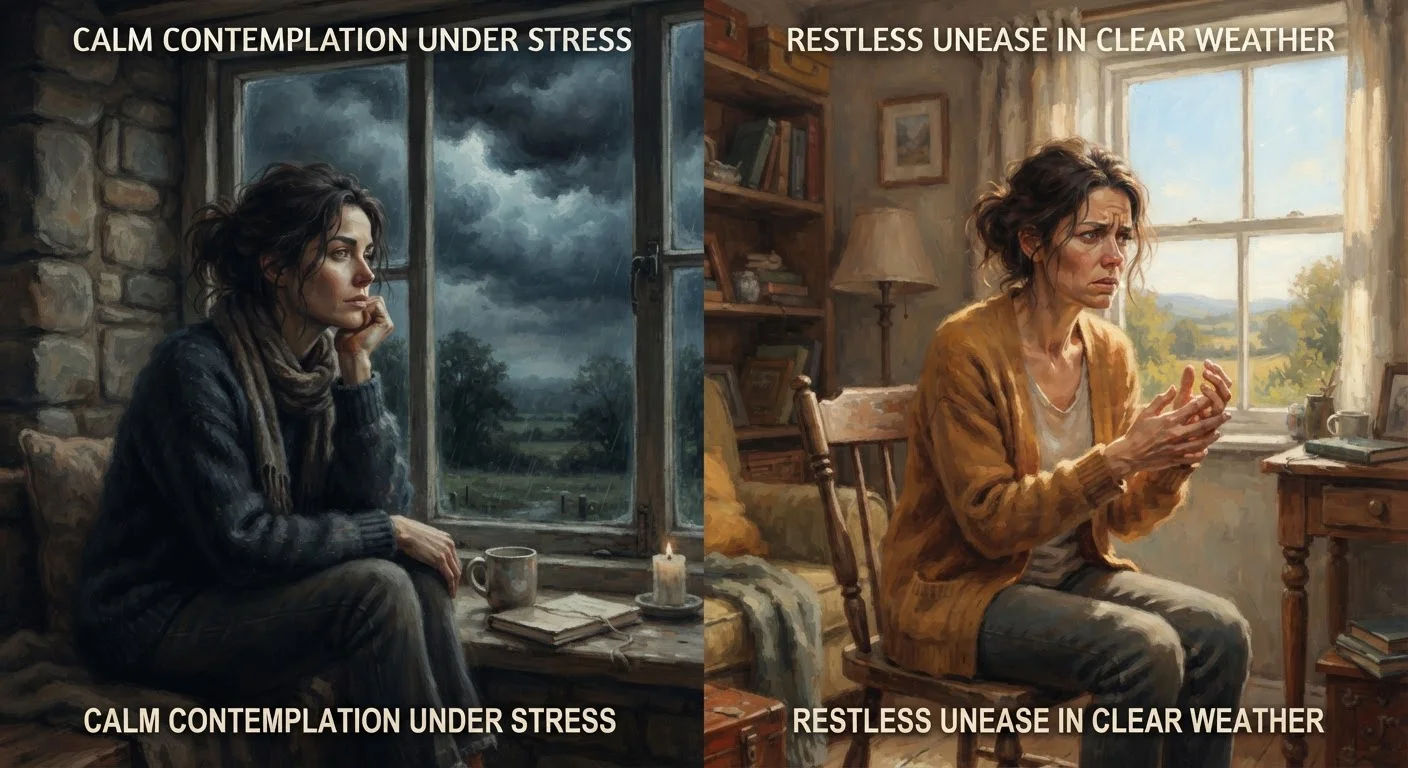
Key Takeaways
Option A
Stress
A normal, identifiable response to external pressure.
Best for: Understanding a reaction tied to a specific, recognizable demand or challenge in your life.
Option B
Anxiety
A persistent worry that outlasts or exists without a clear trigger.
Best for: Recognizing when worry feels disproportionate, hard to control, or detached from any obvious cause.
If your worry is clearly tied to a deadline, conflict, or life event
Stress
When you can name the cause, you're most likely dealing with stress - and addressing the stressor directly is often an effective response.
If worry persists even after a situation resolves or has no clear cause
Anxiety
Anxiety isn't anchored to a specific trigger, which is why it outlasts stressors and may need targeted strategies or professional support.
If symptoms are interfering with daily functioning for weeks or longer
Anxiety
Persistent, impairing worry that feels uncontrollable is a hallmark of anxiety disorders and warrants a conversation with a qualified mental health professional.
Why the Confusion Is So Common
Most people use the words stress and anxiety interchangeably - and understandably so. Both can make your heart race, disrupt your sleep, and leave you feeling overwhelmed. But the two experiences have distinct mechanisms, and knowing which one you're dealing with changes how you respond to it effectively.
For a broader look at mental health vocabulary, see our plain-English mental health glossary for context on commonly confused terms.
A Note on Self-Assessment
Identifying whether you're experiencing stress or anxiety based on an article alone has real limits. These descriptions are educational and meant to help you build vocabulary and awareness - not to serve as a diagnostic tool. If symptoms are persistent, intense, or affecting your daily life, a qualified mental health professional is the appropriate resource.
Stress and Anxiety Side by Side
The clearest way to separate the two is to look at what triggers them and how long they last. The table below contrasts the core features of each.
| Criterion | Stress | Anxiety |
|---|---|---|
| Primary trigger | Specific external event or demand | Often absent, vague, or future-focused |
| Duration | Resolves when stressor lifts | Persists beyond or without a stressor |
| Thought pattern | Problem-focused worry | Repetitive, hard-to-control catastrophic thinking |
| Physical symptoms | Tension, fatigue, racing heart | Same, plus restlessness and chronic unease |
| Sense of control | Usually feels manageable | Often feels uncontrollable |
| Clinical threshold | Not a diagnosable disorder on its own | Can meet criteria for an anxiety disorder |
Stress is your nervous system's response to a perceived demand - a work deadline, a difficult conversation, a financial crunch. Once the demand passes, stress typically fades. Anxiety, by contrast, is characterized by worry that feels persistent and difficult to control, often in the absence of an immediate stressor. The American Psychological Association describes anxiety as involving a future-oriented sense of threat that is disproportionate to the actual situation.
The Physical Overlap - and What Sets Them Apart
Both states activate the body's sympathetic nervous system - the so-called fight-or-flight response - producing overlapping physical sensations: muscle tension, rapid heartbeat, shallow breathing, and digestive upset. This shared physiology is a big reason the terms get conflated.
The difference lies in direction and duration. With stress, the physical arousal is usually proportional and tied to identifiable circumstances. With anxiety, the arousal can feel unpredictable, and the accompanying thoughts tend to cycle rather than resolve. Anxiety also involves a pronounced cognitive component: persistent catastrophic thinking, anticipatory worry, and difficulty tolerating uncertainty.
To understand the long-term health impact of unresolved stress on the body and brain, see what chronic stress does to your body and brain.
31%
U.S. adults affected by anxiety disorder in lifetime
The National Institute of Mental Health estimates that approximately 31% of U.S. adults will experience an anxiety disorder at some point in their lives.
3+ months
Minimum duration for GAD diagnosis
Generalized anxiety disorder (GAD) requires excessive worry occurring more days than not for at least six months under DSM-5 criteria - a clear marker distinguishing it from situational stress.
When One Can Become the Other
Stress and anxiety exist on a continuum, not in sealed categories. Prolonged, unmanaged stress can contribute to the development of anxiety disorders in some people. Conversely, an underlying anxiety disorder can make ordinary stressors feel far more intense and harder to recover from.
Clinically recognized anxiety disorders - including generalized anxiety disorder (GAD), social anxiety disorder, and panic disorder - are diagnosed based on specific criteria, including the duration, intensity, and functional impact of symptoms. A stress reaction, even a severe one, does not automatically constitute a diagnosable anxiety disorder. This distinction matters because the most effective interventions differ: stress often responds well to lifestyle adjustments, problem-solving, and relaxation techniques, while anxiety disorders typically benefit from evidence-based treatments like cognitive behavioral therapy (CBT) or, in some cases, medication prescribed by a qualified provider.
If you're uncertain whether what you're experiencing is within the range of normal stress or something that warrants a closer look, this guide on signs your stress has crossed a line can help you assess next steps.
Responding Effectively to Each
Because the two states have different roots, they call for somewhat different responses.
- For stress: Identify and, where possible, address the stressor. Time management, clear communication, delegation, and rest can all reduce load. Physical activity and relaxation practices like deep breathing may help regulate the nervous system's response.
- For anxiety: Avoidance - a common instinct - tends to reinforce anxiety over time. Evidence-based approaches focus on gradually facing feared situations, challenging unhelpful thought patterns, and building tolerance for uncertainty. Mindfulness-based practices have also shown promise in research settings for reducing anxiety symptoms.
If anxiety symptoms are persistent, severe, or interfering with everyday functioning, consulting a mental health professional is an important step. Understanding the differences between therapy, counseling, and psychiatry can help you determine what type of support is most appropriate for your needs.
This article is for general informational and educational purposes only and is not a substitute for professional medical or mental health advice. If you are experiencing distressing symptoms, please consult a qualified healthcare professional.