

Key Takeaways
Our Verdict
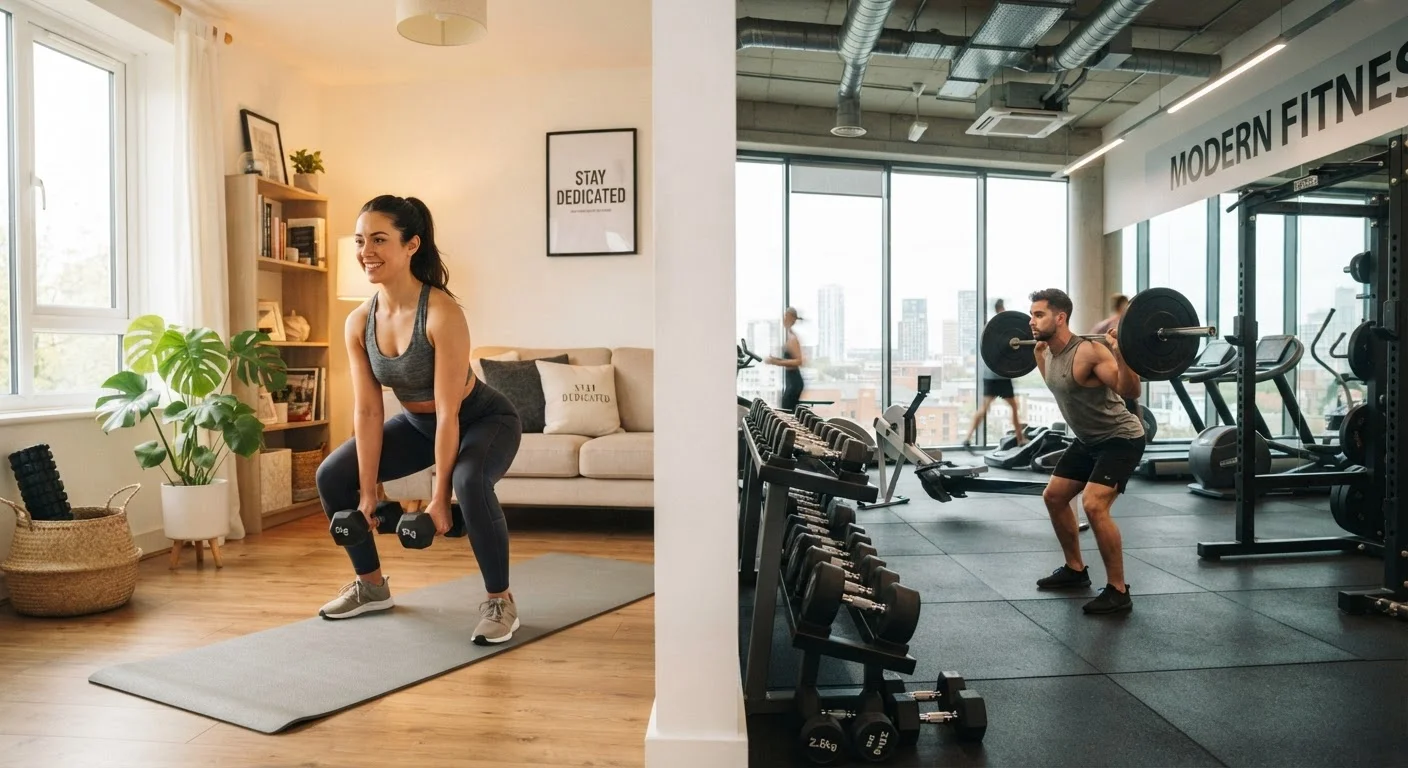
Home workouts and gym training are both legitimate, evidence-supported paths to better fitness. Home training wins on convenience and cost, while the gym excels in equipment access and structured environment. For most people, the best choice is simply the one they will actually stick with - and that varies by individual.
| Best for | Recommended |
|---|---|
| Those working within tight budgets or demanding schedules | Home Workouts |
| Those pursuing progressive strength gains or specialized training | Gym Training |
| Those who thrive on social energy and external accountability | Gym Training |
| Those who value flexibility and privacy above all else | Home Workouts |
The Core Trade-Off: Access vs. Convenience
The debate between home workouts and gym training often comes down to a single friction point: will you actually do it? Both environments can produce meaningful fitness improvements, but each carries practical advantages that suit different lifestyles.
Home workouts remove two of the most commonly cited barriers to exercise - travel time and cost. A session can begin the moment you roll out a mat, which matters when schedules are tight. If you're already navigating a packed calendar, see strategies for fitting movement into a demanding day for practical ideas.
Gym training, on the other hand, provides access to equipment that would be expensive or impractical to replicate at home - cable machines, barbells with substantial weight, rowing machines, and more. For goals that require progressive overload with heavy loads, a gym's infrastructure is genuinely difficult to substitute.
| Home Workouts | Gym Training | |
|---|---|---|
| Upfront Cost | Low to moderate (minimal equipment) | Membership fees required |
| Equipment Variety | Limited without investment | Extensive range available |
| Convenience | No commute, flexible hours | Fixed location and hours |
| Progressive Overload | Possible but requires creativity | Straightforward with weight stacks |
| Social/Motivational Environment | Self-directed, quiet | Community, classes, trainers |
| Privacy | Complete privacy | Shared public space |
| Suitability for Beginners | Good with guided programs | Good with staff support |
What Home Training Does Well
Bodyweight movements - push-up variations, squats, lunges, planks, and their progressions - can build meaningful strength and cardiovascular fitness without a single piece of equipment. Research supports that resistance training with bodyweight is effective for improving muscular endurance, functional strength, and body composition, particularly for those new to regular exercise.
Adding modest equipment, such as resistance bands or adjustable dumbbells, substantially expands what's achievable at home. Many structured programs now exist for home environments, reducing the guesswork that once made self-directed training difficult for beginners. For a grounded overview of where to start, this beginner's guide to moving more lays out the fundamentals clearly.
Privacy is another underrated benefit. For individuals who feel self-conscious in shared spaces, training at home can lower the psychological barrier enough to make exercise a sustainable habit.
Start Where You'll Actually Show Up
Research on exercise adherence consistently finds that perceived ease and enjoyment predict long-term consistency better than any specific training variable. If a home workout feels low-friction enough to do regularly, it will outperform a gym routine you dread or skip. Audit your past habits honestly before committing to one setting.
Where the Gym Has a Real Edge
Progressive overload - gradually increasing the challenge placed on your muscles - is a foundational principle of strength development. Gyms make this straightforward: add a plate, move to the next dumbbell pair, adjust the cable stack. At home, replicating this progression requires either ongoing equipment investment or creative substitution, which has limits.
The social environment of a gym also has measurable motivational effects for many people. Group fitness classes, the energy of a shared training floor, and access to personal trainers all contribute to accountability structures that are difficult to self-generate. For those exploring different training styles within a gym context, understanding what cardio and strength training each do for your body can help you use that equipment more intentionally.
~23%
Adults meeting both aerobic and muscle-strengthening guidelines
According to the CDC's National Health Interview Survey, roughly 23% of U.S. adults meet federal physical activity guidelines for both aerobic and strength training.
64%
Gym members who cite convenience as a top factor
Industry surveys consistently show that proximity and ease of access rank among the most cited reasons people choose - or abandon - a workout location.
Form Matters More Than Location
Without access to a mirror, trainer, or spotter, home exercisers may develop movement compensations that increase injury risk over time. If you train at home, consider periodic video reviews of your form, or occasional sessions with a qualified fitness professional to verify technique - especially when adding load or complexity.
Making the Right Call - or Combining Both
There is no universally correct answer here. The evidence on exercise adherence is clear: the workout you do consistently beats the theoretically optimal one you avoid. Honest self-assessment - of your schedule, budget, personality, and goals - is more useful than any prescriptive recommendation.
A hybrid approach is worth considering. Many people anchor their routine with home workouts during busy weekdays, then use gym sessions on weekends for heavier lifting or group classes. This captures convenience without sacrificing access to equipment that supports continued progress.
If you're weighing which training modalities to prioritize within either setting, clearing up common fitness myths is a useful first step before committing to a specific approach.
This article is for general informational purposes only and is not a substitute for professional medical or fitness advice. Consult a qualified healthcare provider or certified fitness professional before beginning a new exercise program, especially if you have any existing health conditions.