

Key Takeaways
Glycemic Index (GI)
The glycemic index is a numerical scale from 0 to 100 that ranks carbohydrate-containing foods based on how quickly they raise blood glucose levels compared to pure glucose. Foods ranked high on the scale cause a faster, sharper rise in blood sugar, while low-GI foods produce a slower, more gradual response. It was developed as a research tool to help understand how different carbohydrates behave in the body.
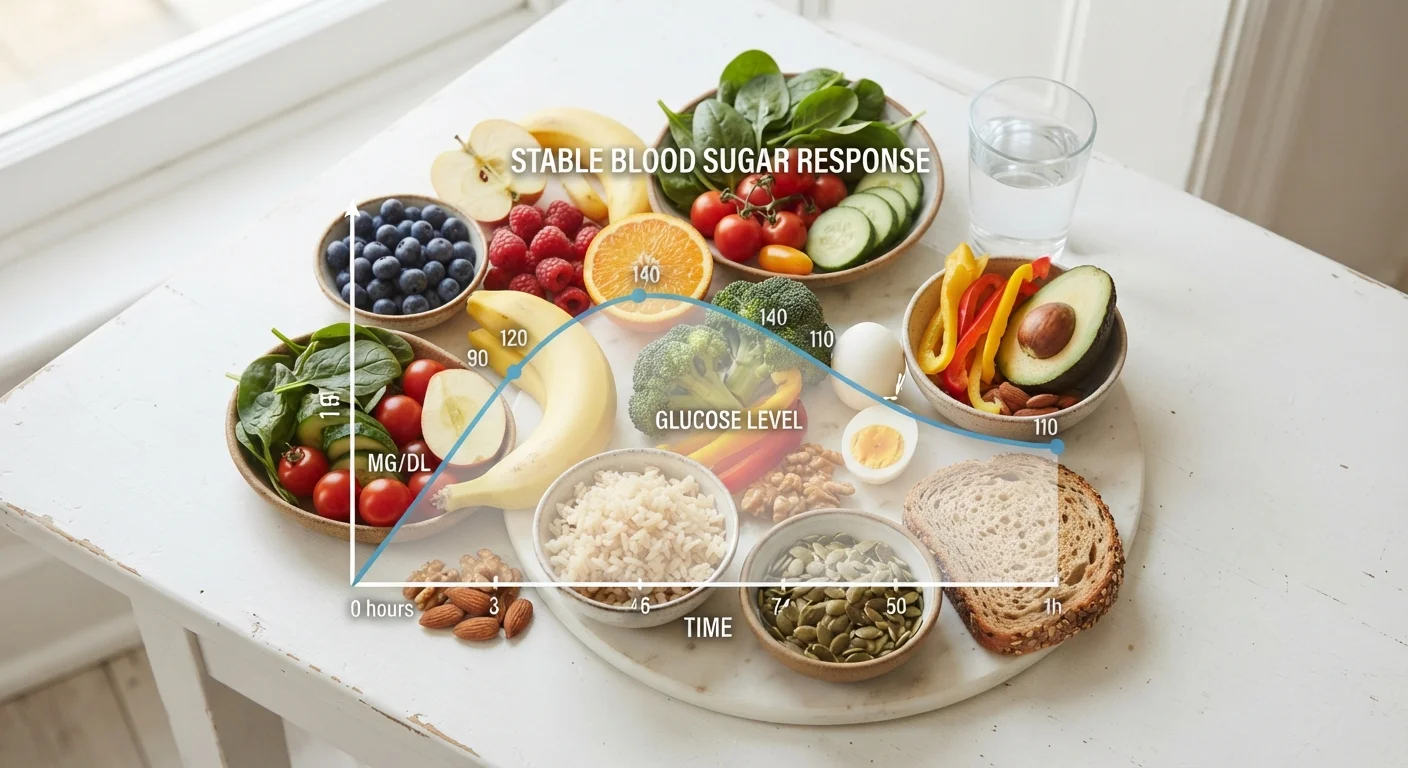
GI values are established by measuring blood glucose in human test subjects at fixed intervals after consuming a 50-gram available carbohydrate portion of a food, then comparing the area under the blood glucose curve to that of a pure glucose reference.
How the Glycemic Index Is Actually Measured
The glycemic index is not derived from a laboratory formula or chemical analysis - it is measured in real people. In a standard GI test, participants consume enough of a specific food to deliver exactly 50 grams of available carbohydrates (total carbs minus fiber). Researchers then draw blood samples at regular intervals over two hours and plot a blood glucose curve. That curve is compared to the curve produced by consuming 50 grams of pure glucose, which serves as the reference point at a GI of 100.
The result is an average across multiple subjects, typically ten or more. This matters because human blood sugar responses vary meaningfully between individuals - the published GI value is a population average, not a personal prediction. Factors like gut microbiome composition, insulin sensitivity, and even stress levels on test day all influence results.
0-100
Glycemic index scale range
Pure glucose sets the reference point at 100; all other foods are ranked relative to it in controlled human trials.
~20%
Variation in GI between individuals
Research published in peer-reviewed nutrition journals has found that the same food can produce meaningfully different glucose responses in different people.
≤10
Low glycemic load threshold
A glycemic load of 10 or below per serving is generally considered low, offering a more practical measure than GI alone for real-meal planning.
Foods are categorized into three bands: low GI (55 or below), medium GI (56-69), and high GI (70 and above). White bread typically scores around 73, table sugar around 65, and lentils around 32 - rankings that sometimes surprise people unfamiliar with the science.
What GI Doesn't Account For
The glycemic index has well-documented limitations that are easy to overlook when the number gets cited out of context. The most significant is portion size. The GI test always uses a 50-gram carbohydrate portion, which rarely matches what people actually eat. Watermelon, for instance, has a high GI of around 72 - but a standard serving contains so little carbohydrate that its real-world blood sugar impact is modest. This is why researchers developed glycemic load (GL), which multiplies a food's GI by the grams of carbohydrate in a typical serving, then divides by 100. A GL of 10 or below is considered low.
Food combinations also change the picture dramatically. Eating carbohydrates alongside protein, fat, or fiber slows gastric emptying and blunts the blood glucose response. A slice of white bread eaten with peanut butter behaves very differently in the body than the same bread eaten alone - yet GI tables list each food in isolation.
Try Glycemic Load for Real-Meal Planning
When evaluating a food's likely blood sugar impact, calculate its glycemic load rather than relying on GI alone. Multiply the food's GI by the grams of carbohydrate in your actual portion, then divide by 100. A result of 10 or below is considered low. This single step makes GI data far more applicable to the way people actually eat.
Ripeness and processing further shift GI values. A barely-ripe banana has a GI near 42; a fully ripe one can reach 62. The same potato baked, boiled, or chilled into a potato salad will yield measurably different GI readings. Understanding these variables helps explain why two people following GI guidelines can have very different outcomes.
The Nutritional Blind Spots of GI
A food's glycemic index says nothing about its vitamin content, mineral density, fiber, protein, healthy fats, or overall caloric value. Chocolate-coated ice cream can carry a lower GI than plain white rice - the fat content slows glucose absorption - but that comparison tells you very little about which food is more nourishing.
This is a critical distinction. Relying on GI as a shorthand for "healthy" can lead to misleading conclusions. Some ultraprocessed foods with added fats and hidden added sugars score deceptively low on the GI scale, while nutrient-dense whole foods like carrots or watermelon score higher. A low GI does not equal a nutritious food, and a high GI does not automatically make a food problematic within a balanced, varied diet.
For a fuller picture of what you're eating, cross-referencing GI with a food's complete nutrition label is a more reliable approach. The Nutrition Facts panel captures fiber, saturated fat, sodium, and micronutrients that GI simply doesn't touch.
Using GI Practically - and Knowing Its Limits
The glycemic index remains a genuinely useful research tool and can support informed food choices when applied thoughtfully. Choosing lower-GI carbohydrate sources - legumes, intact whole grains, most non-starchy vegetables - is consistent with dietary patterns associated with better long-term metabolic health. But GI works best as one data point within a broader nutritional framework, not as a standalone ranking system for good and bad foods.
People managing blood sugar conditions should be particularly cautious about over-relying on GI tables without professional guidance. Individual glycemic responses are far more variable than a published number suggests, and a registered dietitian or healthcare provider can help interpret GI data within the context of a complete eating plan.
Used with its limitations clearly understood, the glycemic index offers real insight into carbohydrate quality. Used as a simple label for what to eat and avoid, it can mislead as often as it guides.
This article is for general informational and educational purposes only and is not medical or dietary advice. Individuals managing health conditions, including blood sugar disorders, should consult a qualified healthcare professional before making changes to their diet.