

Key Takeaways
Why the Nutrition Facts Panel Matters More Than the Front of the Package
The front of a food package is prime real estate for marketing. Words like "wholesome," "natural," and "light" are chosen to attract buyers, not to inform them. The Nutrition Facts panel on the back or side, by contrast, is regulated by the U.S. Food and Drug Administration (FDA) and must follow a standardized format - making it the most reliable nutritional information available to consumers at the point of purchase.
Front-of-Package Claims Can Mislead
Terms like "low fat," "natural," or "multigrain" on the front of a package are marketing language and carry limited regulatory meaning in many cases. These claims do not guarantee a product is nutritionally superior. Always flip to the Nutrition Facts panel and the ingredient list before drawing conclusions about a food's quality.
Understanding how to read this panel accurately is a foundational skill for navigating healthy eating patterns across everyday meals and snacks. It takes less than a minute once you know what to look for.
What you will need
Step-by-Step: Reading Each Section of the Panel
The FDA's updated Nutrition Facts format - phased in through 2020 for most manufacturers - reorganized and clarified several key areas. The walkthrough below follows the panel from top to bottom, the same sequence you'd encounter on any U.S. packaged food.
Serving Size Is Not a Recommendation
The serving size on a Nutrition Facts panel reflects how the manufacturer defines a standard portion - it is not a suggested amount to eat. If you consume two servings, you must double every nutrient number on the label. Always check servings per container before calculating what you're actually consuming.
Start with serving size and servings per container
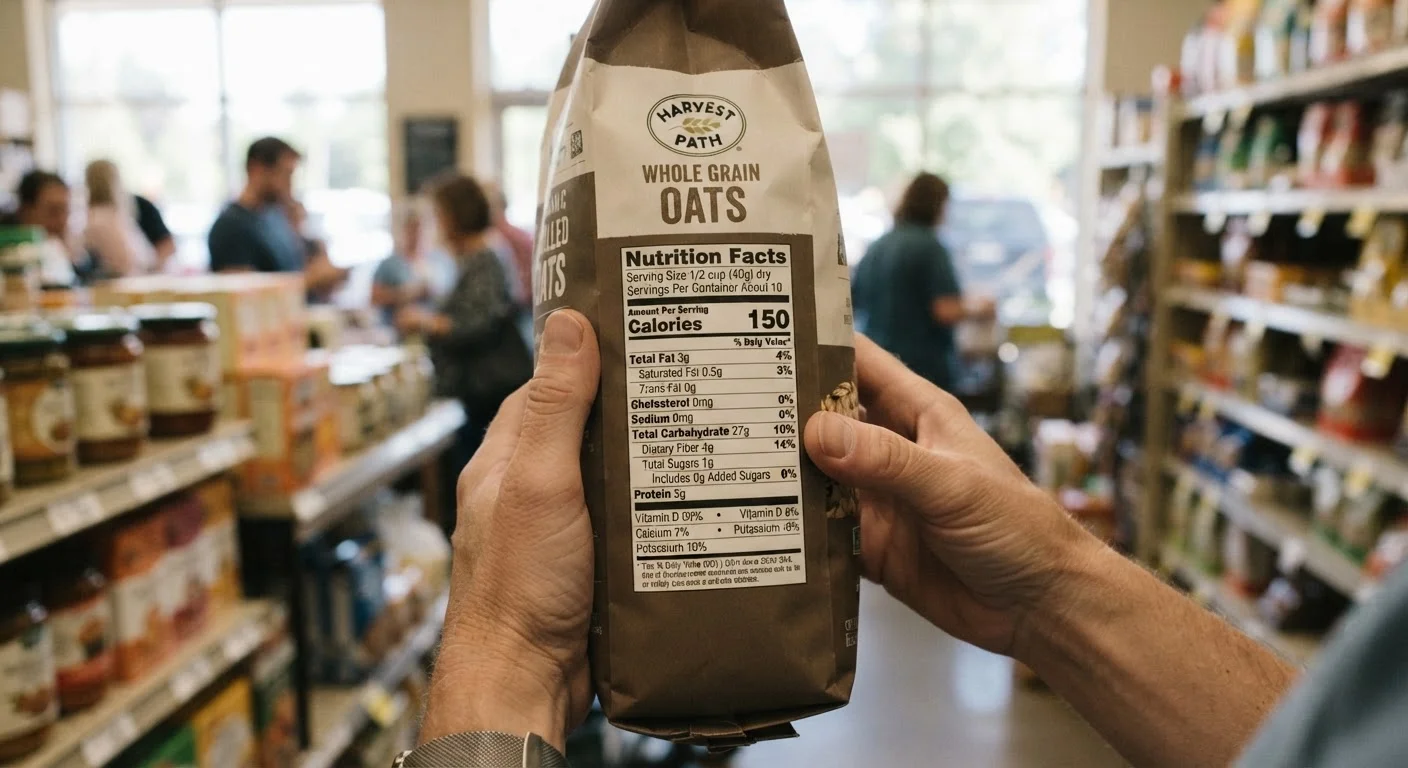
The very first line of the Nutrition Facts panel is serving size, expressed in a common household measure (like cups or pieces) plus grams. Directly below it is the number of servings per container. Every calorie count and nutrient amount listed on the panel applies to one serving - not the whole package.
If a bag of chips lists a serving size as 1 oz (about 28g) and contains 3.5 servings, and you eat the whole bag, you're consuming 3.5 times the stated calories and nutrients.
Read the calorie count in context
Calories are displayed prominently in a large font directly below the serving information. This number tells you the total energy provided by one serving. Calories come from fat, carbohydrates, and protein - the panel no longer requires a separate "calories from fat" line under the updated FDA format introduced in 2020.
Rather than fixating on calories alone, treat this number as one data point within a broader nutritional picture. A 200-calorie food dense in fiber, protein, and micronutrients differs meaningfully from a 200-calorie food made primarily of refined starch and added sugar.
Identify nutrients to limit
The panel lists saturated fat, trans fat, cholesterol, and sodium as nutrients most Americans consume in excess. Current U.S. Dietary Guidelines recommend limiting these for cardiovascular and overall health. Dietary guidance discourages trans fat entirely; look for 0g on this line.
Sodium deserves particular attention. The daily reference value is 2,300 mg - a single processed food item can easily contribute 30-50% of that amount.
Decode total carbohydrates, fiber, and sugars
Total carbohydrates include dietary fiber, total sugars, and other carbohydrates. Each has a distinct nutritional role:
- Dietary fiber - listed as a sub-item; most Americans fall short of daily fiber goals. Higher fiber values are generally desirable.
- Total sugars - includes naturally occurring sugars (from fruit or dairy) plus added sugars.
- Added sugars - broken out on its own line since the 2020 FDA update. The daily reference value for added sugars is 50g (10% of a 2,000-calorie diet). This line is particularly important because added sugars provide calories with minimal nutritional benefit.
For a deeper look at where added sugar hides in packaged foods, see how added sugar hides in ingredient lists.
Look for nutrients to get enough of
Below the sugars line, the panel lists nutrients Americans are commonly advised to consume in adequate amounts: dietary fiber, vitamin D, calcium, iron, and potassium. These are flagged because public health data shows widespread insufficiency. Higher % Daily Values here are beneficial. For a full breakdown of what each vitamin and mineral does in the body, the micronutrient quick reference guide is a useful companion.
Read the ingredient list alongside the panel
The ingredient list appears separately from the Nutrition Facts panel but is equally important. Ingredients are listed in descending order by weight - so the first two or three ingredients make up the bulk of the product. If a refined grain or a sweetener appears first, that ingredient defines what you're primarily eating.
A long list with many unfamiliar chemical-sounding names doesn't automatically mean a product is harmful - some are preservatives, emulsifiers, or natural colorings with well-established safety profiles. But cross-referencing the ingredient list with the added sugars line helps you spot sweeteners that are otherwise easy to miss.
Use the 5/20 Rule as a Quick Filter
A fast way to evaluate any nutrient: 5% Daily Value or less is considered low, and 20% or more is considered high. For nutrients you want to limit - sodium, saturated fat, added sugars - look for values at or below 5% DV. For nutrients you want more of - fiber, calcium, iron - aim for values closer to 20% DV or higher.
Applying this reading framework consistently across different food categories - snacks, cereals, sauces, beverages - helps you build intuition quickly. The Healthy Eating hub covers how these label-reading skills connect to broader dietary patterns.