

Key Takeaways
Why New Orleans Rewards Curious Travelers
New Orleans is one of the most culturally dense cities in the United States—a place shaped by French and Spanish colonial rule, the forced labor of enslaved Africans, Caribbean migration, and waves of European immigration. That layering is visible in the architecture, audible in the music, and tasted in every bowl of gumbo. Yet many visitors spend their entire trip on a single stretch of Bourbon Street and leave with only a fraction of what the city offers.
Unlike cities where the sheer scale trips up first-timers, New Orleans is geographically compact. Most of its most compelling neighborhoods are within a few miles of each other, making genuine exploration realistic even on a short trip. What's required isn't logistics—it's intention.
350+
Years of documented New Orleans history
Founded by French colonists in 1718, New Orleans is one of the oldest continuously inhabited cities in the United States.
~72%
Residents who identify as Black or African American
According to U.S. Census data, the African American community forms the demographic and cultural majority of the city.
100+
Annual festivals and cultural events
New Orleans hosts well over a hundred organized cultural events per year, ranging from Jazz Fest to neighborhood second lines.
Neighborhoods Worth Exploring
The French Quarter is historically significant and worth a walk, but it functions largely as an entertainment district. The neighborhoods surrounding it tell a more complete story.
Tremé
Directly north of the French Quarter, Tremé is widely regarded as the oldest African American neighborhood in the country. It is the birthplace of jazz and the spiritual home of the city's brass band tradition. St. Augustine Church, founded in 1842 partly by free people of color, anchors the neighborhood's cultural identity. Congo Square—now part of Louis Armstrong Park—is where enslaved people gathered on Sundays to maintain African musical and cultural practices, a tradition that seeded jazz and blues.
Marigny and Bywater
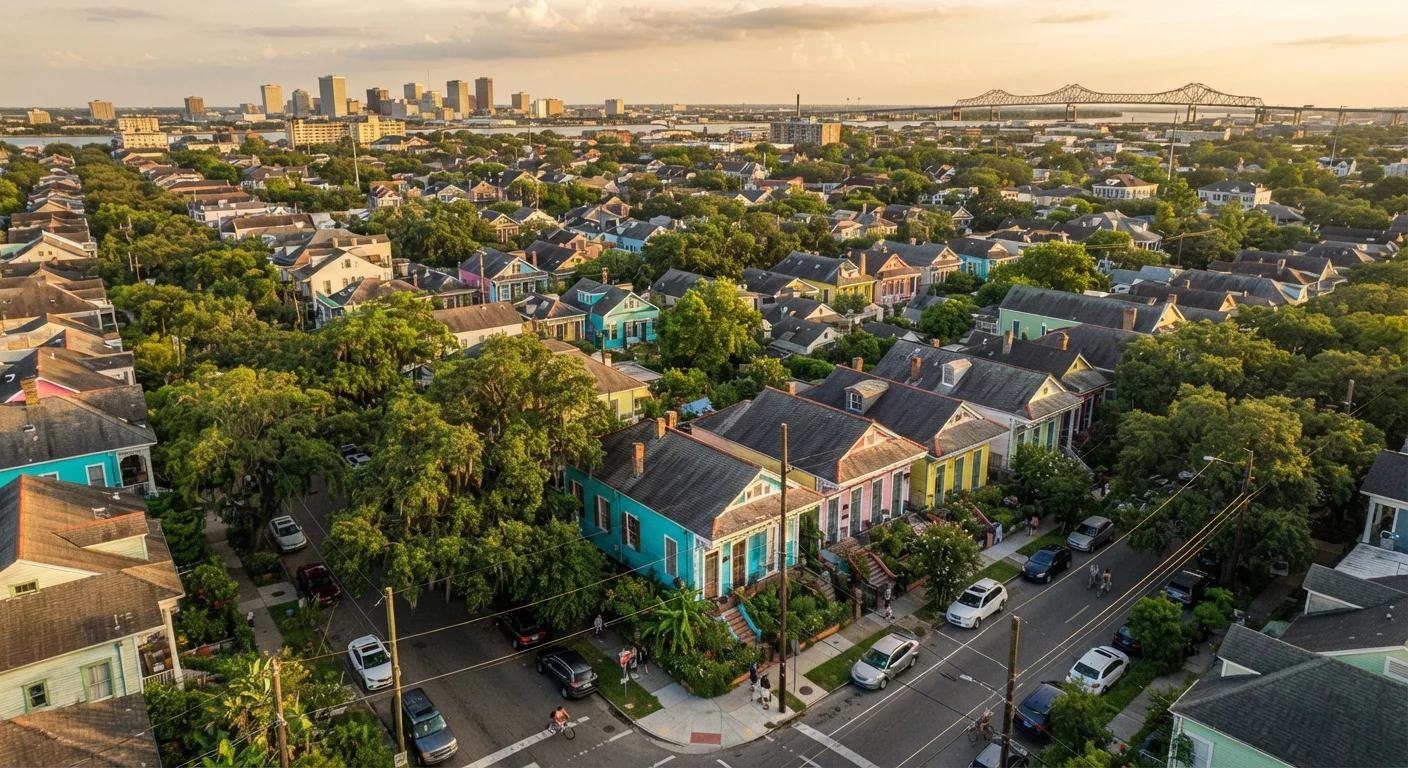
Downriver from the French Quarter, the Faubourg Marigny and Bywater neighborhoods are home to live music venues, independent galleries, and a dense concentration of Creole cottages painted in vivid colors. Frenchmen Street in the Marigny hosts nightly live music with a local-first audience—a stark contrast to the karaoke bars of Bourbon Street.
Uptown and the Garden District
Uptown encompasses the Garden District, known for its antebellum mansions and Spanish moss–draped oak canopy. Magazine Street, running through the area, is lined with small restaurants, vintage shops, and neighborhood cafes. St. Charles Avenue, the main artery, is served by one of the oldest continuously operating streetcar lines in the world.
Walk the perimeter of Congo Square before entering any French Quarter music venue—understanding where jazz began changes how you hear it everywhere else in the city.
Context shapes experience. Congo Square is the documented origin point of many African musical traditions that evolved into jazz, and visiting it first gives historical grounding to everything that follows.
Ask at your accommodation or at a local coffee shop whether any second line parades are scheduled during your stay—locals almost always know, and the schedules are rarely prominent online.
Second line schedules are community-organized and often circulate through local word-of-mouth before appearing on any tourism platform. Local knowledge is the most reliable source.
The Creole Culinary Tradition
New Orleans cuisine is one of the most distinct regional food traditions in America, and it did not emerge from any single culture. Creole cooking synthesizes West African techniques—the use of okra as a thickener, rice as a staple, the holy trinity of onion, celery, and bell pepper—with French classical methods, Spanish spicing, and Indigenous ingredients like filé powder (ground sassafras leaves).
Gumbo, the city's most emblematic dish, is a direct expression of that synthesis. The roux—flour cooked slowly in fat until deeply colored—is a French technique, while the okra or filé thickening has African and Indigenous roots. The same layered logic applies to dishes like jambalaya, red beans and rice, and the muffuletta sandwich introduced by Sicilian immigrants in the early 20th century.
Understanding how flavor is built from technique rather than ingredient lists—a principle explored in this guide to building depth from simple components—helps explain why New Orleans food tastes the way it does. A properly made dark roux, cooked for 45 minutes or more, carries a nutty, complex depth that no shortcut replicates.
Seek Out Neighborhood Restaurants Over Tourist Corridors
Some of the city's most technically accomplished Creole cooking happens in mid-city diners, Uptown neighborhood spots, and Bywater lunch counters—not in restaurants adjacent to the French Quarter. Locals eat lunch at places that rarely appear in travel roundups. Wandering a few blocks off a main tourist route and following your nose is a reliable strategy in this city.
Music, Art, and Living Culture
Jazz, blues, funk, and gospel did not originate as tourist attractions in New Orleans—they developed as living community expressions that happen to be accessible to visitors. Understanding that distinction changes how you engage with them.
Second line parades—community processions led by a brass band, with participants dancing behind in a swaying, improvisational style—happen year-round, not just during Mardi Gras. They are organized by Social Aid and Pleasure Clubs, benevolent organizations rooted in the African American community that date to the post-Civil War period. Schedules are often published publicly, and visitors are generally welcome to join the second line.
Jazz funerals follow a similar structure: a solemn procession to the cemetery gives way to jubilant music on the return, celebrating a life rather than mourning only a loss. These are genuine community rituals, not performances, and should be observed with corresponding respect.
The New Orleans Museum of Art (NOMA), set inside City Park, houses a substantial permanent collection including significant works by artists from Louisiana and the broader African diaspora. The Ogden Museum of Southern Art focuses specifically on the visual culture of the American South.
“New Orleans is the only place I know of where you ask a man what he does and he tells you what he plays.”
— Louis Armstrong, Jazz musician and New Orleans native
Practical Tips for Getting Around
New Orleans is a walkable city in most of its historic core, though summer heat and humidity—routinely exceeding 90°F with high humidity from June through September—make midday outdoor exploration genuinely taxing. Plan outdoor walks for morning or evening and build in shaded rest stops.
The St. Charles streetcar line runs from the French Quarter through the Garden District and Uptown, providing reliable access to many key destinations. The Canal Street line connects downtown to Mid-City and City Park. Both are operated by the New Orleans Regional Transit Authority (RTA); verify current schedules and fares directly with the RTA before your trip.
Heat and Flooding Are Serious Considerations
New Orleans summers are among the most humid and hot in the continental U.S. Heat exhaustion is a real risk for visitors unaccustomed to the climate. Additionally, the city's below-sea-level geography means street flooding can occur rapidly during heavy rain events year-round—not just during named storms. Always verify current weather and local advisories through the National Weather Service.
Flooding remains a structural reality in New Orleans. Some neighborhoods sit below sea level, and heavy rain events can cause rapid street flooding even in tourist areas. Check the National Weather Service forecasts during your visit and be aware of your surroundings during heavy rain.
New Orleans Regional Transit Authority (RTA)
The official source for current streetcar and bus routes, fares, and schedules. Essential for navigating the city without a car.
National Weather Service — New Orleans
Provides real-time forecasts and flood watches for the greater New Orleans area. Strongly recommended during summer months and hurricane season (June–November).
New Orleans Museum of Art (NOMA)
The city's primary fine arts institution, located inside City Park. Its permanent collection includes significant works tied to Louisiana and African diaspora artistic traditions.