

Key Takeaways
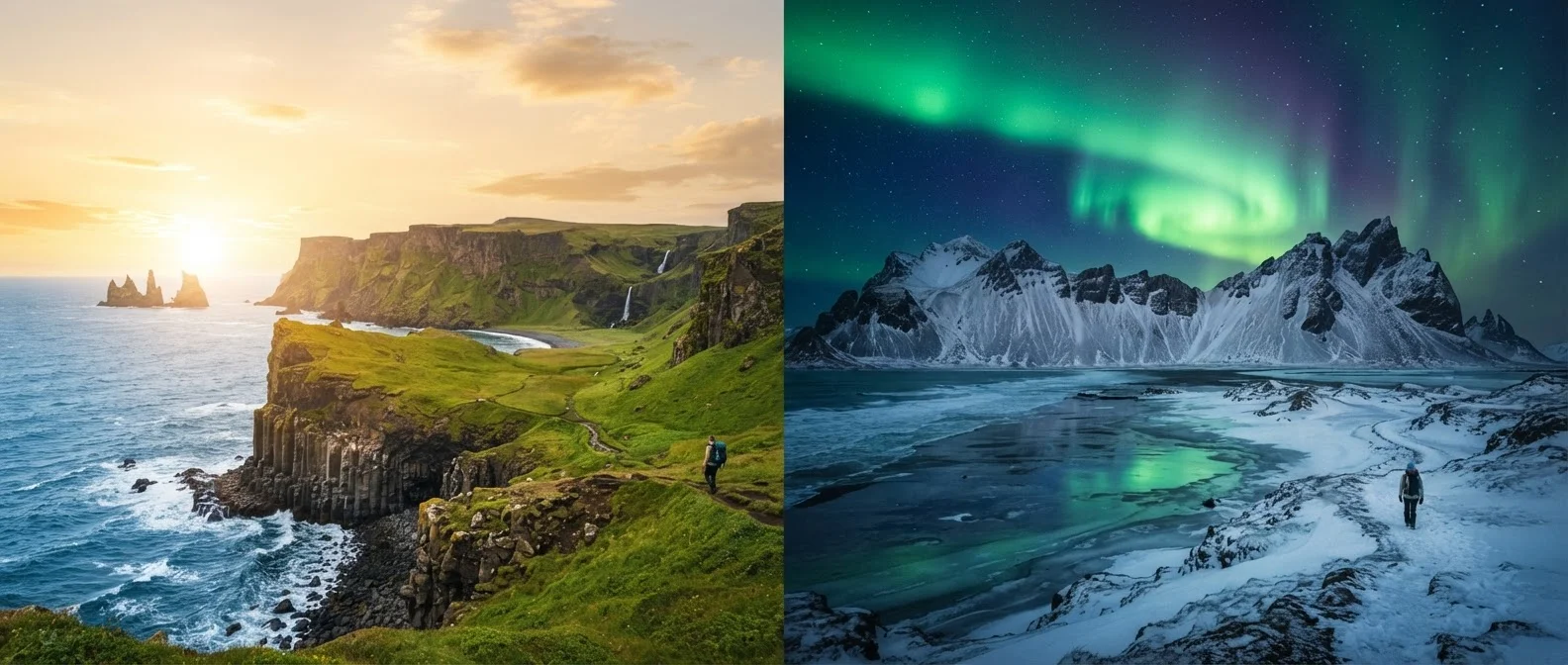
Option A
Iceland in Summer
The accessible, adventure-filled season under the midnight sun.
Best for: Hikers, road-trippers, and first-time visitors who want long daylight hours and easier travel conditions.
Option B
Iceland in Winter
The dramatic, atmospheric season of darkness, ice, and aurora.
Best for: Northern lights chasers, ice cave explorers, and travelers seeking an otherworldly, crowd-free experience.
If you want to hike, drive the Ring Road, and explore waterfalls
Iceland in Summer
Long daylight hours and accessible roads make summer the practical choice for ground-level exploration across the full island.
If seeing the northern lights is your primary goal
Iceland in Winter
Aurora displays require darkness, making winter — particularly November through February — the only viable window for northern lights viewing.
If you prefer fewer crowds and a quieter atmosphere
Iceland in Winter
Visitor numbers drop considerably outside summer, meaning popular sites like Geysir and Seljalandsfoss are far less congested.
If this is your first trip to Iceland
Iceland in Summer
Milder weather, more open roads, and reliable daylight create a more forgiving and broadly enjoyable introduction to the country.
If you want to explore glacier ice caves
Iceland in Winter
Natural ice caves inside glaciers like Vatnajökull are only safely accessible during winter, when cold temperatures stabilize the ice.
Daylight, Darkness, and What They Change
The single biggest factor separating a summer and winter trip to Iceland is light. In June and July, the sun barely dips below the horizon — in Reykjavík, sunset around midnight is followed almost immediately by sunrise. This phenomenon, known as the midnight sun, effectively removes any time pressure from sightseeing. Waterfalls like Skógafoss and Seljalandsfoss look just as spectacular at 11 p.m. as they do at noon.
Winter tells a completely opposite story. In December, Reykjavík sees roughly four to five hours of usable daylight. That compressed window demands tighter daily planning — but it also creates the conditions for aurora borealis displays. Clear, dark skies between September and March offer the best chances, though aurora sightings are never guaranteed and depend entirely on solar activity and weather. Travelers should approach aurora-chasing with flexible expectations rather than certainty.
Consider Shoulder Season as a Middle Ground
April–May and September–October offer a blend of both worlds — some aurora opportunity in autumn, blooming landscapes in spring, and generally fewer visitors than peak summer. Weather remains unpredictable and some highland routes may not yet be open in early spring. For a broader look at how off-peak timing works across destinations, see our shoulder season travel guide.
For anyone weighing a shoulder-season visit in April–May or September–October, those months can blend elements of both: some aurora visibility in autumn, wildflowers emerging in spring, and lower crowds than peak summer. See our guide to shoulder season travel for broader context on how off-peak timing affects destinations.
What You Can — and Can't — Do in Each Season
Summer unlocks Iceland's full geographical range. The highland interior, accessed via unpaved F-roads, opens roughly from late June through early September. Routes like the Landmannalaugar trail system and Þórsmörk valley are only reachable during this window — and they represent some of the most dramatic terrain in Europe. Puffin colonies on the Westfjords and Vestmannaeyjar islands are also a strictly summer occurrence, with birds nesting between May and August.
Winter, by contrast, opens access to experiences that simply don't exist in summer. Guided tours into natural glacier ice caves beneath Vatnajökull — Europe's largest ice cap — operate from approximately November through March, when stable cold temperatures prevent structural changes that make the caves unsafe. Snowmobiling across glaciers and dog sledding in northern Iceland are also winter-exclusive activities.
| Criterion | Iceland in Summer | Iceland in Winter |
|---|---|---|
| Daylight hours | Up to 22–24 hrs (midnight sun) | 4–6 hrs in December |
| Northern lights visibility | Not possible (too bright) | Sept–March, weather permitting |
| Glacier ice caves | Closed (unsafe conditions) | Open approx. Nov–March |
| Highland F-roads | Open late June–early Sept | Closed entirely |
| Puffin sightings | May–August only | Not available |
| Crowd levels | High — peak season | Lower, but not empty |
| Road safety | Generally accessible | Ice, snow; daily checks needed |
| Average temperatures (Reykjavík) | 50–55°F (10–13°C) | 28–36°F (-2–2°C) |
Road access is the most critical practical difference. Iceland's Meteorological Office and Road Administration provide real-time road condition updates, and winter travelers should check these daily. Rental agreements for standard two-wheel-drive vehicles often prohibit F-road use even in summer — a point worth confirming before booking. For comparison, seasonal hiking conditions across the US follow similar logic: season determines access as much as preference does.
Crowds, Costs, and Practical Realities
Iceland's tourism has grown substantially over the past decade, and summer — particularly July — is by far the busiest period. Accommodation in the South Coast and Reykjavík fills months in advance, and popular viewpoints can feel more like urban attractions than wilderness destinations. Advance reservations for accommodation, rental vehicles, and guided tours are effectively mandatory for summer travel, particularly around midsummer.
Winter sees a meaningful reduction in visitor numbers, though Iceland has become a year-round destination and "quiet" is relative. Prices for flights and lodging tend to be lower outside the June–August peak, though this varies significantly by specific dates and booking lead time. Weather risk is higher in winter — storms can ground flights, close roads, and limit what's achievable in a given day. Building buffer days into a winter itinerary is a sensible precaution rather than a luxury.
~2.3M
Annual visitors to Iceland (pre-2020 peak)
Iceland's tourism authority reported approximately 2.3 million international visitors in 2019, compared to a local population of roughly 370,000.
4–5 hrs
Usable daylight in Reykjavík in December
Iceland's geographic position near the Arctic Circle means winter daylight is dramatically compressed, fundamentally shaping what travelers can accomplish each day.
Nov–Mar
Natural ice cave access season at Vatnajökull
Tour operators generally limit guided ice cave access to the coldest months, when sub-freezing temperatures keep glacial ice structurally stable enough for safe entry.
Packing requirements also differ substantially. Summer calls for waterproof layers and sturdy footwear but is generally manageable without specialist gear. Winter demands proper insulated and waterproof outerwear, and for any glacier or ice cave activity, a licensed guided tour is not optional — attempting these independently is dangerous and, for many sites, prohibited.