

Key Takeaways
Option A
Fiber Internet
The newer, symmetrical-speed technology built on light signals.
Best for: Households with multiple heavy users who need consistent upload and download speeds for video calls, gaming, and large file transfers.
Option B
Cable Internet
The widely available, established choice riding existing coaxial infrastructure.
Best for: Households in areas without fiber access, or those with moderate usage needs who want reliable speeds without infrastructure changes.
If your household streams 4K video, games online, or runs frequent video calls simultaneously
Fiber Internet
Fiber's symmetrical speeds and low latency handle multiple concurrent high-demand activities without the slowdowns that can occur on cable during peak hours.
If fiber isn't available in your area or you have light-to-moderate internet needs
Cable Internet
Cable reaches far more U.S. households and delivers adequate performance for streaming, browsing, and remote work at moderate usage levels.
If you work from home and regularly upload large files or host video conferences
Fiber Internet
Cable's asymmetric speeds can bottleneck upload-heavy tasks; fiber's equal upload capacity makes remote work significantly more reliable.
If you're in a rural or underserved area where cable is the only wired option
Cable Internet
Where fiber isn't deployed, cable remains a strong wired alternative - and is generally preferable to satellite for latency-sensitive tasks.
The Core Difference: How Each Technology Actually Works
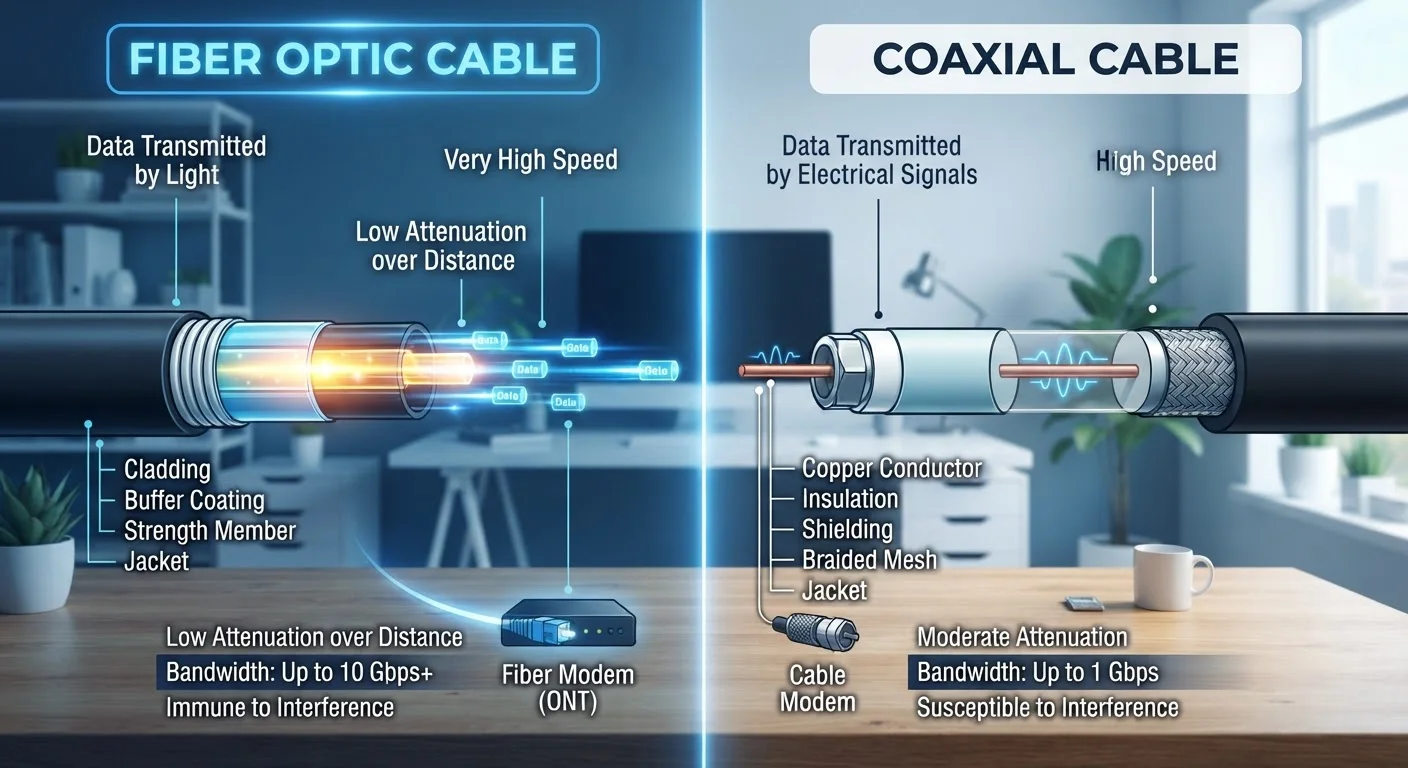
Fiber internet transmits data as pulses of light through thin strands of glass or plastic called optical fibers. Cable internet sends electrical signals over coaxial cables - the same type of line historically used to deliver television. That fundamental hardware difference drives almost every practical distinction between the two.
Because light travels faster and experiences less signal degradation than electrical current, fiber connections maintain their speed and integrity over longer distances. Coaxial cable is also capable of high speeds but is more susceptible to interference and signal loss the further the data travels from the provider's node.
Understanding the physical layer helps demystify why two plans that look similar on a spec sheet can feel very different at home. To learn more about how this affects your day-to-day needs, see how to estimate the right bandwidth for your home.
| Criterion | Fiber Internet | Cable Internet |
|---|---|---|
| Transmission medium | Light through glass/plastic fiber | Electrical signal over coaxial cable |
| Upload vs. download speed | Typically symmetrical | Typically asymmetrical (much slower upload) |
| Peak-hour consistency | Generally more stable | Can slow during high-traffic periods |
| Latency | Generally lower | Slightly higher, varies by plan |
| U.S. household availability | Limited; expanding in urban areas | Widely available nationwide |
| Infrastructure age | Newer deployments | Established; built on existing TV cable lines |
| Best suited for | Heavy multi-user households | Moderate use; areas without fiber |
Upload Speed: The Gap Most Consumers Don't Notice Until It Matters
One of the most consequential - and least advertised - differences is upload speed. Fiber connections are typically symmetrical, meaning your upload speed matches your download speed. If you pay for a 500 Mbps fiber plan, you generally get 500 Mbps in both directions.
Cable plans are usually asymmetrical by design. A cable plan advertising 500 Mbps download might only provide 20-50 Mbps upload. For most historical internet use - browsing, streaming, downloading - this asymmetry was invisible. But video conferencing, cloud backups, uploading content, and remote desktop access all depend heavily on upload capacity.
~1:10
Typical cable upload-to-download speed ratio
Many cable plans advertise high download speeds while upload capacity lags significantly - a ratio that affects video conferencing and cloud work.
~43%
U.S. homes with access to fiber internet
According to FCC broadband data, fiber availability has grown but still leaves the majority of U.S. households relying on cable or other technologies.
~1ms-10ms
Typical fiber internet latency range
Fiber connections commonly achieve latency in this range under normal conditions, which benefits real-time applications like video calls and online gaming.
If your household includes remote workers, content creators, or frequent video callers, the upload gap is one of the most practically important differences to weigh.
Consistency Under Real Conditions
Cable internet uses a shared network architecture within neighborhoods. During peak usage hours - typically evenings - multiple households drawing from the same local node can cause noticeable slowdowns. This is sometimes called network congestion, and it's a legitimate, documented phenomenon rather than a myth.
Fiber networks are generally structured differently, with more dedicated capacity per user, which makes them less susceptible to congestion-related slowdowns. This doesn't mean fiber is immune to all performance issues, but peak-hour dips are less commonly reported.
It's worth separating real performance facts from widely held misconceptions. Our piece on common myths about internet speed covers several misunderstandings that affect how consumers evaluate their service.
Advertised Speed vs. Real-World Speed
Internet plans are marketed using maximum theoretical speeds, which may not reflect what you consistently experience at home. Factors including router quality, in-home wiring, device age, and the number of simultaneous users all affect actual throughput. Running periodic speed tests - especially during evening hours - gives you a more accurate picture of your connection's real performance.
Availability and What It Means for Your Decision
Fiber's technical advantages are compelling, but availability remains a significant constraint. As of recent years, fiber internet reaches a substantially smaller share of U.S. households than cable. Urban and suburban areas are seeing faster fiber expansion, but many rural and smaller markets still lack access entirely.
Cable, by contrast, is available to the vast majority of U.S. homes. For many households, the choice isn't really fiber versus cable - it's cable versus no wired broadband at all. If fiber isn't available where you live, cable is typically a strong default option. If satellite is your only alternative, our overview of satellite internet trade-offs provides useful context before committing.
For a broader understanding of connection types, equipment, and what to look for, the complete consumer guide to home internet covers the full picture.