

Key Takeaways
Our Verdict
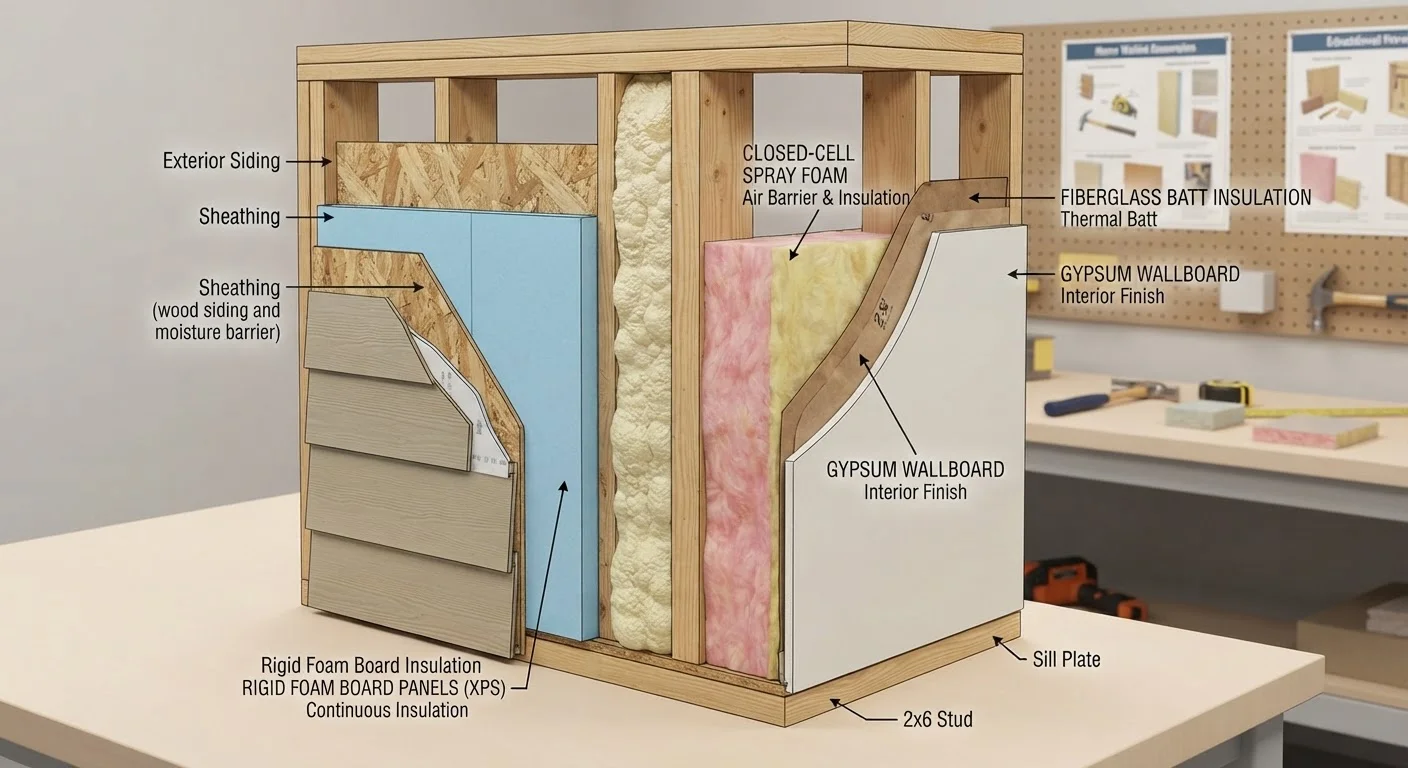
Each insulation type performs well in specific contexts rather than universally. Fiberglass suits most standard residential installations at lower cost, spray foam delivers the tightest air seal for complex or irregular spaces, and rigid board shines where moisture or space constraints are primary concerns. Choosing wisely means matching the material to the specific location, local climate, and available budget.
| Best for | Recommended |
|---|---|
| Budget-conscious homeowners insulating standard wall cavities or attics | Fiberglass Batts |
| Sealing crawl spaces, rim joists, or irregularly shaped cavities | Spray Foam |
| Basement walls, exterior sheathing, or areas with moisture exposure | Rigid Board |
| DIY-friendly projects where installation simplicity is a priority | Fiberglass Batts |
Why Insulation Type Matters
Choosing the wrong insulation material can result in underperformance, moisture problems, or costs that outpace any energy savings. The three most common residential insulation types - fiberglass batts, spray foam, and rigid board - each serve distinct purposes and perform differently depending on where and how they're installed.
The key metric to understand before comparing options is R-value - a measure of thermal resistance per inch of thickness. A higher R-value means the material resists heat flow more effectively. But R-value alone doesn't tell the whole story; air sealing capability, moisture resistance, and ease of installation all factor into real-world performance.
| Fiberglass Batts | Spray Foam (Closed-Cell) | Rigid Board (XPS) | |
|---|---|---|---|
| R-value per inch | R-2.9 to R-3.8 | R-6 to R-7 | ~R-5 |
| Air sealing | None on its own | Excellent | Moderate (with taped seams) |
| Moisture resistance | Low | High | High |
| DIY-friendly | Yes | No (pros only) | Mostly yes |
| Relative material cost | Lower | Higher | Moderate |
| Typical applications | Walls, attics, floors | Crawl spaces, rim joists | Basements, exterior sheathing |
Fiberglass Batts: The Everyday Workhorse
Fiberglass batts are pre-cut panels of spun glass fibers designed to fit snugly between standard wall studs and floor joists. They're the most widely available residential insulation option and are typically sold in widths that correspond to common framing dimensions (16-inch or 24-inch on center).
- R-value: Approximately R-2.9 to R-3.8 per inch, depending on density
- Best applications: Attics, exterior walls, floors over unheated spaces
- Installation: DIY-friendly with appropriate safety gear (gloves, eye protection, N95 mask)
- Limitations: Does not air-seal on its own; gaps around pipes, wires, or irregular framing reduce effectiveness significantly
Fiberglass performs well when installed correctly - meaning no compression, no gaps, and a vapor retarder where required by local code. Compressed batts lose R-value proportionally, a common installation mistake.
Install Batts Without Compression
Fiberglass batts are designed to work at their full loft - squishing them into a thinner cavity reduces their R-value. If your cavity is shallower than the batt thickness, choose a lower-depth product rated for that dimension rather than forcing a thicker batt into a tight space.
Spray Foam: High Performance, Higher Complexity
Spray polyurethane foam (SPF) expands on contact to fill cavities, gaps, and irregular surfaces, making it the most effective option for air sealing. It comes in two main forms: open-cell (lower density, lower R-value, vapor-permeable) and closed-cell (denser, higher R-value, vapor barrier).
- R-value: Open-cell - approximately R-3.5 per inch; closed-cell - approximately R-6 to R-7 per inch
- Best applications: Rim joists, crawl spaces, attic roof decks, around pipes and penetrations
- Installation: Full two-component spray systems require professional equipment and training; small cans of one-part foam are DIY-appropriate for gap-filling only
- Limitations: Higher material and labor cost; closed-cell foam is not vapor-permeable, which can matter in mixed-humid climates
Spray Foam Requires Professional Application
Two-component spray foam systems involve chemicals that pose serious respiratory and skin hazards during application. Professional installers use supplied-air respirators and protective suits. Attempting a full spray foam job with improper equipment can cause lasting health harm. Reserve DIY use to small, single-component cans designed for gap-filling around windows and doors.
Rigid Board: Thin Profile, Strong Moisture Resistance
Rigid foam boards - including expanded polystyrene (EPS), extruded polystyrene (XPS), and polyisocyanurate (polyiso) - are manufactured panels used primarily in continuous insulation applications. Unlike batt insulation, rigid boards are installed over framing rather than between studs, which reduces thermal bridging (heat loss through the framing members themselves).
- R-value: Varies by type - EPS: ~R-3.6/inch; XPS: ~R-5/inch; polyiso: ~R-6 to R-6.5/inch (though polyiso loses some R-value in cold temperatures)
- Best applications: Basement walls, exterior wall sheathing, under-slab applications, garage doors
- Installation: Can be cut with a utility knife and installed as DIY in many above-grade locations; below-grade or exterior applications may require permits and professional guidance
- Limitations: Must be covered with a fire-rated material (such as drywall) when used in interior applications per most building codes
Rigid board is particularly effective in basements because XPS and EPS resist moisture absorption better than fiberglass in damp environments.
~15%
Home energy lost through the floor
The U.S. Department of Energy estimates that floors, walls, and ceilings account for significant portions of a typical home's heating and cooling loss.
R-49 to R-60
Recommended attic R-value in cold climates
DOE climate zone recommendations for attic insulation in northern U.S. regions range from R-49 to R-60 for most homes.
How to Choose for Your Specific Project
Matching insulation type to application is more important than chasing the highest R-value across the board. A few practical guidelines:
- Attics with standard framing: Fiberglass batts between joists, or blown-in fiberglass/cellulose layered on top for higher R-value targets
- Rim joists and crawl spaces: Closed-cell spray foam offers both insulation and moisture control in a single application
- Basement walls: Rigid board (XPS or EPS) handles the moisture environment; check local code for required fire protection
- Exterior continuous insulation: Rigid board reduces thermal bridging better than any cavity insulation can
Before beginning any insulation project, check local building codes and permit requirements - some insulation work (particularly in conditioned crawl spaces or when altering exterior wall assemblies) may require inspection. For work involving electrical panels, gas lines, or structural elements, consult a licensed contractor.
This article provides general home improvement information only and does not constitute professional engineering, building, or construction advice. Always verify requirements with local building authorities and consult licensed professionals for project-specific guidance.