

Key Takeaways
Why Car Seat Stage Matters More Than Age Alone
Many parents default to age as the primary trigger for moving a child to the next car seat stage. In practice, the National Highway Traffic Safety Administration (NHTSA) and the American Academy of Pediatrics (AAP) both emphasize that weight and height limits printed on the seat - not birthday milestones - should drive that decision. A large two-year-old may hit a seat's weight ceiling before a smaller three-year-old does, yet both are equally subject to the same crash physics.
The underlying reason is biomechanical. Each stage is engineered to manage crash forces differently based on a child's musculoskeletal development. Moving too early removes protections the child's body is not yet equipped to compensate for.
When in doubt about whether your child has truly outgrown their seat, look at the manufacturer's label on the seat shell - not the product box or online listing - for the exact weight and height limits that apply to your specific unit.
Labels on the seat itself reflect the installed product and any model-year specifications, which can differ from general marketing descriptions. This is the document technicians reference during inspections.
Dress children in thin layers before buckling rather than bulky winter coats. Place the coat over the buckled harness as a blanket if needed.
Thick coat material compresses dramatically in a crash, creating hidden slack in the harness that eliminates the restraint's effectiveness - a well-documented finding in child passenger safety research.
Stage 1: Rear-Facing Car Seats
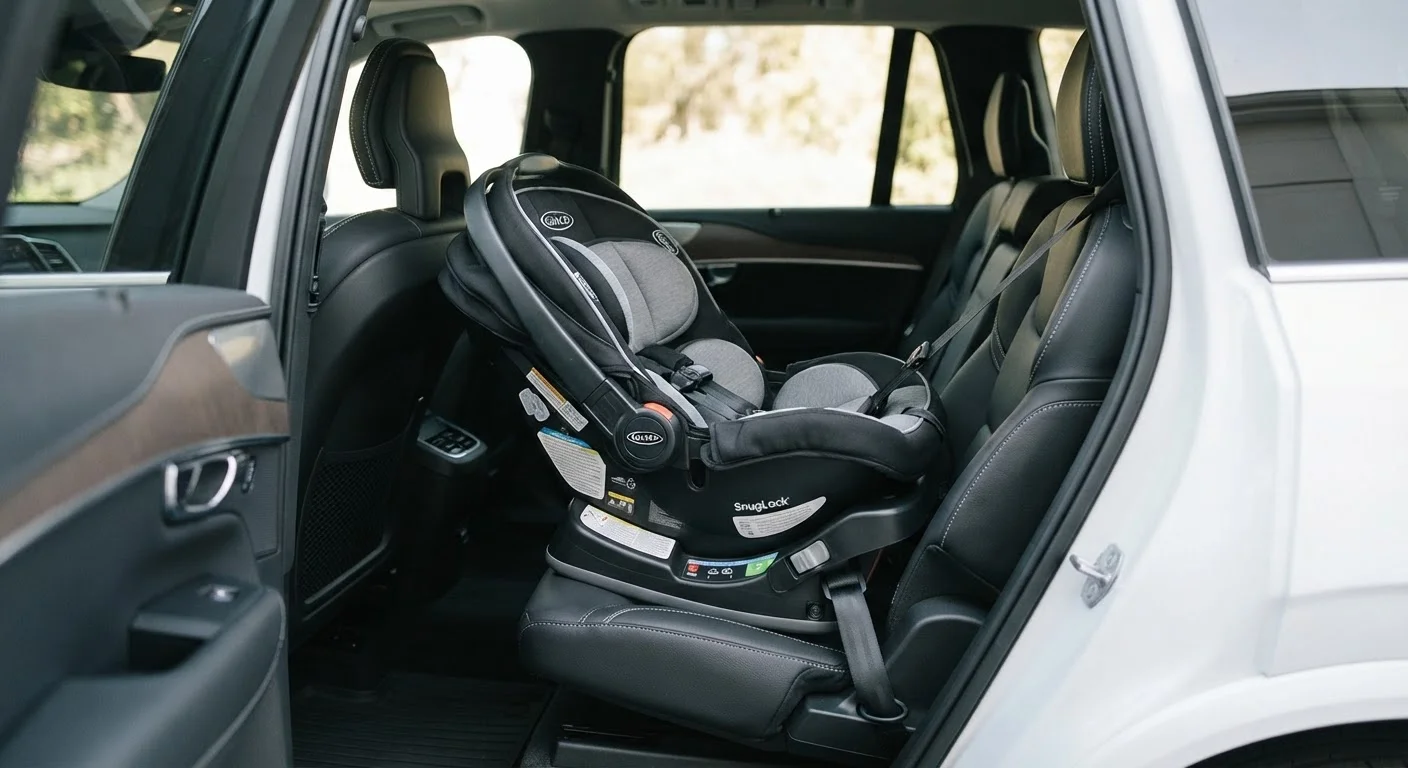
Rear-facing seats cradle the head, neck, and spine together, distributing crash forces across the entire back rather than concentrating stress on the neck. This matters most for infants because their heads are disproportionately large relative to body mass and their neck muscles are still developing.
There are two product types in this stage:
- Infant-only seats - compact, with a carry handle; typically accommodate children up to 22-35 lbs depending on the model.
- Convertible seats used rear-facing - larger shells with higher weight limits, often 40-50 lbs rear-facing, allowing children to remain in this position significantly longer.
The AAP recommends keeping children rear-facing until they reach the maximum weight or height allowed by the car seat manufacturer. There is no safety benefit to transitioning earlier simply because a child "looks big" or their legs touch the seatback. Leg contact with the vehicle seat is not a risk factor in a frontal crash.
Never Use a Secondhand Seat Without Full History
Car seats that have been in a moderate or severe crash should be replaced, even if visible damage is not apparent. Internal structural components can be compromised in ways that are not visible. If you cannot verify a used seat's crash history, manufacture date, and that it has not been recalled, using it is not recommended.
Stage 2: Forward-Facing Car Seats with Harness
Once a child has genuinely outgrown the rear-facing limits of their seat, a forward-facing seat with a five-point harness is the appropriate next step. The harness spreads crash forces across the shoulders, chest, and hips - the body's strongest structures - while the tether strap (anchored to the vehicle's designated tether anchor) limits forward head movement.
Key installation points:
- The harness chest clip should sit at armpit level, not on the abdomen.
- Shoulder straps must thread through slots at or just above the child's shoulders.
- After buckling, the pinch test should confirm no slack - you should not be able to pinch harness webbing between your fingers.
- Always connect the top tether to the vehicle's anchor point; skipping this step is one of the most common errors technicians find.
Convertible and combination seats in this stage typically accommodate children up to 40-65 lbs depending on the product. Harness-only use should continue until the child reaches those limits.
Stage 3: Belt-Positioning Booster Seats
Booster seats exist to solve a specific problem: standard vehicle seat belts are designed for adults, and a child who uses one without a booster risks abdominal or neck injury because the belt does not cross the body in the right position. A booster raises the child so the lap belt sits across the upper thighs and the shoulder belt crosses the chest and collarbone.
The NHTSA recommends booster use until a child passes the five-step test for adult belt fit:
- The child can sit with their back flat against the seat.
- Knees bend comfortably at the seat edge.
- The lap belt sits across the upper thighs, not the stomach.
- The shoulder belt crosses the chest and shoulder - not the neck or face.
- The child can maintain this position for the entire trip.
Most children do not pass this test until they are between 8 and 12 years old and approximately 4 feet 9 inches tall. Using a booster too briefly is among the most common transitions parents make prematurely.
~46%
Car seats used incorrectly
NHTSA observational research has found that nearly half of child restraint systems are misused in ways that could reduce their effectiveness in a crash.
4 ft 9 in
Typical height for adult belt fit
Most children do not achieve proper adult seat belt fit until they are approximately 4 feet 9 inches tall, often between ages 8 and 12.
43%
Reduction in crash fatality risk, rear-facing
Studies cited by the AAP indicate rear-facing restraints substantially reduce injury and fatality risk for young children compared to forward-facing in frontal crashes.
Stage 4: Seat Belt Only
Once a child passes the five-step fit test consistently, a vehicle's three-point seat belt provides sufficient restraint without a booster. Children should always ride in a back seat until at least age 13, as front passenger airbags deploy with force calibrated for adults and can injure smaller occupants.
At this stage, correct belt habits are the priority: belt buckled on every trip, no tucking the shoulder belt behind the back or under the arm, and no slouching that repositions the lap belt onto the abdomen.
Federal Guidelines, State Laws, and Installation Errors
Federal vs. state requirements: Federal motor vehicle safety standards set baseline manufacturing requirements for child restraint systems. Individual states set their own child passenger safety laws, which vary considerably. Some states require booster use only until age 8; others mandate it until age 9 or until a height threshold is met. State law is the legal minimum - safety guidance from NHTSA and the AAP often recommends keeping children in each stage longer than the legal cutoff.
Before traveling across state lines, verify local requirements, as they change and vary. Your state's DMV or highway safety office is the authoritative source.
Installation errors: NHTSA research has found that close to half of car seats are not installed or used correctly. The most common errors include:
- Seat installed with too much movement (more than one inch side to side or front to back at the belt path).
- Harness straps too loose or routed through the wrong slots.
- Top tether not attached on forward-facing seats.
- Seat installed in a recline angle outside the manufacturer's specified range for rear-facing use.
- Aftermarket products (head supports, strap covers, mirrors) added without manufacturer approval, potentially interfering with crash performance.
The NHTSA's website maintains a locator for certified Child Passenger Safety Technician (CPST) inspection stations, where trained technicians will check your installation at no charge. This is one of the highest-value, zero-cost safety checks available to any parent or caregiver.
This article provides general educational information about child passenger safety and is not a substitute for guidance from a certified Child Passenger Safety Technician or your vehicle and car seat owner's manuals. Always follow the specific instructions provided by your car seat and vehicle manufacturers.